You avoid conflict.
You overthink relationships.
You feel responsible for everyone.
You struggle to rest.
You choose the same type of partner.
You feel anxious about money even when things are okay.
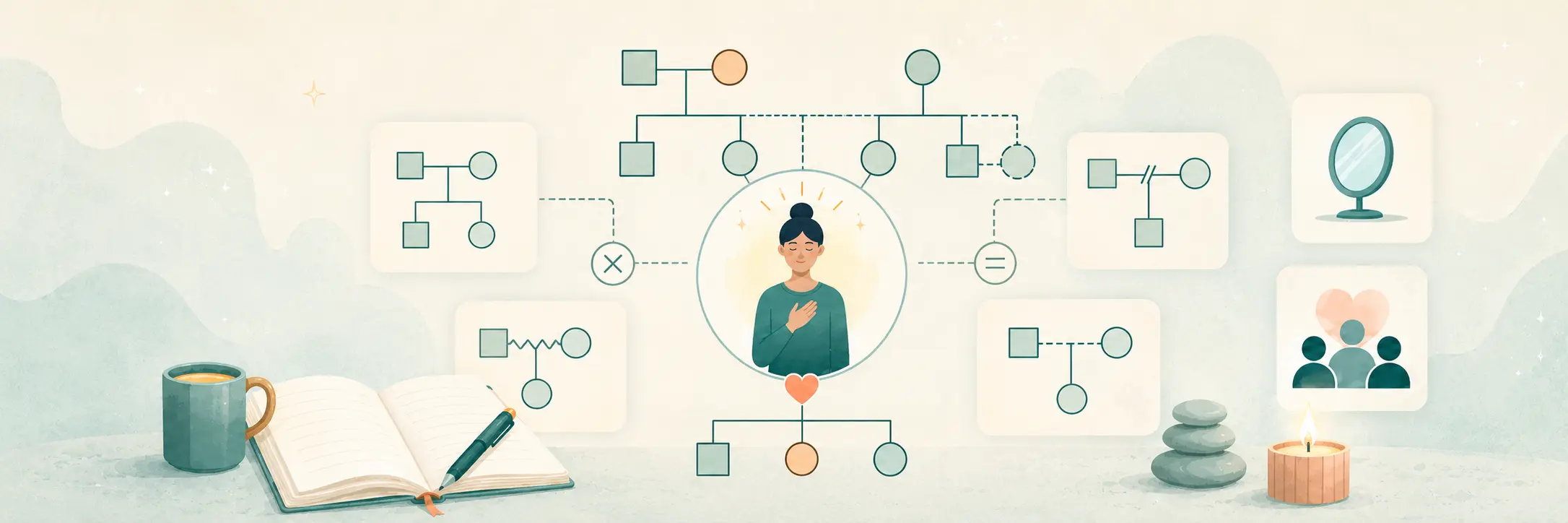
These patterns often make more sense when you look at the family system you came from. A genogram for personal growth helps you map those patterns visually so you can understand what shaped you and decide what you want to do differently.
What Is a Genogram for Personal Growth?
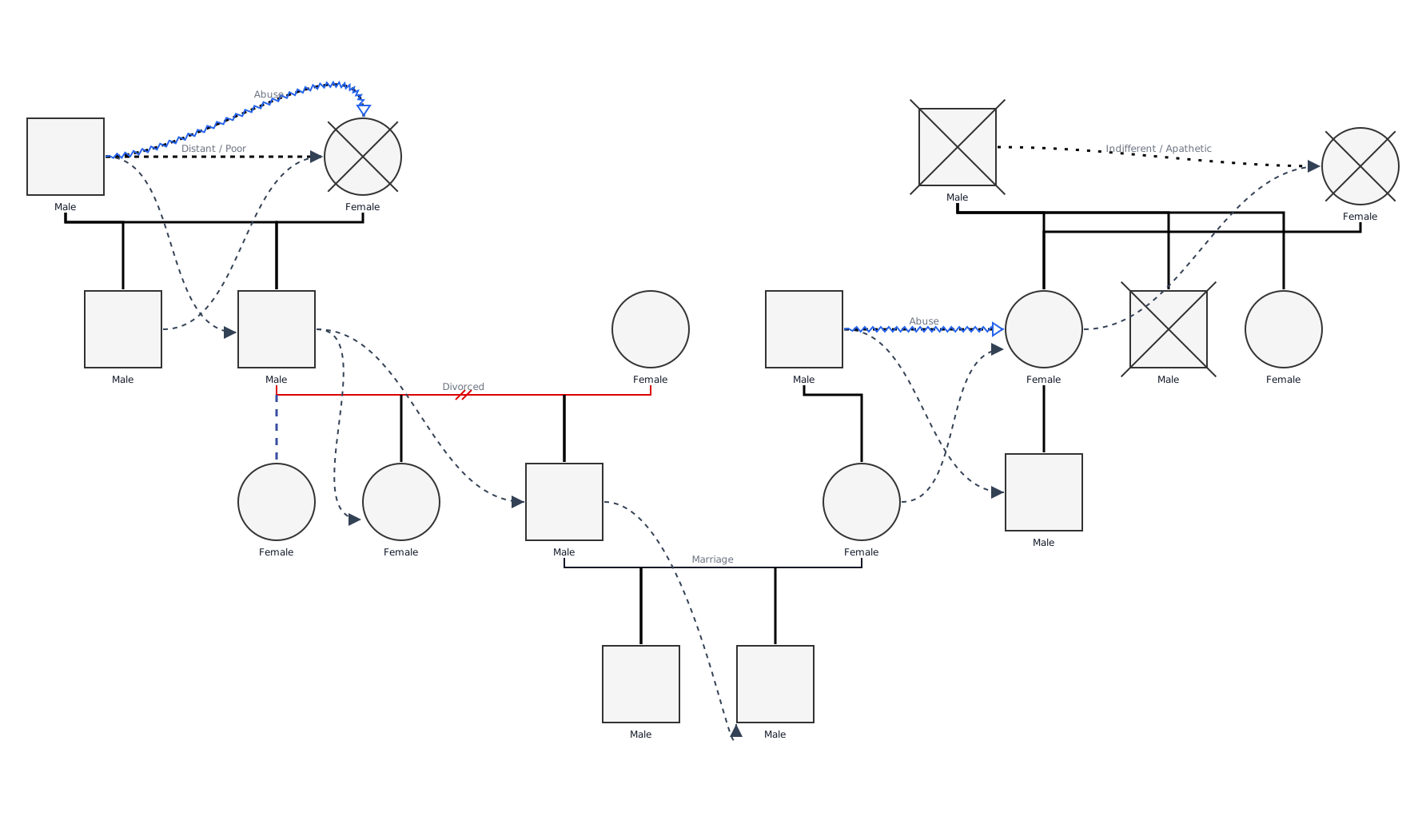
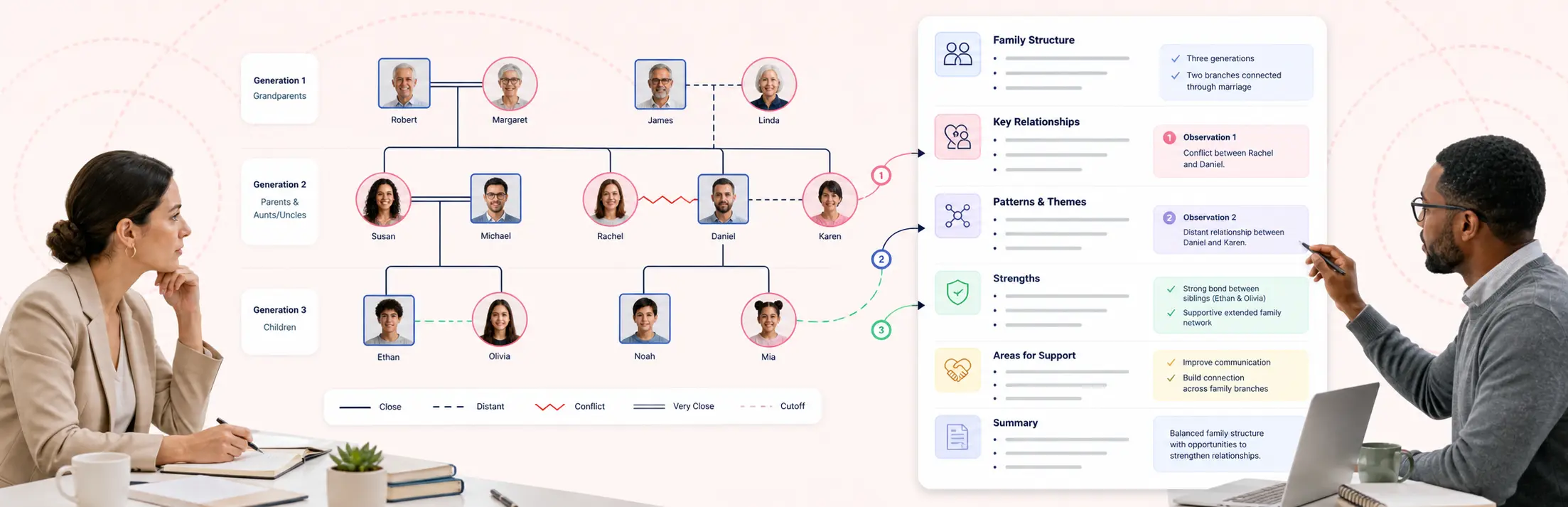
A genogram for personal growth is a visual family map that shows more than names and relationships. It helps you see emotional patterns, family roles, relationship dynamics, major life events, values, strengths, and repeated behaviors across generations.
Unlike a family tree, it is not just about who is related to whom. It is about spotting the patterns that may still be shaping how you think, relate, work, react, and make decisions.
How to Create a Genogram for Personal Growth
You do not need to map your entire family history at once. Start with one pattern, build around it, and use the genogram to decide one thing you want to do differently.
Step 1: Pick One Pattern to Map
Start with one pattern you want to understand. (Choose a pattern that feels manageable. You do not have to map painful details all at once. If this brings up trauma, grief, abuse, or overwhelming memories, pause and consider working through it with a therapist, counselor, or coach.)
For example:
- I avoid conflict.
- I overgive in relationships.
- I feel responsible for everyone.
- I choose similar partners.
- I struggle to ask for help.
- I feel anxious about money.
- I feel pressure to succeed.
- I repeat a parenting pattern I want to change.
Turn the pattern into a question:
| Pattern | Question to Place on Your Canvas |
| I avoid conflict | Where did I learn that conflict is unsafe? |
| I overgive | Who else in my family carried responsibility for others? |
| I fear failure | What did my family teach me about success? |
| I feel anxious about money | What money stories did I grow up around? |
| I shut down emotionally | How did my family handle difficult feelings? |
Open Creately’s AI genogram tool and place this question at the top of your canvas. This keeps your genogram focused.
You can start with a blank canvas, choose an editable genogram template, or use AI text-to-genogram generation by describing your family in plain language. In Creately, you can use templates, quick-add options, and AI text-to-genogram generation for turning family descriptions into editable genograms.
Example prompt to paste into Creately:
“Create a three-generation genogram for me. I am Maya. My parents are Daniel and Priya. I have one older brother, Arun. My mother often avoided conflict, and my father became distant during arguments. My maternal grandparents had a strained relationship and stopped speaking to some relatives after disagreements. I want to understand conflict avoidance in my family.”
Step 2: Add Yourself and the People Who Shaped You
Place yourself at the center. Then add the people who may be connected to the pattern you chose.
This may include parents, siblings, grandparents, partners, children, stepparents, adoptive or foster family members, caregivers, close relatives, or chosen family members.
Try to include three generations if you can, but do not wait until you know everything. Start with what you know.
For each person, add only what helps your question:
- name or initials
- relationship to you
- family role
- important life events
- relevant strengths or struggles
- key relationship dynamics
In Creately, use standard genogram symbols and quick-add options to add relatives faster. Creately’s quick-add lets users add relatives such as partners, children, parents, and siblings more quickly while building a genogram.
Step 3: Mark the Relationships Connected to That Pattern
Now add the relationships connected to your reflection question.
Do not try to capture every relationship in detail. Focus on the ones that help explain the pattern you are exploring.
For example, if your question is about conflict, look for relationships marked by arguments, silence, cutoff, avoidance, distance, or repair.
If your question is about caregiving, look for who carried responsibility, who needed care, who sacrificed, and who was expected to hold the family together.
You can map dynamics such as:
- closeness
- distance
- conflict
- cutoff
- support
- dependency
- control
- caregiving
- emotional absence
- repair or reconciliation
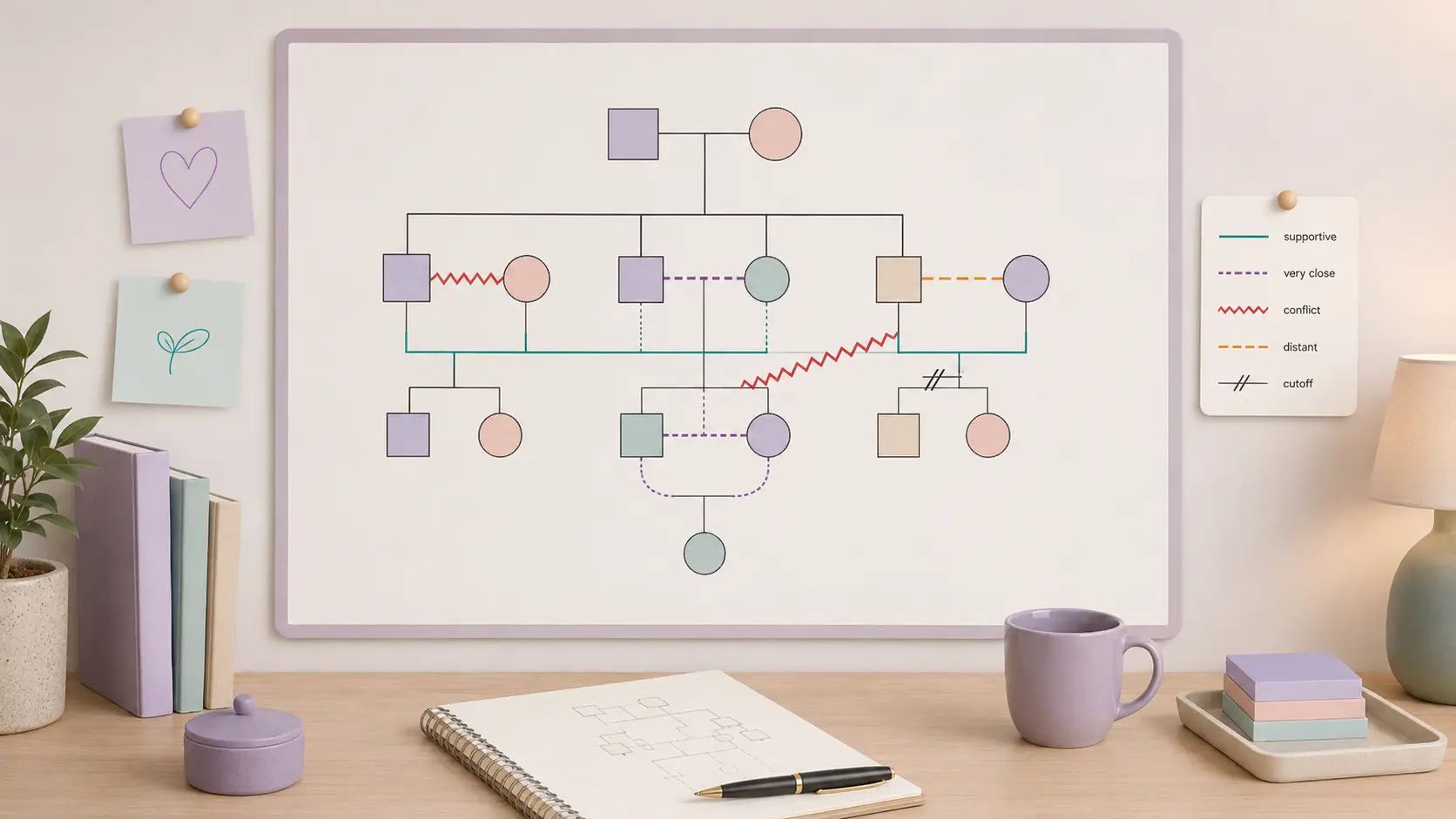
In Creately, choose relationship lines for closeness, conflict, distance, cutoff, or support, then label the line only when the meaning may not be obvious. Different relationship types help separate the family structure from emotional patterns, so the genogram is easier to read.
Step 4: Add the Events That Help Explain It
Family patterns usually have a reason behind them. Add the major events that may have shaped how people behaved, related, or made decisions.
These may include:
- divorce or separation
- death
- illness
- migration
- financial hardship
- addiction
- job loss
- trauma
- remarriage
- caregiving responsibilities
- major career changes
- education or achievement milestones
You do not need to document everything. Add only what helps explain the pattern you are trying to understand.
For example, if your family experienced financial hardship, that may explain anxiety around money or pressure to choose stable work. If several family members were cut off after conflict, that may explain why difficult conversations feel unsafe.
Add notes beside people, relationships, or events instead of placing too much text directly on the genogram. This keeps the diagram clean while still giving you space to capture important details.
Step 5: Highlight What Repeats
Once your basic genogram is in place, step back and look for what repeats.
Ask yourself:
- Who else had this pattern?
- Where does it seem to begin?
- Did it become stronger or weaker over time?
- Who repeated it?
- Who challenged it?
- Who was affected by it?
- What helped people cope?
- What did the pattern cost them?
You may notice that conflict was avoided across generations. Or that women in the family often became caregivers. Or that people chose stability over passion. Or that emotional distance appeared again and again. You may also notice strengths such as resilience, education, humor, faith, independence, or strong family loyalty.
Use colors, tags, or grouped areas to mark repeated patterns such as conflict, caregiving, emotional distance, achievement pressure, money stress, support, or resilience. This turns your genogram from a family map into a pattern map.
Step 6: Ask the Genogram Assistant What You May Be Missing
After you have added your family members, relationships, and notes, use the Genogram Assistant to review the map.
For personal growth, the assistant can help you look for missing details, unclear relationships, repeated patterns, and areas that may need more reflection. For example, it can help you notice whether certain relationship dynamics, health patterns, emotional themes, or family roles appear across generations.
You can also use the assistant to ask specific questions such as:
- What relationship patterns appear in this genogram?
- Are there repeated caregiving roles?
- Are there signs of emotional distance or cutoff?
- What details are missing?
- What follow-up questions should I ask family members?
- What strengths appear across generations?
Creately’s AI features support pattern detection, relationship suggestions, and identifying missing or unclear information in the genogram, which can help users move from mapping to reflection.
Step 7: Connect the Pattern to Your Life Today
A genogram becomes useful when you connect what you see to how you live now.
Ask yourself:
- Where do I see this pattern in my own life?
- When does it show up most?
- How did this pattern protect me before?
- How does it limit me now?
- What did I learn from my family that I still believe?
- What belief am I ready to question?
- What behavior do I want to practice instead?
For example:
| What You Notice | How It May Show Up Today |
| Conflict was avoided | You shut down during difficult conversations |
| Love was shown through sacrifice | You overgive or ignore your own needs |
| Money was always stressful | You feel anxious even when things are stable |
| Achievement was highly valued | You struggle to rest or feel good enough |
| Emotional distance was common | You find vulnerability uncomfortable |
| Caregiving roles repeated | You feel responsible for everyone’s wellbeing |
The point is not to judge the pattern. The point is to understand it clearly.
Step 8: Add One Action You Can Take This Week
Do not stop at insight. Choose one action you can take now.
| Genogram Insight | Personal Growth Action |
| I avoid conflict because conflict felt unsafe growing up | Practice one calm, honest conversation instead of withdrawing |
| I overgive because caregiving was expected | Set one small boundary this week |
| I feel guilty resting because productivity was praised | Schedule rest without earning it first |
| I repeat emotionally distant relationships | Notice early signs of emotional unavailability |
| I inherited financial anxiety | Create a simple weekly money check-in |
| I carry the “responsible one” role | Ask someone else for help with one task |
In Creately, add this action step directly beside your genogram as a note, task card, or small action plan. This helps you keep the insight and the next step together.
Personal growth does not always begin with a major life change. Sometimes it begins with one different response.
What Patterns Should You Look For?
Use this as a quick checklist while reviewing your genogram:
| Pattern Type | Look For |
| Relationship patterns | Closeness, distance, cutoff, dependency, emotional absence, support |
| Conflict patterns | Avoidance, silence, arguing, repair, grudges, mediation |
| Family roles | Caregiver, achiever, peacemaker, rebel, responsible one, invisible one |
| Money and work patterns | Scarcity, stability, risk, overwork, achievement pressure, career expectations |
| Emotional patterns | Suppressed anger, anxiety, shame, grief, vulnerability, asking for help |
| Strength patterns | Resilience, courage, humor, education, loyalty, creativity, independence |
Choose only the pattern types connected to your original question. You do not need to analyze everything at once.
Example: Using a Genogram to Understand Conflict Avoidance
Maya wants to understand why she shuts down during conflict.
She creates a genogram with herself, her parents, her siblings, and her grandparents. She focuses only on conflict patterns.
As she maps the relationships, she notices:
- her grandparents stopped speaking to some relatives after major disagreements
- her parents rarely argued openly, but tension stayed in the house for days
- difficult topics were avoided
- her older brother often acted as the mediator
- Maya learned to stay quiet to keep the peace
At first, Maya thought she was simply bad at conflict. But her genogram shows her something different. She learned that silence was safer than honesty. In her family, direct conflict often led to distance, tension, or disconnection.
Her insight is:
“I shut down because I learned that conflict can threaten connection.”
Her next step is small:
“When I feel myself shutting down, I will pause and say one clear sentence: ‘I need a moment, but I do want to talk about this.’”
This is how a genogram supports personal growth. It helps you see the pattern, understand where it came from, and choose a healthier response.
Using a Genogram With a Partner
A personal growth genogram can also help couples understand each other better.
Many relationship conflicts are shaped by what each person learned in their family. One person may come from a family where conflict was loud but temporary. Another may come from a family where conflict led to silence or cutoff. One person may see money as freedom. The other may see money as safety.
Creating or sharing genograms can help partners talk about these differences with more empathy.
Use these questions together:
- How did your family handle conflict?
- How did your family show love?
- What did you learn about money?
- What did commitment look like in your family?
- What role did you play growing up?
- What parenting patterns do you want to keep or change?
- What family patterns affect our relationship now?
The goal is not to judge each other’s families. The goal is to understand each other’s patterns.
Free Personal Growth Genogram Templates to Get Started
Family Genogram Template
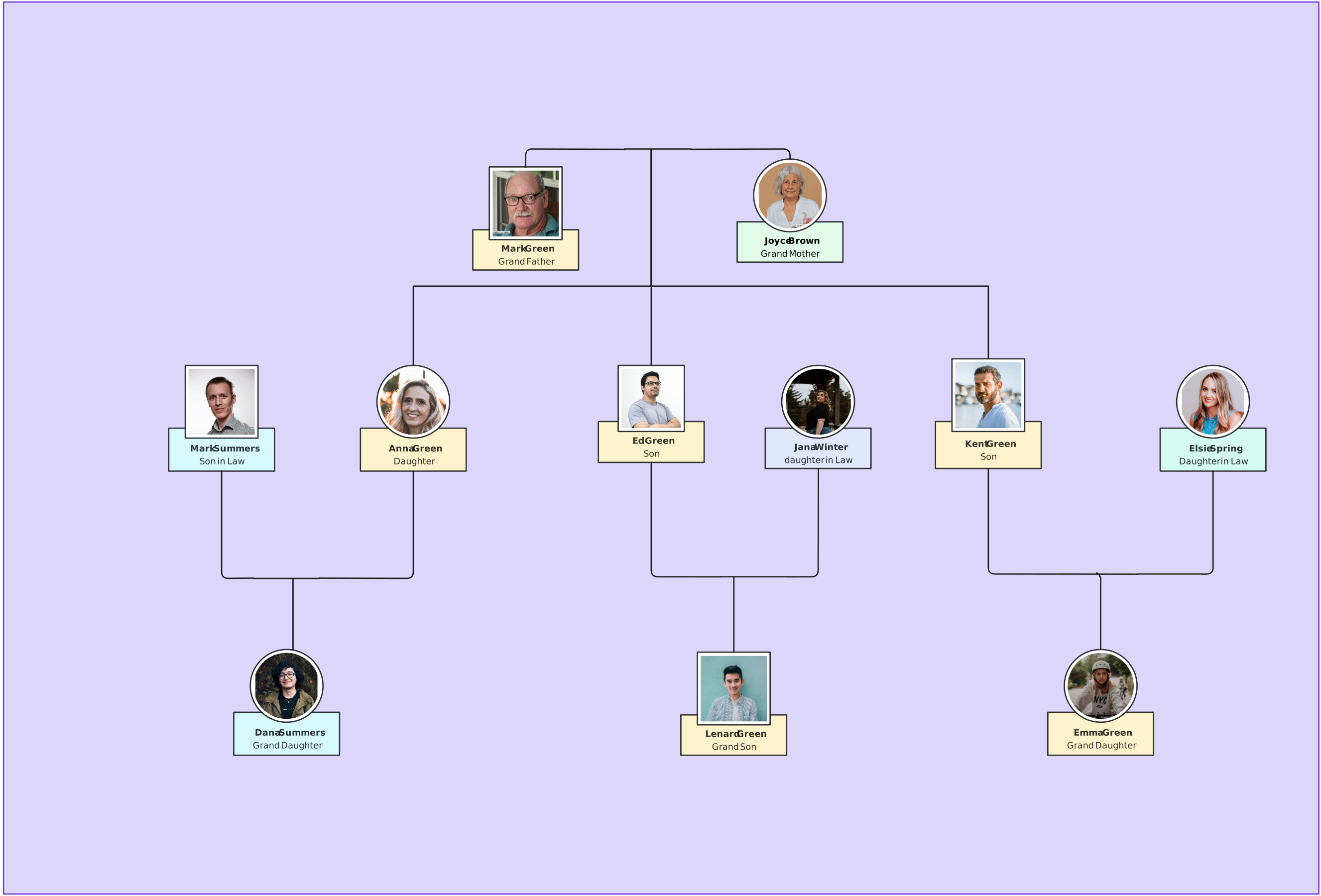

3 Generations Genogram Template
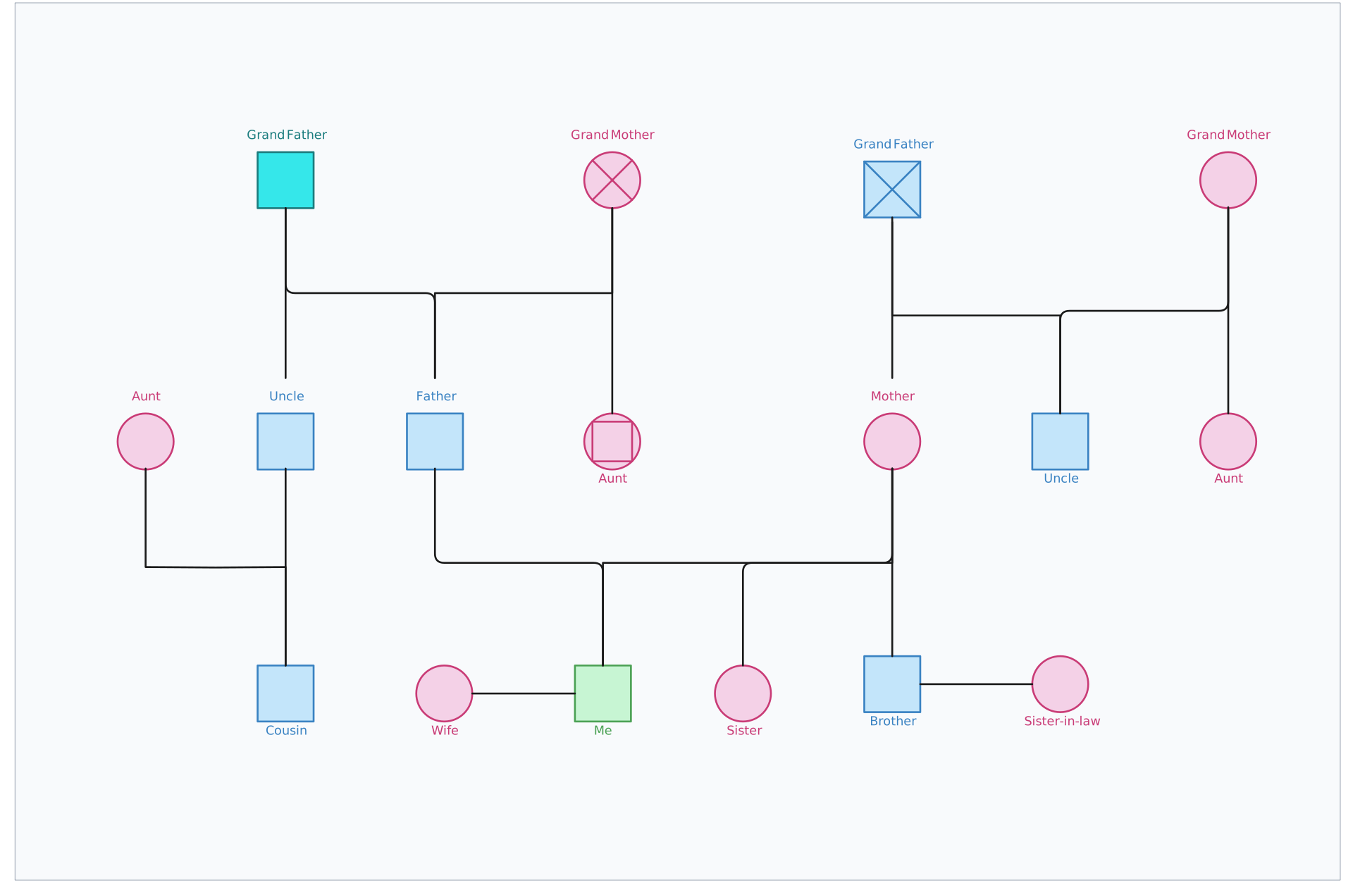
Family Career Genogram Template
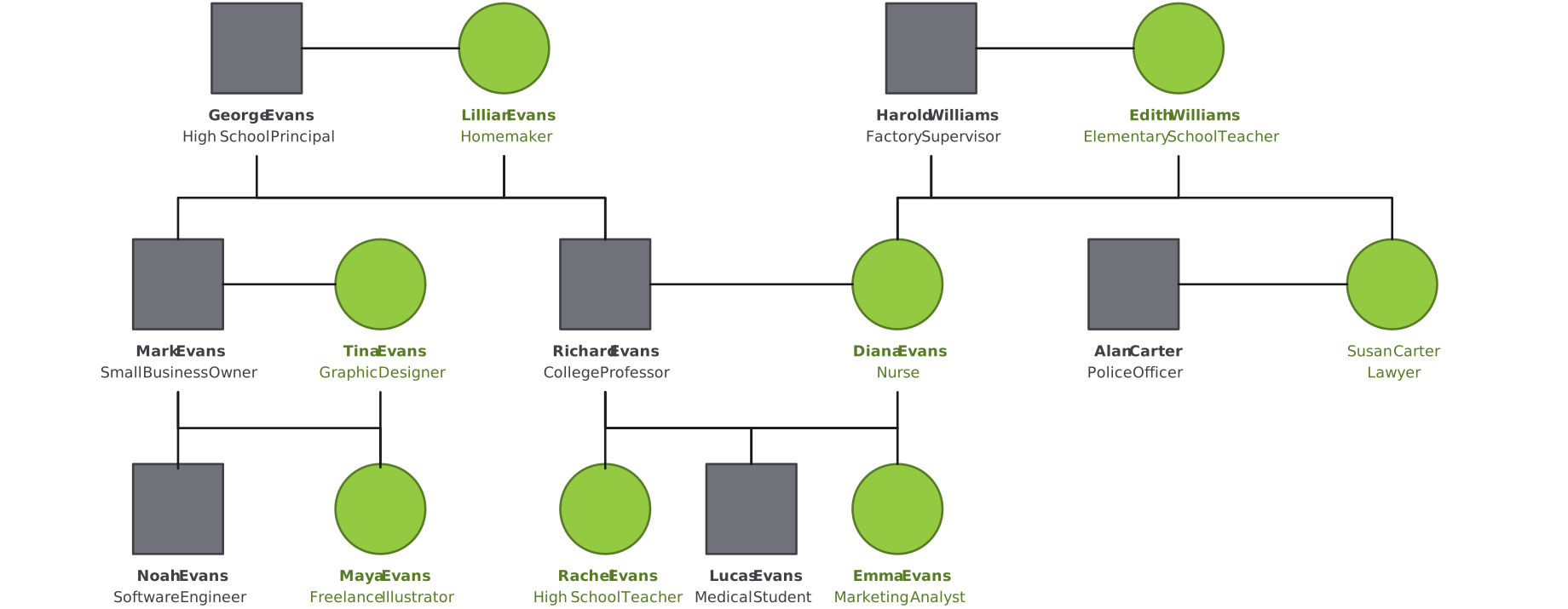
Cultural Genogram Template
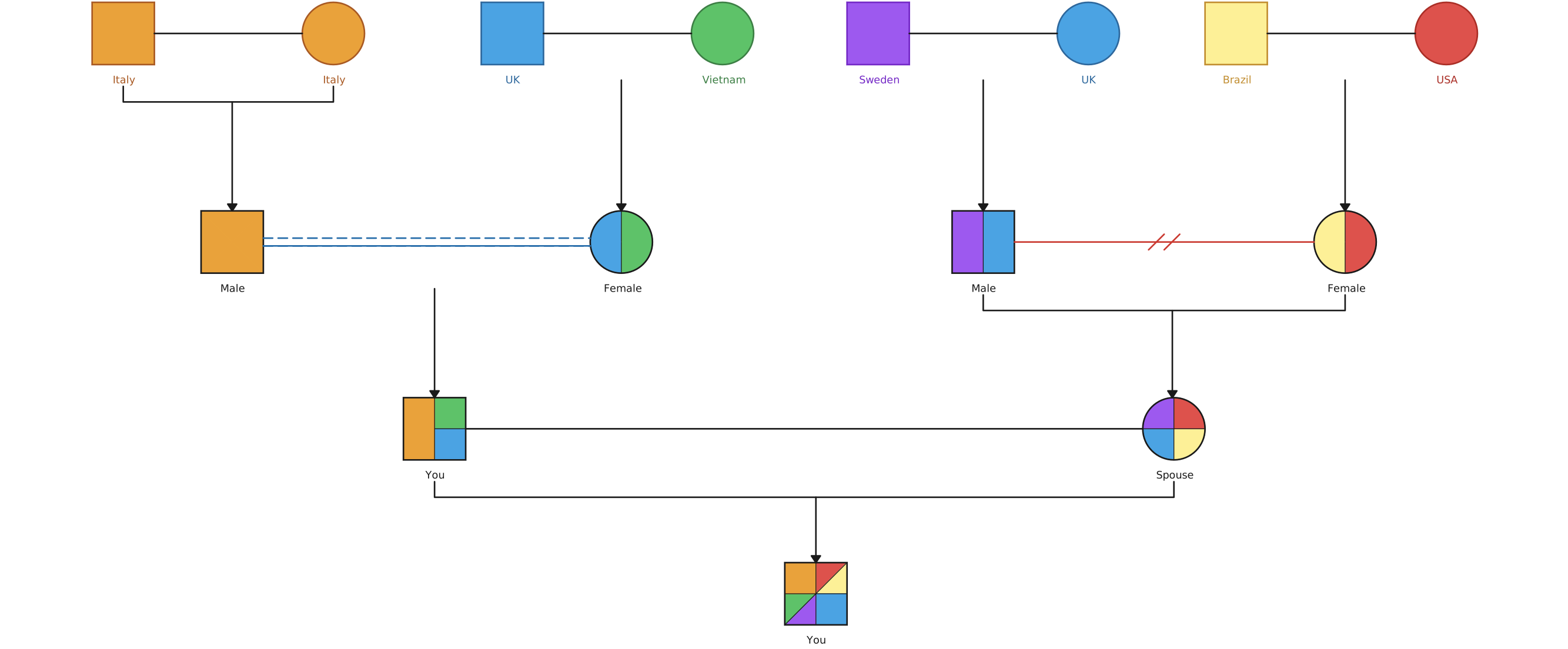
Social Work Genogram Template