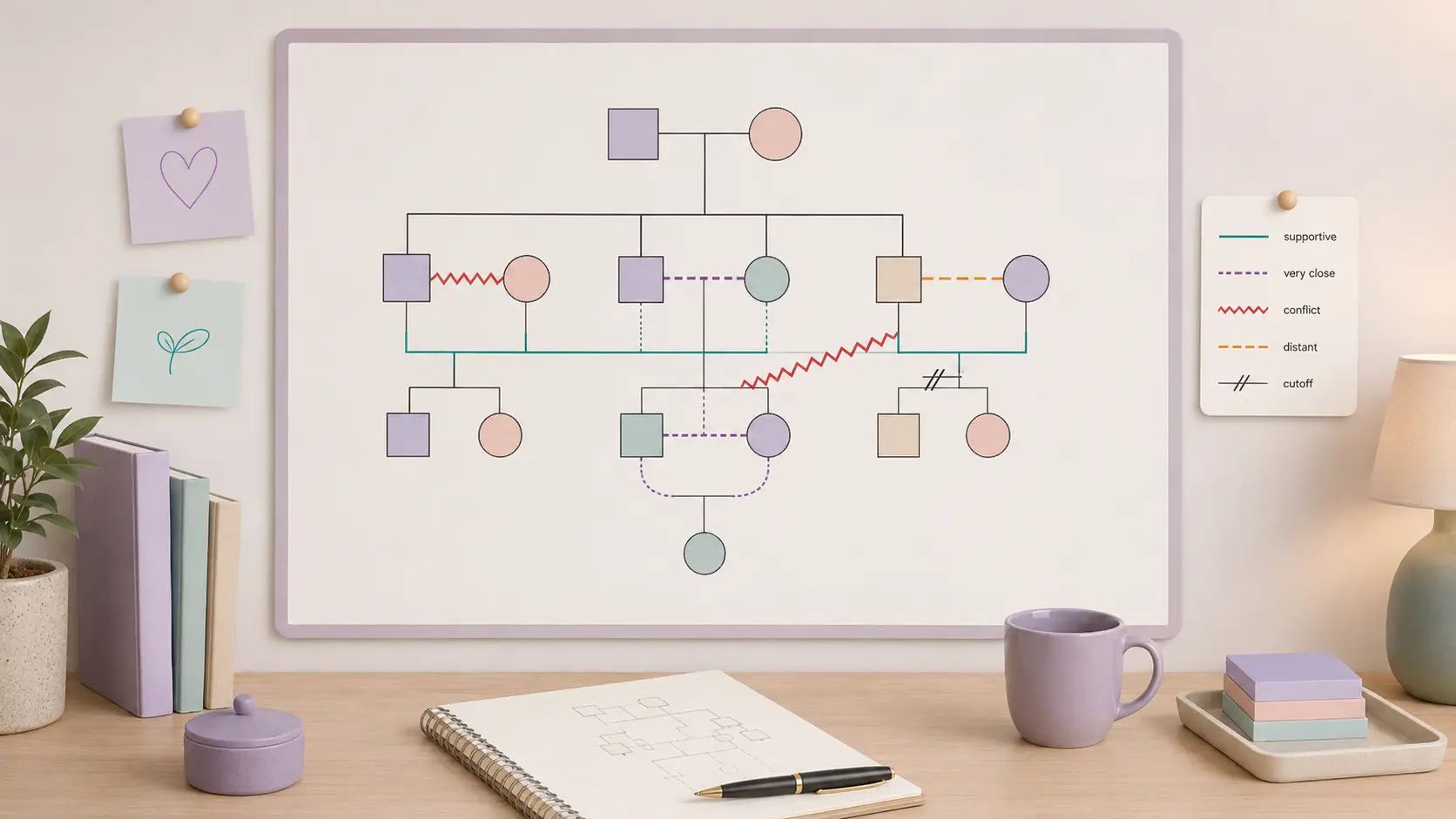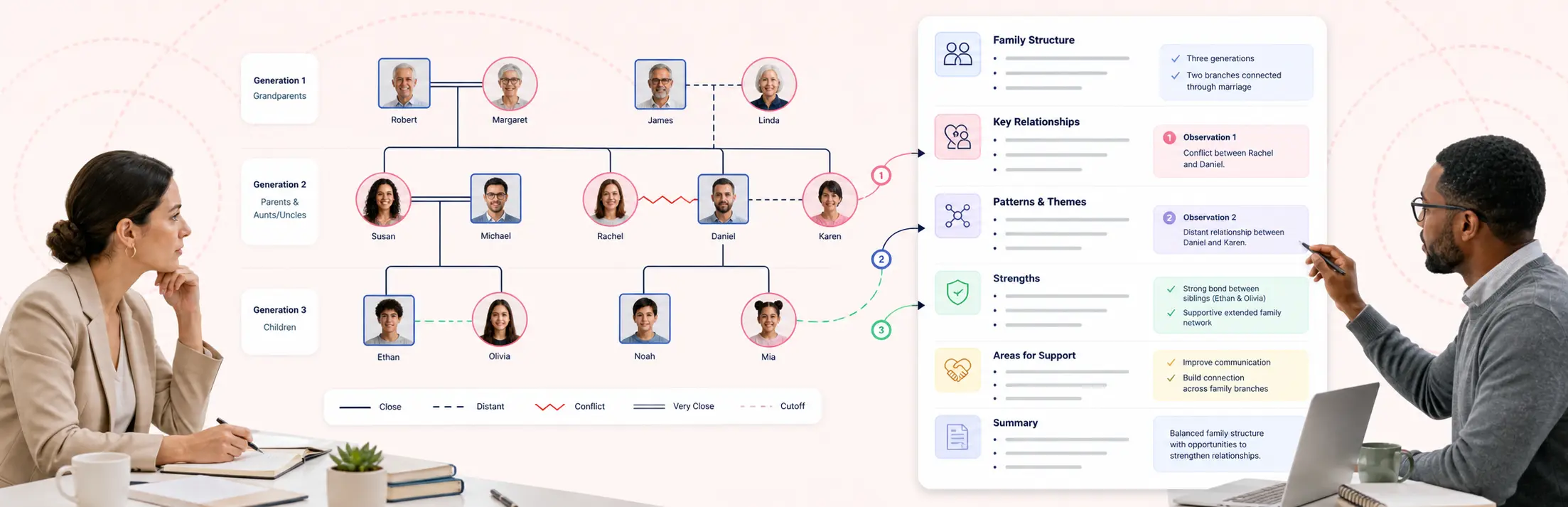
A genogram assessment report explains what the diagram documents, which patterns are supported by the available evidence, what remains unknown, and what should be explored next. A strong report separates facts from interpretations and avoids turning a visible family pattern into an unsupported diagnosis.
What Is a Genogram Assessment Report?
A genogram assessment report is the written companion to a family genogram. The diagram shows people and relationships; the report records why the genogram was created, what evidence was used, which structural or relational patterns are visible, and what limitations affect interpretation.
The report may support therapy, counseling, social work, genetic counseling, medical family-history review, research, or supervised education. Its terminology, included fields, and confidentiality requirements should match the professional context.
Genogram Assessment Report Structure
| Section | What to document |
|---|---|
| Purpose and scope | Why the genogram was created, the review period, and the professional context |
| Sources and limitations | Interviews, records, client reports, unknown information, and conflicting accounts |
| Family structure | Generations, households, unions, separations, children, foster placements, and significant transitions |
| Relationship observations | Recorded closeness, conflict, cutoff, distance, fusion, or other documented dynamics |
| Professional data | Relevant information from active field packs, such as Medical & Genetic, Family Therapy, Social Work, Legal & Estate, or General Research & Genealogy |
| Recurring patterns | Cross-generational occurrences supported by the recorded evidence |
| Strengths and resources | Supportive relationships, coping resources, services, and protective factors |
| Risks and concerns | Documented concerns without unsupported causal or diagnostic claims |
| Follow-up questions | Missing evidence and areas that require clarification |
| Summary | A bounded synthesis tied directly to the evidence in the genogram |
How to Write a Genogram Assessment
1. State the purpose
Open with the reason for creating the genogram and the question the assessment is meant to support. A family-therapy intake, child-welfare review, medical family history, and research record require different evidence and language.
Identify the index person—the client, patient, or primary subject around whom the genogram is organized. State how the other people in the family system relate to this person.
2. Identify the evidence
List the sources used to build the genogram. Distinguish information confirmed by records from client-reported or third-party information. Record disagreements and uncertainty rather than forcing one version into the diagram.
Confirm the genogram’s legend before interpreting its symbols or relationship lines. Note any custom colors, markers, terminology, or professional conventions because notation may vary between tools and settings.
3. Describe the family structure first
Document the people and relationships before interpreting dynamics. Include the number of generations, significant unions, divorces, remarriages, biological, adoptive, foster, and step relationships, deaths, household changes, and other relevant transitions. Record important dates and timing, including births, deaths, diagnoses, marriages, separations, relocations, losses, and changes in caregiving arrangements.
4. Record relationship observations
Describe only the dynamics represented by the available evidence. For example: “The client described repeated periods of cutoff between the index person and the maternal parent.” This is more defensible than presenting the relationship marker as an objective fact.
5. Examine recurring patterns
Look for conditions, behaviors, roles, relationship dynamics, or life events that appear across generations. Note where the pattern appears and where the information is missing. Recurrence does not by itself prove inheritance, causation, or a diagnosis.
Creately’s AI pattern detection can help surface hereditary, emotional, or behavioral patterns across generations. Treat these findings as prompts for professional review rather than verified facts, diagnoses, or proof of causation.
6. Include strengths and resources
A useful family assessment is not only a risk inventory. Document supportive relationships, effective coping strategies, stable caregivers, community services, cultural strengths, and other protective factors.
7. Document evidence gaps
Identify unnamed people, disconnected family members, unknown relationships, incomplete professional fields, uncertain dates, and conflicting reports. These limits belong in the assessment because they affect how confidently a pattern can be discussed.
8. End with follow-up questions
Turn gaps and tentative observations into clear questions. Ask what additional records, interviews, or professional input would confirm, challenge, or contextualize the current assessment.
Short Genogram Assessment Example
The three-generation genogram records repeated conflict and intermittent cutoff in the maternal line, based primarily on the client’s account. The maternal grandmother and mother are both described as important caregivers, but the dates and duration of estrangement are incomplete. The current diagram also records anxiety for two family members; no clinical records were reviewed. Follow-up should clarify the timing of the relationship changes, identify protective relationships during those periods, and distinguish reported diagnoses from unverified descriptions.
This example separates recorded information, tentative observations, evidence limits, and follow-up questions. For full cases, see genogram analysis examples.
Turn the Assessment into Professional Documentation
Use Creately’s Genogram Assistant and AI pattern detection to review recurring patterns and possible evidence gaps. When the assessment is ready, generate a Clinical Case File as a fixed-layout PDF for filing or an editable DOCX for adding professional notes. The generated report can include a cover page with a confidentiality statement, the genogram diagram, individual profiles, union summaries, a relationship matrix, AI-generated observations, data notes, and a symbol-legend appendix.