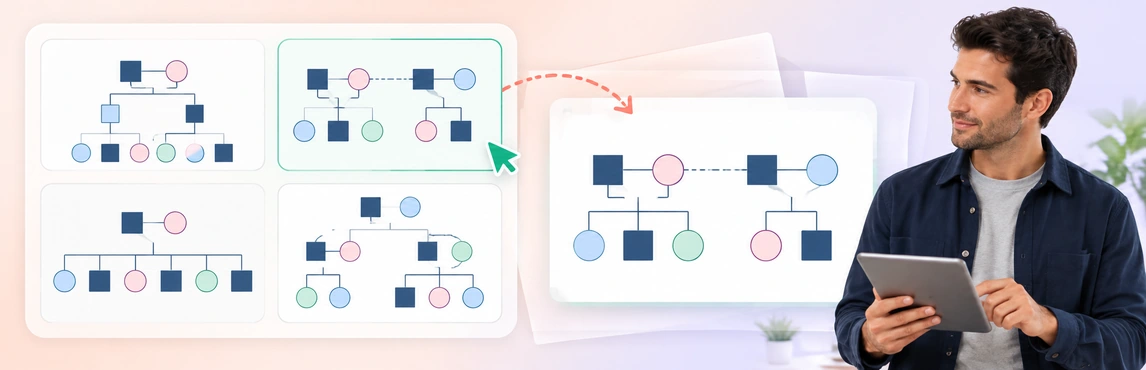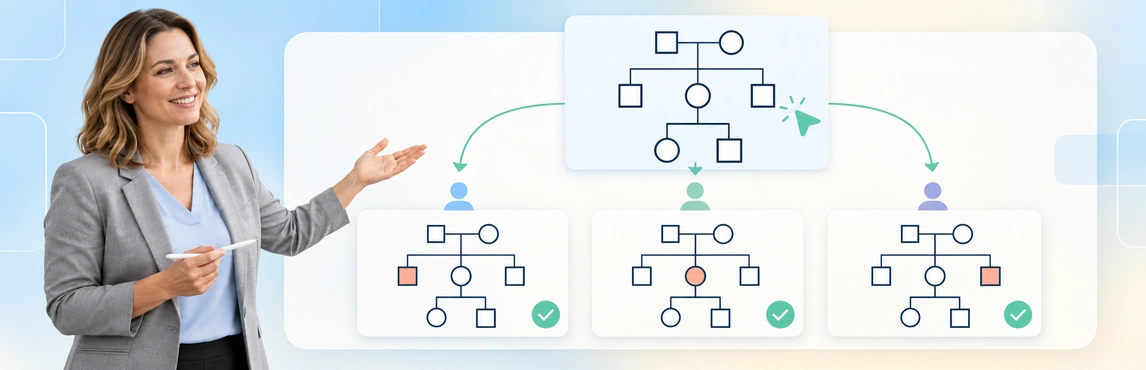
Training case workers to use genograms consistently requires practice that can be checked: agree on a notation reference, demonstrate how to map a sourced account, and have learners explain and correct their own diagrams. Use varied fictional scenarios and a shared review rubric. Consistency means that another reader can understand the same relationships and uncertainties, even when two maps have different layouts.
This guide provides an onboarding framework for child-welfare teams. Use the child-welfare case-management guide for the wider workflow and the team symbol-standardization guide to establish the reference before teaching it.
Define What Learners Must Be Able to Do
Start with the problem observed in practice. Missing relatives, unsupported relationship labels and unreadable exports need different exercises; a software demonstration alone will not address all three.
CDC’s Quality Training Standards recommend assessing training needs and using learner assessments aligned with learning objectives. Applied here, that means checking a completed map or observing a task rather than relying only on attendance or confidence ratings. These public-health training standards inform the approach; this guide is not a CDC-approved course. Source: CDC, Quality Training Standards.
Set observable objectives such as:
- Map the people and relationships established by a fictional source.
- Distinguish biological connections, current care and sourced legal status.
- Explain the legend and mark information that remains unknown.
- Attribute sensitive labels to the account or observation supporting them.
- Prepare an appropriate review copy and describe its limitations.
Give each learner the same short source note and the Basic Family Genogram below. Ask them to build only what the note establishes, then identify one question they would need to follow up. Compare the reasoning before comparing the layout.


Demonstrate the Reference, Then Ask for an Explanation
Show a small map and explain how each symbol and connector relates to the source. Keep the agency’s agreed legend available; use the genogram symbols guide as supporting reference rather than silently mixing conventions.
Victoria’s Child Protection Manual recommends explaining the purpose, process and symbols when completing a genogram with a family, and including a key for additional symbols. This supports teaching workers to explain the diagram as well as draw it; follow local agency requirements for the actual notation. Source: Victoria Child Protection Manual, Genograms.
Use a brief teach-back:
- Point to a relationship and ask what it communicates.
- Ask which source detail supports it.
- Ask what the reader must not infer from it.
- Have the learner correct an intentionally ambiguous label.
The Twins Genogram adds a different structural exercise. Ask learners to explain its branching convention and leave details such as twin type unspecified unless the fictional source establishes them. Shared age or appearance should not fill a gap in the record.

Add Care Arrangements and Uncertainty to the Exercise
Increase complexity after learners can explain a simple map. Include different households, half-siblings, step relationships and care arrangements, with some facts deliberately missing.
For example: “Ari lives with a parent and that parent’s partner. Ari’s half-sibling lives elsewhere. An aunt sometimes helps with school collection. The notes do not establish the aunt’s legal responsibility or the frequency of contact with the sibling.”
For a 20-minute fictional exercise, give learners five minutes to map this note, five minutes to explain their evidence, five minutes to find an intentional error, and five minutes to correct and score the result. Answer key: Ari, the parent, the parent’s partner, the half-sibling and the aunt are present; Ari’s household and the aunt’s reported school-collection help are distinct; the aunt’s legal responsibility and sibling-contact frequency remain unknown. An example incorrect map labels the aunt a legal guardian. Correct it by removing that unsupported status, recording only the reported help and keeping legal responsibility unresolved.
Use a second fictional note for independent practice: “Nia’s mother, Jo, lives with Nia. Jo says Nia visits her father, Malik, on some weekends. Malik’s sister, Bea, is named as an emergency contact; the note does not say Bea provides care.” Answer key: show Jo and Malik as Nia’s parents, keep the reported weekend visit attributed to Jo, and identify Bea as Malik’s sister and an emergency contact only. Do not label Bea a caregiver or infer a legal arrangement. Ask learners to state which detail they would verify before using either map in a case review.
Ask learners to submit:
- The family structure supported by the scenario.
- Separate labels for current household and reported practical support.
- Visible unknowns rather than guessed relationships or dates.
- Two focused follow-up questions.
The Divorce and Blended Family Genogram is a useful layout for this exercise. Replace its sample details, and require the learner to explain why a partner connection, a care role and legal responsibility cannot be treated as interchangeable. For broader structures, see foster-care and blended-family documentation.

Practice Respectful Questions and Contextual Notes
The next exercise should test how information is gathered, not only how it is drawn. One learner plays a worker and another reads a fictional family account; the observer checks whether the worker explains the purpose and asks without assuming the answer.
Useful prompts include:
- “Who would you include as important to this family?”
- “How would you describe this connection?”
- “Which details are you unsure about?”
- “Is there anything on this map that I have misunderstood?”
Use the Three-Generation Cultural Genogram to practice recording context in the speaker’s terms. Do not infer identity, beliefs or relationship quality from a surname, appearance or a template’s colors. Ask learners to distinguish a self-described detail from an interpretation and explain what belongs in the review copy.

Review the Map with a Shared Rubric
For training case workers, use the same observable criteria across exercises and reviewers. The sample rubric below is an author-created training aid, not a validated clinical assessment or certification standard; the agency should adapt and approve it.
| Criterion | Evidence to look for | Correction if it is missing |
|---|---|---|
| Source fidelity | People and connections match the scenario | Remove inferred facts and revisit the source |
| Relationship meaning | Care, family and legal-status labels remain distinct | Replace the ambiguous label and explain why |
| Uncertainty | Unknown or disputed information is visible | Mark the gap and add a follow-up question |
| Attribution | Sensitive labels identify whose account is represented | Add the appropriate source context |
| Readability | Another reader can follow the map and legend | Revise labels, connectors or layout |
| Audience awareness | The learner explains what can be shared and with whom | Rework the review copy through the approved process |
Record each criterion as demonstrated, needs revision or not yet assessed. Ask learners to correct material errors and explain the change; do not allow a neat layout to compensate for an invented relationship or inappropriate disclosure.
Copyable assessment record: Scenario: [Ari/Nia]; learner: [name]; date: [date]; criteria and status: [source fidelity, relationship meaning, uncertainty, attribution, readability, audience awareness]; material correction: [issue and revised label]; next practice: [task]; trainer review: [named reviewer/date]. This is an agency-adaptable worksheet, not a validated competency score.
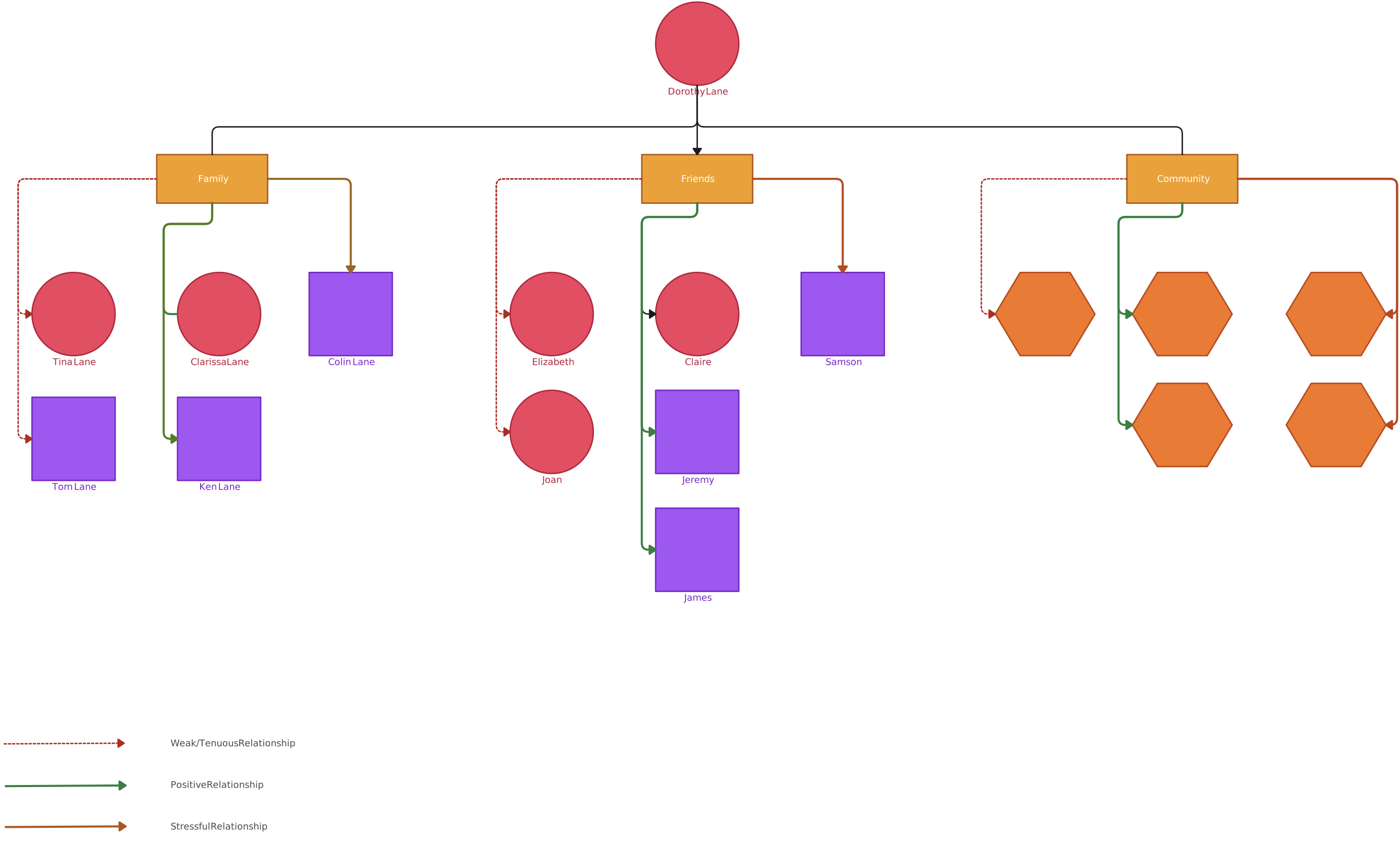
The Social Genogram provides a final transfer exercise. Ask learners to map reported support beyond the household and explain what is still unknown about each person’s role. A connection does not establish availability, willingness or suitability to provide care.
Teach the Digital Workflow in Creately Clinical Maps
Creately Clinical Maps supports McGoldrick/Gerson notation, 60+ relationship types, notes and collaboration. Use those capabilities to teach a repeatable review process; a common tool does not guarantee that workers interpret the source consistently.
- Identify the gap and objectives. Choose the skills the session will assess.
- Demonstrate the approved workflow. Show how source details become a map and where uncertainty stays visible.
- Use guided and independent practice. Have learners work from fictional scenarios rather than copying the demonstration.
- Review and revise. Use comments or another approved feedback method to explain material errors.
- Agree supervised next steps. Record what was demonstrated and what requires more practice.
For an AI exercise, paste a fictional account into text-to-genogram and compare the draft against the original statement. Ask learners to find unsupported people, connections or certainty before improving the layout. AI observations are heuristic, not diagnoses or validated risk scores.
| Capability | Training use | Boundary |
|---|---|---|
| Basic drawing and image export | Build practice maps and check the submitted copy | Available on every plan |
| Text-to-genogram | Practice checking a generated draft against its source | Assisted generation has a lifetime allowance |
| Comments and collaboration | Discuss why a label needs revision | Confirm appropriate access and record required assessment outcomes separately |
| Advanced field packs, views and reports | Teach an authorized domain-specific workflow | Require Enterprise, a Genogram grant and protected-data clearance |
Use the Creately genogram maker for the practical drawing exercise. Confirm organizational approval before moving from fictional material to identifiable case information; this training plan does not imply an EHR integration or replace the agency’s case-record process.
Calibrate Reviewers and Follow Up After Onboarding
Have two trainers review the same fictional map independently, then compare their reasons. Resolve disagreements about the rubric or reference before interpreting inconsistent marks as a learner problem.
| Recurring difficulty | Follow-up exercise |
|---|---|
| Different meanings assigned to one connector | Explain the approved legend using a fresh example |
| Missing branch or support person | Reconstruct the map from the source and identify what was overlooked |
| Inferred legal status | Separate the reported arrangement from the record that would establish status |
| Unattributed emotional label | Rewrite the label with its source and uncertainty |
| Overcrowded review copy | Prepare a readable, audience-appropriate artifact |
| AI draft accepted without checking | Compare every claim with a deliberately incomplete scenario |
Training case workers should continue through supervised practice and targeted refreshers. Review a new fictional scenario after learners have had time to apply the workflow, and use recurring errors to improve instruction. The agency’s designated reviewer should decide readiness under its own requirements; no universal score or training duration is supplied here.
Keep the approved legend and rubric alongside each exercise so learners and reviewers use the same reference points.
Helpful Resources
Prepare clear genogram exports for case files, review meetings, and court-related workflows.
Review practical considerations for sharing sensitive genograms with the right people.
Choose an editable family-mapping layout for a fictional onboarding or review exercise.