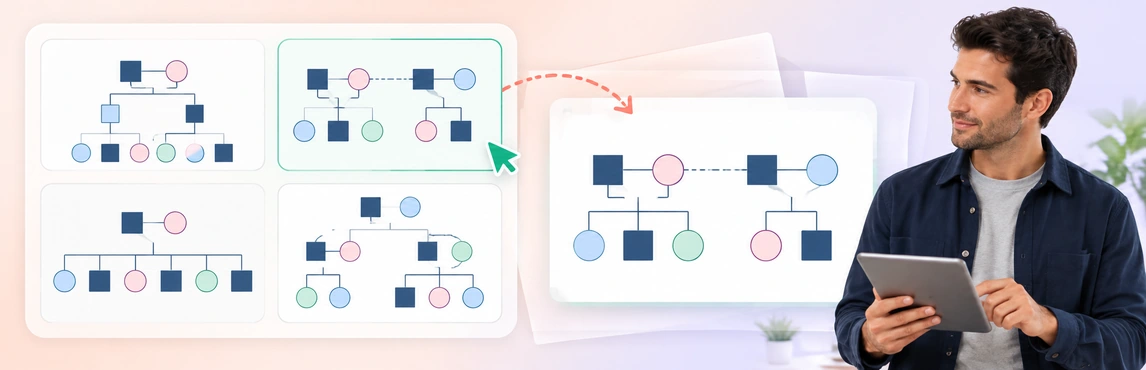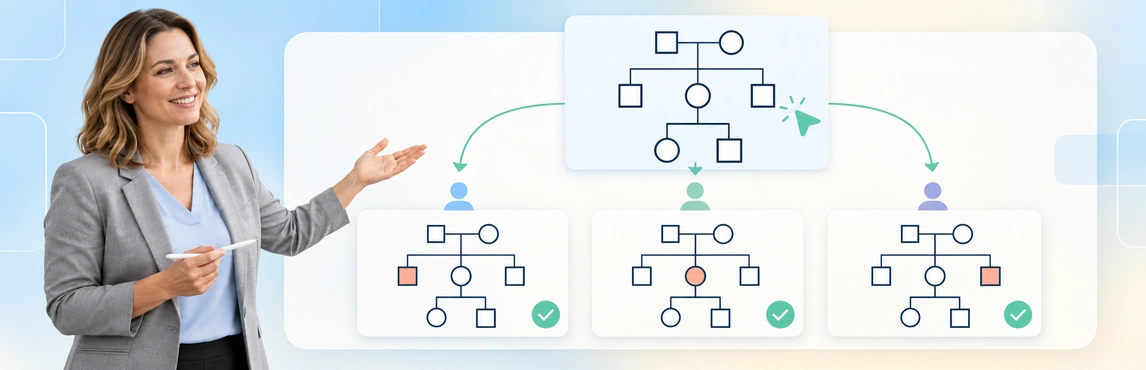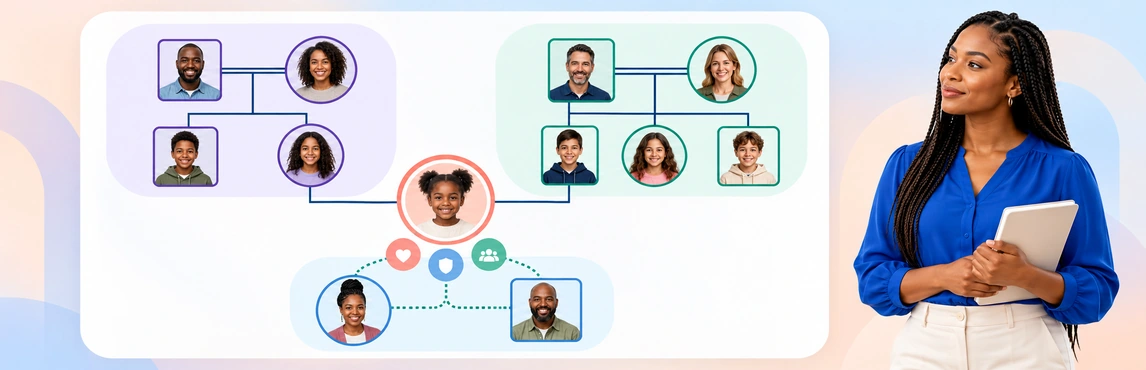
Use genograms in foster care to show family connections, current caregivers and important relationships without treating them as the same thing. Give each relationship a clear meaning in the legend, record its source and date, and keep legal status tied to the authoritative case record. A child’s current address alone cannot explain who is family, who provides care or who holds decision-making responsibility.
This guide covers foster, kinship, adoptive, blended and informal-caregiver structures. For the wider assessment workflow, see genograms for child-welfare case management; for notation, use the genogram symbols guide alongside your agency’s requirements.
Separate Family Connections, Care and Legal Status
Start with the child and ask what the map needs to explain. A case-review map may need current caregivers and sibling connections; a broader assessment may also need earlier placements, extended kin and people the child identifies as family.
Victoria’s Child Protection Manual explicitly allows genograms to include people significant to a child who are not biologically related. Its guidance also recommends a key for additional symbols, supporting a map whose scope and meaning are clear to its readers. Source: Victoria Child Protection Manual, Genograms.
| Information | Record it as | Avoid implying |
|---|---|---|
| Biological connection | A sourced parent-child or sibling relationship | Current residence or responsibility |
| Day-to-day care | A named role with relevant dates | Legal guardianship or custody |
| Legal status | A concise label linked to the applicable record | A legal conclusion derived from a line style |
| Household membership | A dated residence note or explained boundary | That everyone living together is related |
| Emotional connection | An attributed account or observation | That contact frequency establishes closeness or safety |
| Unknown detail | A visible gap with a follow-up question | That an unrecorded person does not exist |
Use the Basic Family Genogram as a starting structure. Replace sample identities with fictional details for practice, then add separate care-role labels; this general layout needs adaptation before it can describe a placement.


Record Kinship and Informal Care Without Assuming Authority
A relative can have more than one relationship to a child. An aunt may be a family connection, a current caregiver and a person the child trusts, but each description has a different basis.
Consider this fictional note: “Maya stays with her maternal aunt, Leena, during the school week. Her grandmother collects her on Fridays. The available notes do not establish legal responsibility.” Show the family connections and reported care arrangements, then leave legal status unresolved until the appropriate record is checked.
For each care role, document:
- Who reported the arrangement and when.
- What care the person provides and the relevant dates.
- Whether the arrangement is current, proposed or historical.
- What remains unknown, including any formal status that needs verification.
Ask how the child and family describe kinship, including culturally significant and chosen-family relationships. Use their description with attribution and an explained convention rather than forcing every important person into a biological category. A person’s presence on the map does not establish suitability for placement; use the separate safety and placement decision guide for that assessment boundary.
Distinguish Foster Care, Adoption Plans and Completed Adoption
Keep the current foster-care relationship distinct from any proposed adoption. A future plan should remain visibly a plan until the relevant record confirms a change, and contact with birth relatives should be documented separately from legal parentage.
| Situation | Useful documentation | Detail to verify |
|---|---|---|
| Current foster placement | Caregiver, placement start date and current-status note | The source of the placement information |
| Proposed adoption | A clearly labeled proposed arrangement | Whether any legal change has occurred |
| Confirmed adoption | Adoptive relationship with the relevant record reference | Information-sharing restrictions for the audience |
| Contact with birth relatives | Who has contact, its reported form and the date | Whether the account is current and attributed |
| Restricted or unknown birth-family information | An explained gap or restricted-detail note | What the audience is authorized to receive |
Do not use an emotional-cutoff connector to communicate a legal change. Equally, a legal change does not tell the reader whether a child feels connected to a person. See genogram relationship types for the distinction between structural and emotional relationships.
The Foster-to-Adopt System Genogram fits this transition directly. Use its layout to separate the existing arrangement from a possible future one, and review every sample label before using it; the template is not evidence that adoption has been approved.

Keep Blended Households and Sibling Relationships Readable
A blended-family genogram should make each child’s connections understandable across households. Show the relevant partner and parent-child relationships first, then label step, half-sibling and care relationships according to the legend.
For example, a child may live with a parent and that parent’s partner while a half-sibling lives elsewhere. Record those connections without treating the partner as an adoptive parent or assuming that the siblings have the same contact arrangements.
Check the map from each child’s perspective:
- Can a reader identify their parents and relevant caregivers?
- Are sibling relationships clear even when children live apart?
- Are household and relationship dates distinguishable?
- Does a separation label describe partner status rather than the child’s contact?
The Divorce and Blended Family Genogram is useful for this check because it brings several partner and child relationships into one layout. Add household and care notes only when supported by the scenario or case record.
A Fictional Multi-Household Map and Placement Chronology
In this training example, Maya’s birth parents are Nila and Aaron. Nila is now married to Jo; their child Kai is Maya’s maternal half-sibling. Jo is Maya’s step-parent, not an adoptive parent. Maya currently lives with foster caregiver Ruth, whose child Eli is adopted. These details are fictional, and the map does not establish who holds legal responsibility for Maya.
| Family map today — 3 November, fictional | Placement chronology for Maya |
|---|---|
| Maya → Nila and Aaron: biological parent-child ties | 3 March: Maya began living with foster caregiver A; retain the dated placement record |
| Nila + Jo: married partners; Jo → Maya: step relationship; Nila + Jo → Kai: parent-child ties; Maya ↔ Kai: maternal half-siblings | 20 June: Maya moved from foster caregiver A to Ruth; check the authoritative effective date |
| Ruth → Maya: current foster-care role; Ruth → Eli: documented adoptive parent-child tie. Eli and Maya share a household, but are not labeled siblings from residence alone. | 3 November: current map reviewed against the placement record; any contact with caregiver A remains separately sourced and dated |
| Label in this example’s legend | What it means on the map | What it must not imply |
|---|---|---|
| Biological parent-child | Nila or Aaron’s relationship to Maya | Current care or legal decision-making status |
| Foster care | Ruth’s current care role for Maya, with effective date | Biological or adoptive parentage |
| Adoptive parent-child | Ruth’s documented relationship to Eli | An approved adoption plan for Maya |
| Step relationship | Jo’s relationship to Maya through marriage to Nila | Adoption or parental responsibility without a record |
| Half-sibling | Maya and Kai share Nila as a parent | That they live together or have a particular contact plan |
Use the map for the current structure and the chronology for moves and dates; keep authoritative legal-status references in the approved record. For the broader case process, use the child-welfare genogram guide.

Preserve Placement History Alongside the Current Map
Genograms in foster care become difficult to read when every earlier arrangement looks current. Keep the present map legible and use a companion chronology for moves, changes in care and the sources that establish them.
NSW’s case-planning guidance describes planning as an ongoing process, with goals, actions and responsibilities documented and reviewed as circumstances change. A dated genogram can support that process by making the current relationship picture easier to check; it does not replace the case plan. Source: NSW Government, Case planning.
The Maya example above keeps the 3 March and 20 June placement events in its chronology while the current map shows Ruth’s care role as of 3 November. If Maya reports later contact with caregiver A, record the source and date separately rather than silently restoring A as a current caregiver.
Retain earlier records according to agency requirements. Do not erase an ongoing relationship simply because a placement ended, or label a series of moves as proof of an attachment difficulty. The long-running case maintenance guide covers the update workflow in more detail.
Include Significant People Beyond the Household
An informal caregiver, family friend or former carer may remain important even when they have no current placement role. Record what the person actually does and how the child describes the relationship, including uncertainty or disagreement.
Use questions that identify concrete connections:
- Who does the child ask for help with everyday problems?
- Who helps with transport, school or maintaining family contact?
- Which relationships does the child want the worker to understand?
- Whose involvement is reported but has not yet been confirmed?
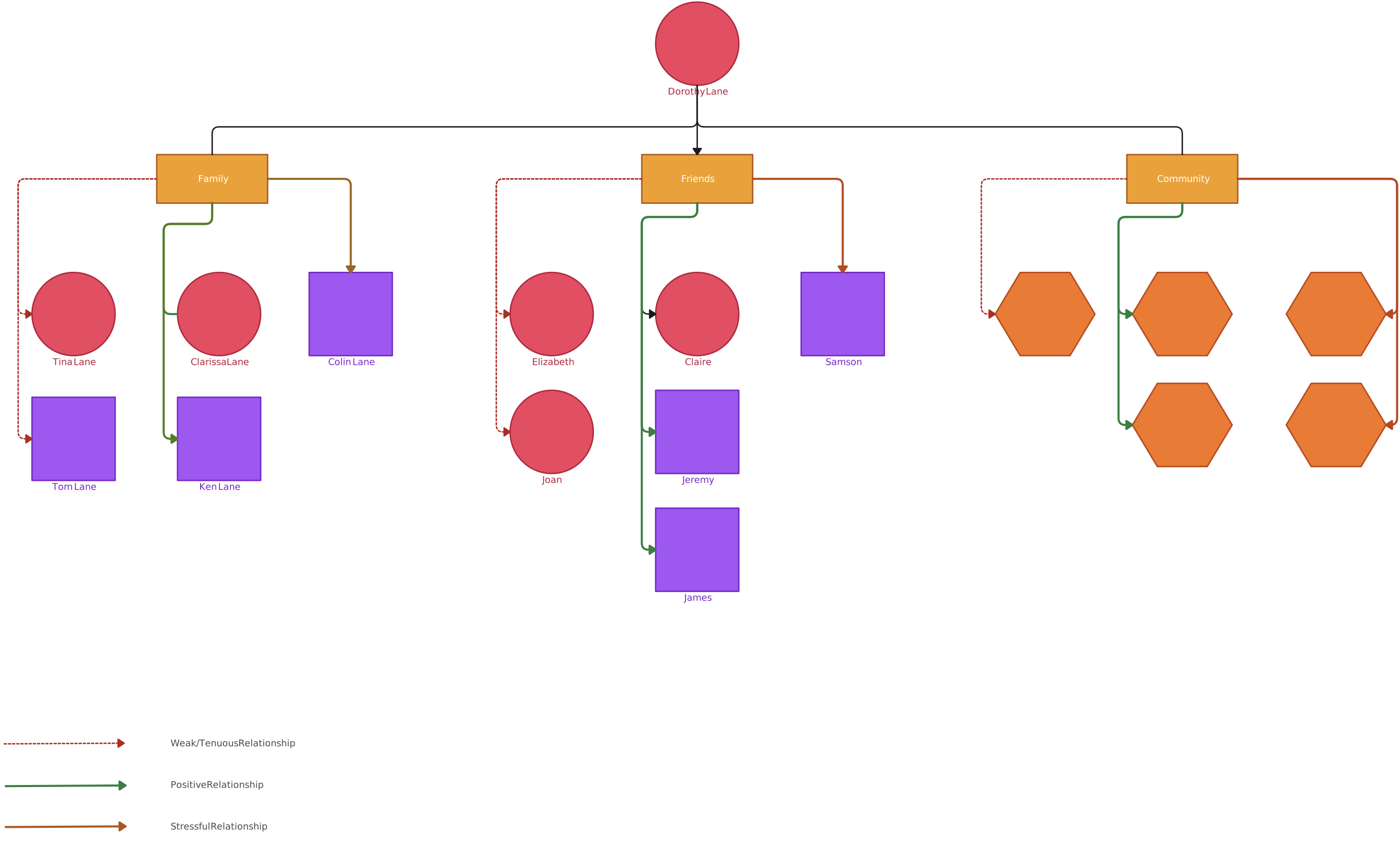
The Social Genogram provides a different starting point for mapping these connections. Define each link and distinguish a reported support relationship from a checked care arrangement; use a companion ecomap when service and community connections would overcrowd the family map.
Record Cultural Connections in the Family’s Own Terms
Family documentation should leave room for the child’s language, identity, community and cultural connections. Ask what is important, who supplied the information and what may be included for the intended audience.
Use the Three-Generation Cultural Genogram to explore relevant connections across generations. Its colors and labels need a clear legend; do not infer identity, beliefs or relationship quality from a surname, appearance or placement arrangement.

Before sharing this information, check that:
- The descriptions reflect an attributed account rather than the worker’s assumption.
- Important connections outside the current household remain visible where relevant.
- Color has a text label or another cue so meaning survives grayscale export.
- The information is necessary and appropriate for the recipient.
Build and Review the Map in Creately Clinical Maps
Creately Clinical Maps supports McGoldrick/Gerson notation, 60+ relationship types, notes and collaboration. Its biological, adoptive, foster and step relationships help represent different structures; the worker must still verify what each connection means in the case.
- Define the purpose and audience. Use fictional information for practice and confirm agency authorization before entering case data.
- Map connections and care roles. Start from a relevant template or permitted text, then separate family structure from current care.
- Add sources, dates and uncertainty. Check people and relationships against the available records; keep proposed arrangements clearly labeled.
- Record earlier placements separately. Use a dated companion chronology where the main diagram becomes crowded.
- Review before sharing. Check the legend, recipient access, included details and actual exported output.
A fictional text-to-genogram prompt could be: “Maya is the child. Leena is Maya’s maternal aunt. Maya currently stays with Leena during the school week. Legal responsibility is not established in these notes. Do not infer missing relationships or legal status.” Review the generated result even when the prompt includes these limits; wording alone does not guarantee that a draft preserves them.
| Capability | Use in documentation | Availability or review boundary |
|---|---|---|
| Basic drawing and image export | Build the map and inspect an image for the intended audience | Included on every plan |
| Text-to-genogram | Draft a structure from permitted notes | Assisted generation is metered; verify the result and confirm current allowances with Creately |
| Notes and comments | Explain sources and discuss unclear relationships | Keep access and content appropriate for authorized reviewers |
| Advanced field packs and reports | Organize domain-specific details and prepare reviewable output | Require an eligible Enterprise Genogram workspace and approved protected-data arrangements; confirm access with your administrator or Creately sales |
Social-work fields can organize support and living-arrangement information, but they do not establish legal status. AI pattern observations are heuristic, not diagnoses or validated risk scores. Neither a template nor a generated report determines placement suitability or guarantees acceptance by a court.
When evaluating genogram software for foster care, test it with a fictional blended-family scenario first. Check whether the team can explain every connection, distinguish current and earlier arrangements, and produce a readable output under its approved information-handling process.
Check the Audience Before Sharing
For genograms in foster care, the useful working map and the appropriate shared version may contain different detail. Review the actual output, including notes, identifiers and legend, rather than assuming that read-only access removes sensitive information.
Before handoff, confirm:
- The purpose, recipient and permission to disclose.
- Whether identifying or adoption-related information must be restricted.
- That legal labels have supporting records and dates.
- That reported accounts remain attributed and uncertainty is visible.
- That the version date and current care arrangement are clear.
- That the file can be read at its intended display or print size.
Follow the case-review and court-report guide for audience-specific preparation and local review requirements. No universal diagram style establishes legal compliance.
Adapt one of the five examples above or browse the genogram template collection. Explore social-work genogram software to test a fictional family structure before applying your organization’s approved case-documentation process.