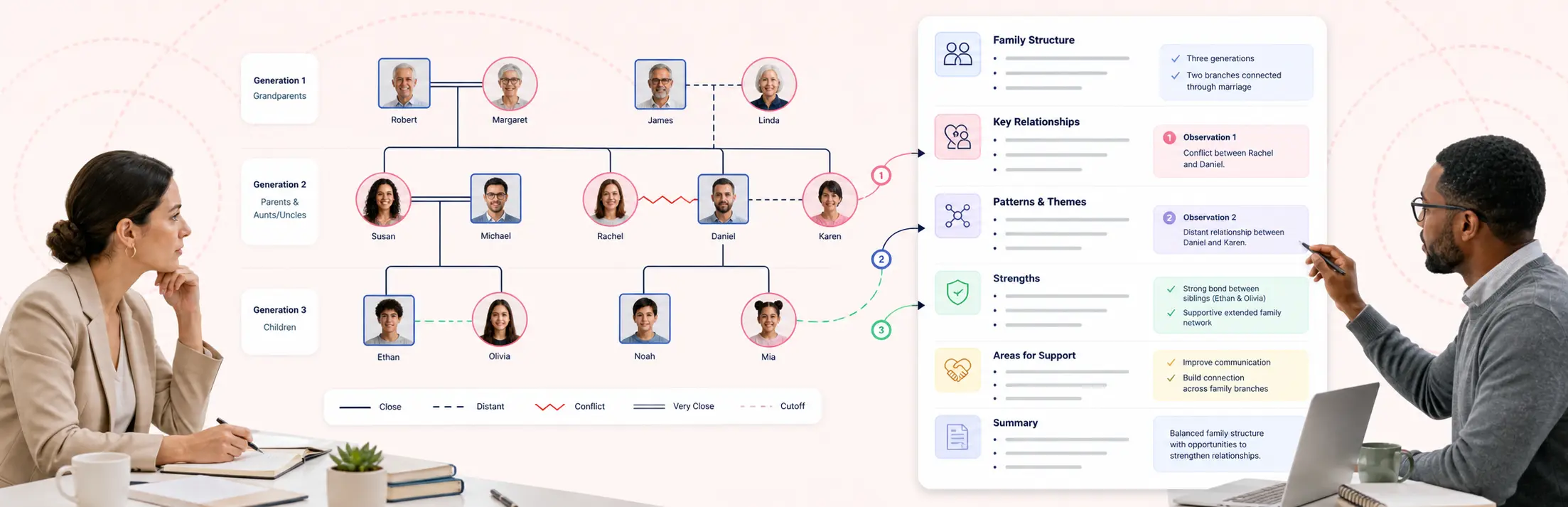
A written genogram analysis is not another diagram gallery. It documents the evidence represented in a completed genogram, distinguishes observations from interpretations, identifies missing information, and recommends questions that could confirm or challenge the initial reading.
The examples below therefore focus on the written output rather than editable diagram templates. They are simplified learning scenarios that demonstrate analytical structure, not clinical conclusions about real people.
How to Read These Genogram Analysis Examples
Each example contains six parts:
- Context: Why the genogram was created.
- Evidence: Information represented in the diagram.
- Observed pattern: What visibly recurs or connects.
- Bounded interpretation: What the pattern may suggest without presenting it as fact.
- Missing information: Evidence that would change confidence.
- Follow-up questions: What to clarify next.
For the full reporting method, see how to write a genogram assessment report.
Example 1: Three-Generation Relationship Cutoff
Context
A family therapist creates a three-generation genogram during intake to understand recurring disruptions in parent-adult-child relationships.
Evidence
- The client reports no contact with the mother for approximately two years.
- The mother reportedly had a similar period of no contact with the maternal grandmother.
- Both relationships are marked as cutoff based on the client’s account.
- Dates and reasons for the earlier cutoff have not been independently confirmed.
Observed pattern
The diagram records cutoff in two consecutive maternal-line relationships.
Bounded interpretation
The recurrence may indicate a family pattern in how severe conflict is managed, but the current evidence comes from one informant and does not establish that the situations had the same causes or meaning.
Missing information and follow-up
- How did each cutoff begin and end?
- Were there periods of repair or limited contact?
- How would other family members describe the relationships?
- Which relationships remained supportive during each period?
Example 2: Health Conditions Across Generations
Context
A medical professional reviews a family-history genogram before a patient appointment.
Evidence
- Type 2 diabetes is recorded for the patient, one parent, and one maternal grandparent.
- Age of onset is available only for the patient.
- Medication and screening information is incomplete.
- No genetic testing information is recorded.
Observed pattern
The same recorded condition appears across three generations on the maternal side.
Bounded interpretation
The genogram shows a family-history pattern worth reviewing. It does not determine inheritance, individual risk, or causation because age, lifestyle, diagnostic confirmation, and other clinical evidence are incomplete.
Missing information and follow-up
- Were the family diagnoses clinically confirmed?
- What were the ages of onset?
- Are screening results available for currently unaffected relatives?
- What relevant environmental or lifestyle information should be documented?
Example 3: Blended Family and Caregiving Roles
Context
A social worker maps a blended household during a child-welfare assessment.
Evidence
- The child lives with a biological parent and step-parent.
- A grandparent provides regular childcare.
- The other biological parent has intermittent contact.
- Housing is stable, while employment and insurance information are incomplete.
Observed pattern
Day-to-day support appears concentrated in the current household and the grandparent relationship.
Bounded interpretation
The recorded relationships suggest a potentially important caregiving network. Contact frequency alone does not show relationship quality, legal responsibility, safety, or the child’s experience.
Missing information and follow-up
- What care does each adult provide?
- Are custody and guardianship arrangements documented?
- How does the child describe each relationship?
- What services or community supports are already involved?
Example 4: Repeated Substance-Use Records
Context
A counselor uses a genogram to explore the client’s account of substance use in the family.
Evidence
- Alcohol misuse is reported for the client’s father and paternal grandfather.
- Recovery is recorded for the father, but dates are missing.
- The grandfather’s information is based on family recollection.
- Several paternal relatives have no substance-use information recorded.
Observed pattern
Reported alcohol-related concerns occur in two paternal generations.
Bounded interpretation
The diagram supports further exploration of family experiences, coping, recovery, and beliefs about substance use. It does not establish a diagnosis for either person or predict the client’s behavior.
Missing information and follow-up
- Which records are confirmed versus family-reported?
- What recovery supports were important?
- How did the family respond to the substance use?
- Are missing relatives unknown or confirmed unaffected?
Example 5: Cultural Heritage and Migration
Context
A therapist uses Culture View to discuss migration, identity, and intergenerational expectations.
Evidence
- Two cultural heritages are recorded in the current household.
- The grandparents migrated at different life stages.
- The client reports conflict concerning language and career expectations.
- Other family members’ perspectives are not yet recorded.
Observed pattern
The diagram places cross-cultural relationships, migration events, and reported conflict in the same family context.
Bounded interpretation
Migration and cultural difference may be relevant to the reported tension, but the genogram does not prove that culture is the cause. Individual values, developmental changes, financial pressures, and other evidence may also matter.
Missing information and follow-up
- How does each person describe their cultural identity?
- Which traditions are experienced as supportive?
- When did the conflict emerge relative to migration and other life events?
- Are language, discrimination, or financial pressures part of the context?
A Reusable Written Genogram Analysis Format
Use this sequence for each case:
The genogram records [specific evidence]. A visible pattern is [bounded structural observation]. This may be relevant because [careful interpretation], although [limitations]. Before drawing a conclusion, clarify [follow-up evidence].