Working in today’s fast-moving business environment often means juggling competing priorities, collaborating across teams, and staying aligned even when everyone’s moving fast. That’s exactly why many organizations turn to the matrix structure. The matrix organizational structure gives teams the flexibility to work across functions while still keeping the stability of their core roles. And the easiest way to make sense of how it all comes together is through a clear, well-designed organizational chart for a matrix structure (matrix org chart). Once you see the chart, the entire system suddenly feels simpler—who works with whom, who supports which projects, and how decisions actually flow day to day.
What Is a Matrix Organizational Structure?
Matrix organizational structure is a way of organizing work where people report to more than one manager at the same time—usually their functional manager and a project, product, or client manager. It’s designed for fast-moving, collaborative workplaces where teams need to work across departments without losing the stability of functional expertise.
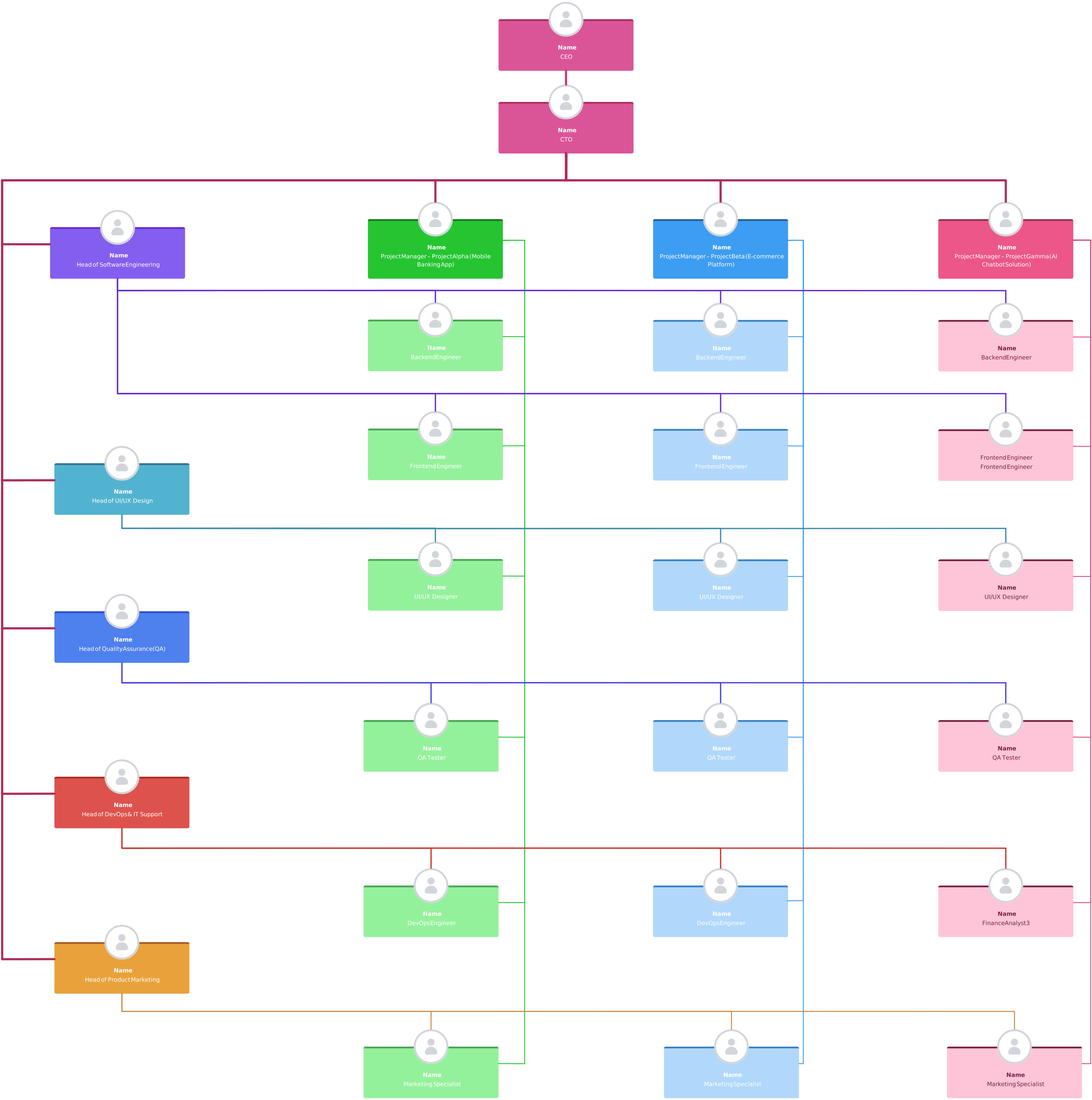
The best way to make sense of this dual reporting setup is with a matrix organizational structure diagram. The chart turns what could feel like a complicated web of responsibilities into a clear, visual map.
What Is a Matrix Organizational Structure Chart?
A matrix organizational structure chart is the visual version of a matrix organization. It shows vertical functions on one side and horizontal projects, products, or client teams on the other, with employees sitting at the intersections. Solid and dotted lines show primary and secondary reporting, so you can instantly see who leads what, who supports which projects, and how teams collaborate across the company. Basically, it turns the complexity of a matrix into a clear, easy-to-follow roadmap.
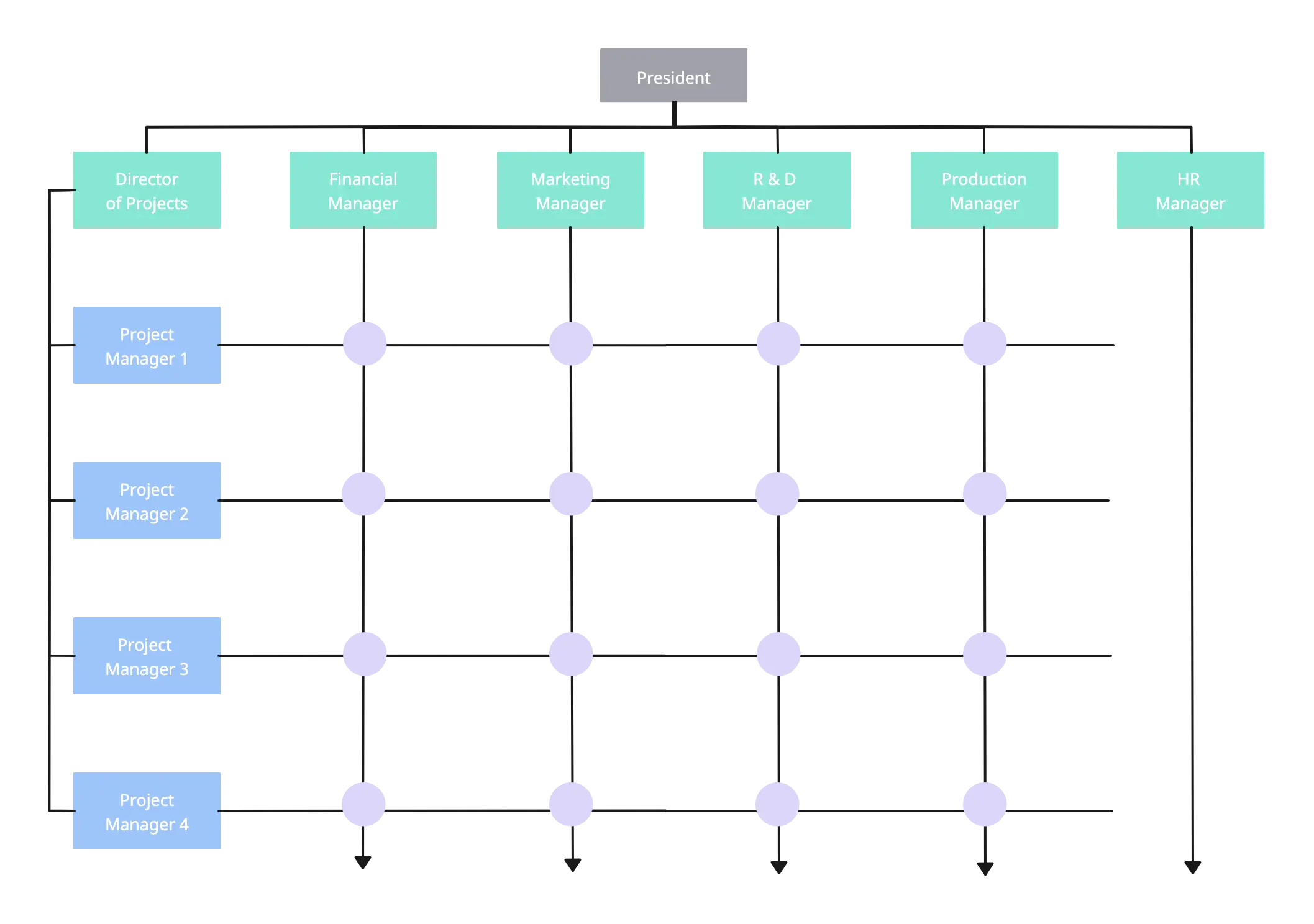
A matrix org chart works best when it clearly shows a few key pieces:
Vertical functions: Departments like marketing, engineering, or finance.
Horizontal projects or products: Initiatives, clients, or product lines that cut across functions.
Dual reporting lines: Solid lines for primary managers, dotted lines for secondary or supporting managers.
Employee intersections: Where team members sit at the crossroads of their function and project.
Swimlanes and visual cues: Keep the chart organized and easy to read.
Decision rights or accountability markers: Optional, but helpful for showing who approves what and who owns which decisions.
Types of Matrix Organizational Structures
Not all matrix setups are the same. Companies pick the type that fits their culture, projects, and how decisions are made. The three main types are:
| Type | Authority Focus | Project Manager Role | Best For | Key Advantage |
| Weak Matrix | Functional manager | Coordinates projects, limited authority | Small projects or when deep expertise is critical | Strong functional oversight |
| Balanced Matrix | Shared between functional and project managers | Shares decision-making and project delivery | Collaborative projects requiring input from multiple functions | Balanced teamwork and resource allocation |
| Strong Matrix | Project manager | Leads project, makes key decisions | Fast-paced or product-focused organizations | Clear project accountability and faster delivery |
How Does a Matrix Organizational Structure Work?
A matrix structure works by giving employees two main lines of focus at the same time, creating a balance between expertise and agility. Here’s how it plays out:
Functional connection: Employees stay part of their department—marketing, engineering, finance, HR—so they can grow skills and maintain deep expertise.
Project or product focus: They also join cross-functional teams to work on projects, products, or client initiatives. This brings diverse skills together for specific goals.
Dual reporting: Employees report to both a functional manager (guides development and resources) and a project manager (drives deadlines and results).
Flexible collaboration: Teams can pull specialists where needed without disrupting the functional structure.
Balanced agility and stability: Functional teams provide structure, projects provide focus, and employees at the intersection make the organization dynamic and adaptable.
This setup can feel tricky at first, but when managed well, it lets organizations move faster, share expertise efficiently, and respond to change without losing stability.
How to Implement a Matrix Organization Structure
Implementing a matrix structure doesn’t have to feel overwhelming. Follow these six clear steps to set it up effectively, and use a matrix organizational chart to make it visual and actionable:
Step 1. Identify functions and teams
List your core departments like marketing, engineering, finance, or HR.
These form the vertical backbone of your matrix and show who manages expertise and resources.
Create an org chart here to map functional teams clearly.
Step 2. Define projects, products, or initiatives
Identify horizontal teams that cut across functions—these could be products, client programs, or strategic projects.
The org chart can visually show which people belong to which projects.
Step 3. Assign dual reporting lines
Decide who employees report to for functional guidance and who they report to for project outcomes.
Use solid and dotted lines on your org chart to make reporting relationships crystal clear.
Step 4. Clarify roles, responsibilities, and decision rights
Use a simple framework like RACI to show who is Responsible, Accountable, Consulted, or Informed.
Highlight these roles on your org chart so everyone knows their responsibilities at a glance.
Step 5. Communicate and pilot
Explain the matrix setup to your teams—why it’s being used and how it benefits them.
Start with one or two projects first, gather feedback, and adjust before scaling.
The org chart can be shared as a living document to help employees visualize the structure during the pilot.
Step 6. Monitor, adjust, and maintain
Track project delivery, resource allocation, and team workload.
Update your matrix org chart regularly to reflect changes in projects, teams, or reporting lines.
This keeps everyone aligned and ensures the structure stays flexible and efficient.
Matrix Structure Examples
Matrix structures are perfect for organizations that need to balance functional expertise with cross-team collaboration. Here are some practical examples to help you understand how they work:
1. Global product company
How it works: Employees belong to their functional departments like engineering, marketing, and finance (vertical teams) but also work on specific product lines (horizontal teams).
Why use a matrix: Specialists can contribute to multiple products without leaving their functional teams. This makes it easier to share expertise across the organization.
2. Consulting or professional services firm
How it works: Functional teams such as analytics, HR, and operations support multiple client projects simultaneously. Each consultant reports to both their functional manager and the project manager for each client.
Why use a matrix: This setup allows consultants to rotate between projects while maintaining growth in their functional specialty.
3. Pharmaceutical company
How it works: R&D, regulatory, and marketing teams (vertical functions) support several research programs or therapeutic areas (horizontal projects). Employees may be part of multiple program teams at once.
Why use a matrix: Combines deep scientific expertise with cross-functional collaboration on drug development, speeding up decision-making and innovation.
4. IT or software development organization
How it works: Teams like UX, engineering, QA, and DevOps (vertical) work across multiple project sprints or software programs (horizontal).
Why use a matrix: Developers and designers can be allocated to the right projects without leaving their functional team, keeping skills sharp while delivering project results efficiently.
5. Marketing and advertising agency
How it works: Creative, strategy, and account management teams (vertical) support multiple client campaigns (horizontal). Staff report to both their functional manager and the client/project manager.
Why use a matrix: Ensures each client gets a fully staffed, cross-functional team without disrupting functional departments.
Key takeaway: In all these cases, a matrix structure allows employees to stay anchored in their functional expertise while contributing to multiple projects, making organizations flexible, efficient, and highly collaborative. A matrix organizational chart is essential here because it visually shows who reports to whom, who works on what, and how resources are shared across projects.
Matrix Organizational Structure Chart Templates
Now that you know what is a matrix structure, here are pre-made matrix organization structure diagram templates to help you quickly map dual reporting lines, cross-functional teams, and project responsibilities.
Cross-Functional Matrix Org Chart
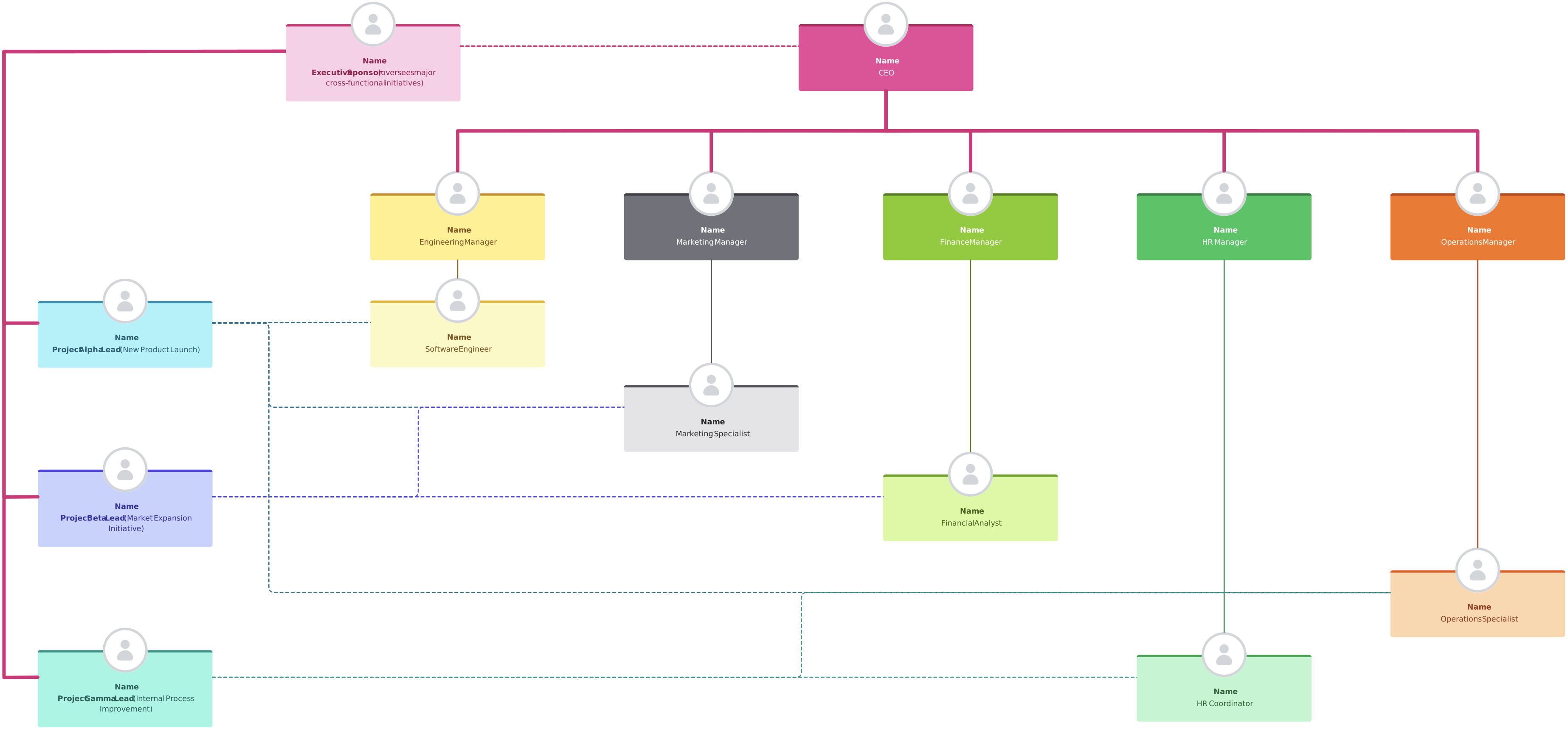

Project-Based Matrix Structure Org Chart
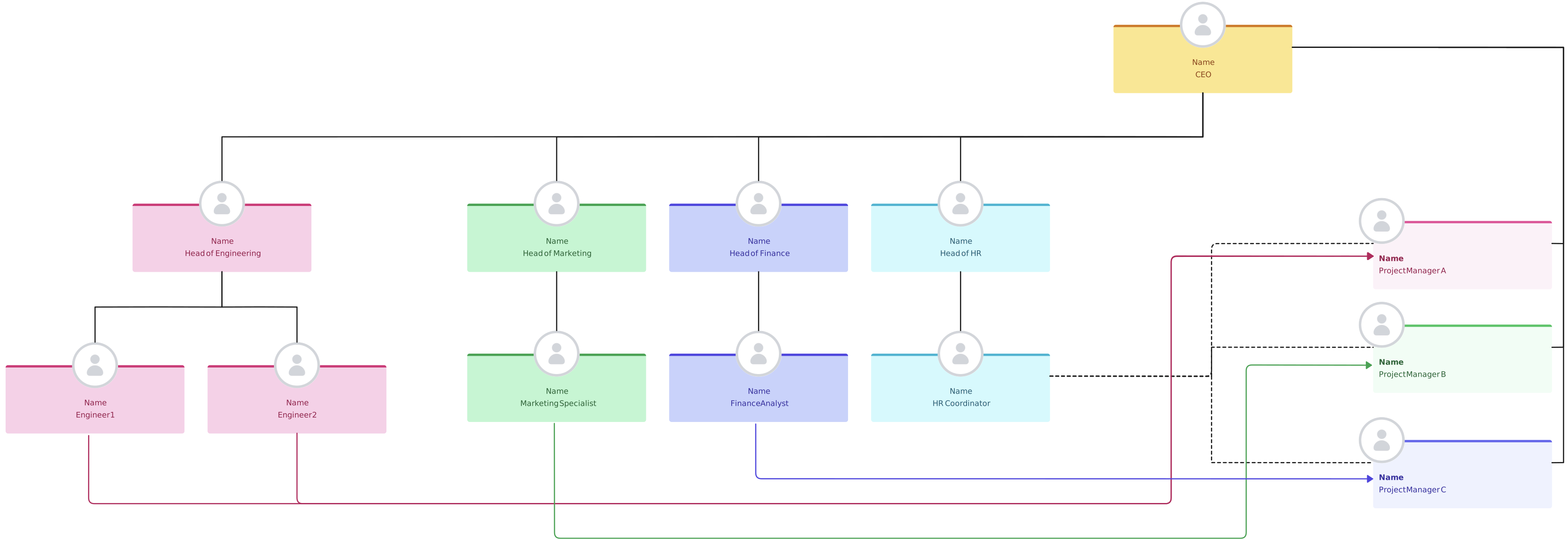
Matrix Structure Org Chart Template
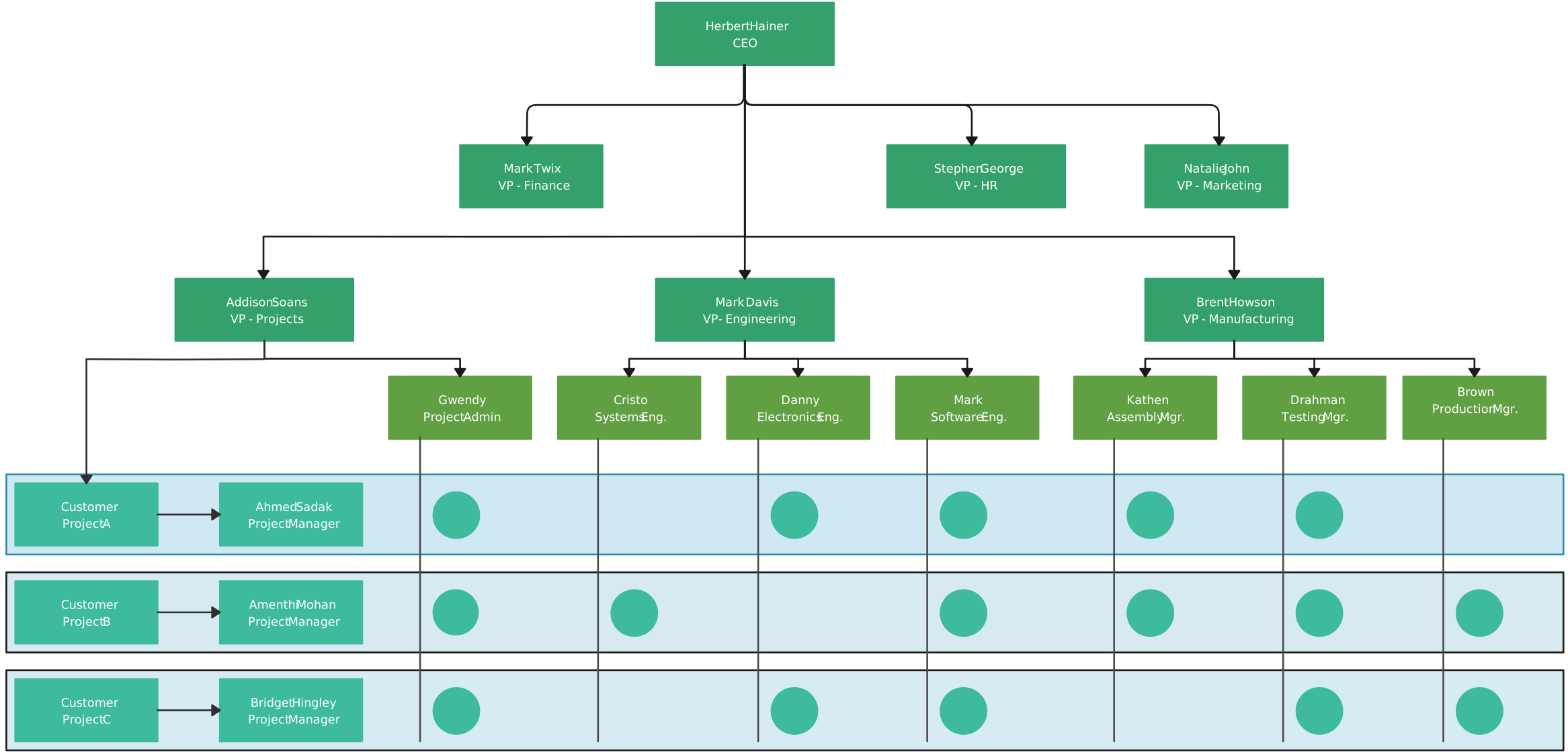
Product-Based Matrix Org Chart
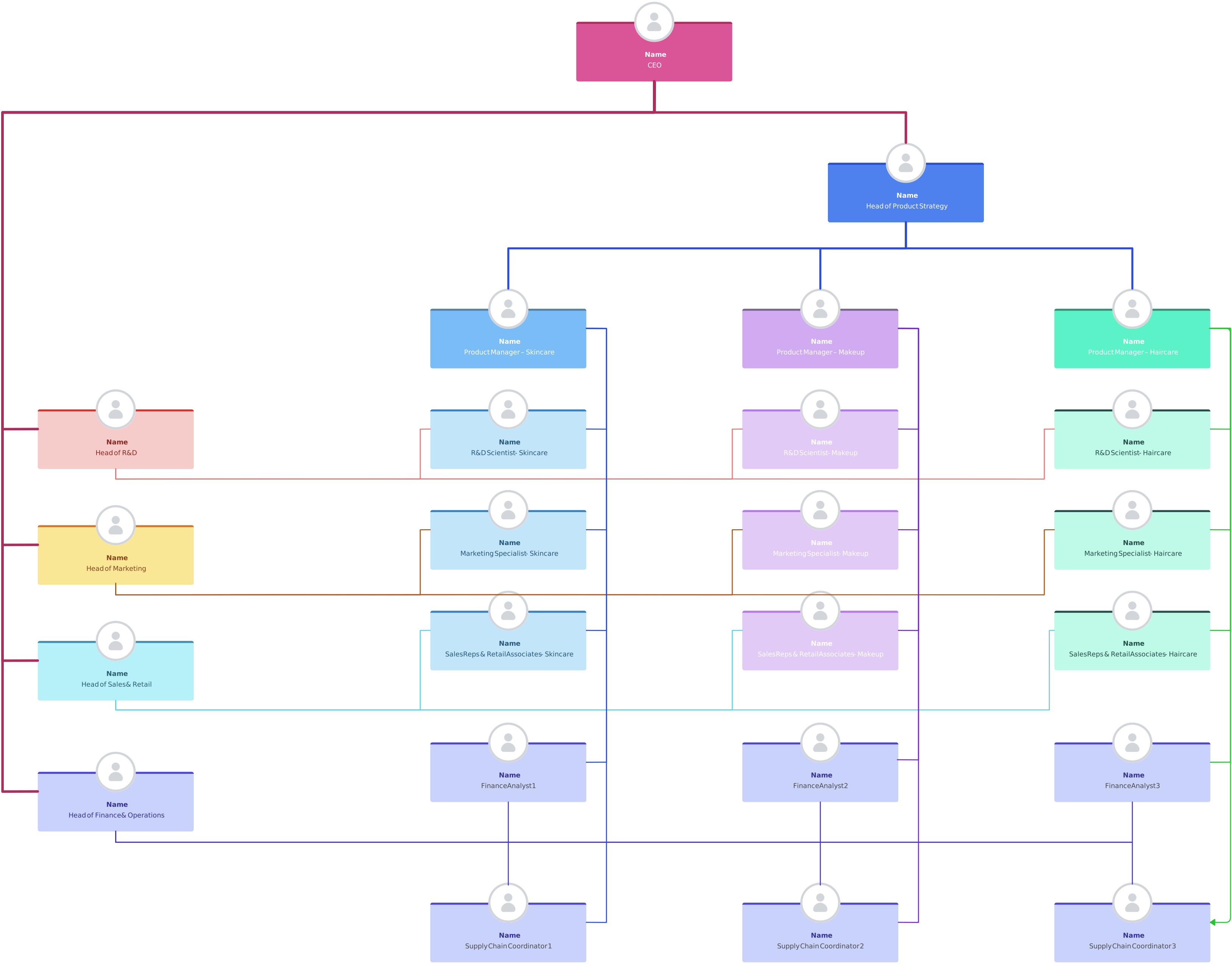
Multi-Project Matrix Org Chart
Helpful Resources
Learn what a product organizational structure is, explore common team models, key roles, pros and cons, and how to build a scalable product org chart.
Project organizational structure explained. Learn types, how to choose the right model, and use pre-made templates to map roles and reporting lines.
A practical guide to geographic organizational structure: pros, cons, free templates, and a step-by-step implementation plan for regional teams.
Learn the difference between functional and divisional organizational structures, with examples, pros & cons, a comparison table and guidance on which to choose.
Team‑based organizational structure: definition, benefits & drawbacks, best practices, and real‑world examples with free templates.
Learn what a hybrid organizational structure is, explore its types and key characteristics, and discover how to implement it effectively with free templates.
Learn what a decentralized organizational structure is, its benefits and drawbacks, real company examples, and steps to implement decentralization in your business.
Advantages and Disadvantages of a Matrix Organizational Structure
| Advantages of Matrix Organizational Structure | Disadvantages of Matrix Organizational Structure |
| Better cross-functional collaboration – Teams from different departments work together, sharing expertise and ideas. | Dual reporting can create confusion – Employees report to two managers, which can lead to conflicting priorities. |
| Efficient use of resources – Specialists can contribute to multiple projects without leaving their functional teams. | Potential conflicts between managers – Functional and project managers may disagree on priorities or workload. |
| Faster adaptation to change – Projects or products can be launched quickly because teams are flexible and cross-functional. | Slower decision-making in some cases – Balancing input from two managers can delay approvals or actions. |
| Employee skill development – Staff gain exposure to multiple projects while maintaining functional expertise. | Workload can become overwhelming – Managing multiple reporting lines and projects may lead to stress or burnout. |
| Balance between stability and agility – Functional teams provide structure, while project teams drive innovation and results. | Performance evaluation can be unclear – Determining accountability and giving feedback may be tricky with dual reporting. |
FAQs About the Matrix Org Structure
What is a matrix organization?
How do matrix organizations work?
When should a company use a matrix organization model?
How does reporting work in a matrix organization?
What does the organizational matrix structure focus on?
What are the main benefits of a matrix team structure?
How do you prevent conflicts in a matrix organizational design?
What’s the difference between a matrix organizational structure and a matrix organizational structure chart?