The main types of organizational structures are hierarchical, flat, functional, divisional, matrix, team-based, network, process-based, line, and circular. The right structure depends on how your organization divides authority, groups teams, makes decisions, and coordinates work.
A hierarchical or functional structure works well when clear reporting lines matter most. Flat and team-based structures support faster collaboration. Divisional structures suit companies organized around products, markets, or regions, while matrix structures help people work across functions. Compare the examples below to find the structure that best matches your organization’s size, operating model, and growth plans.
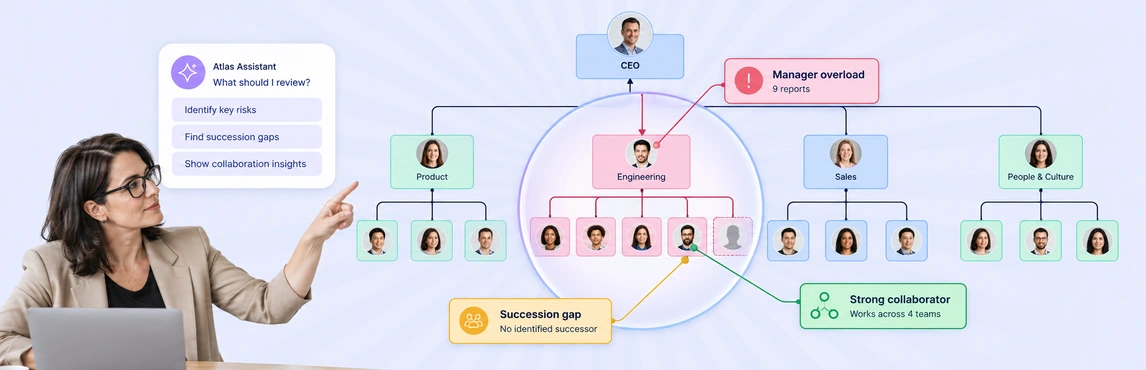
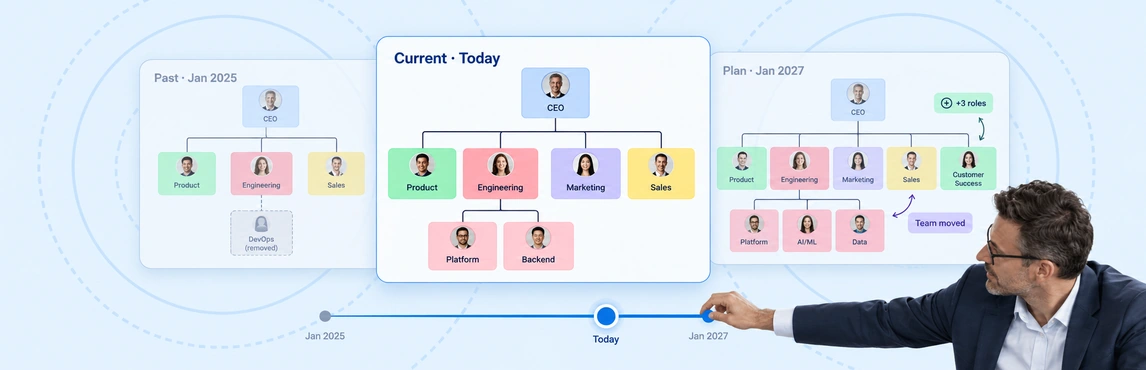
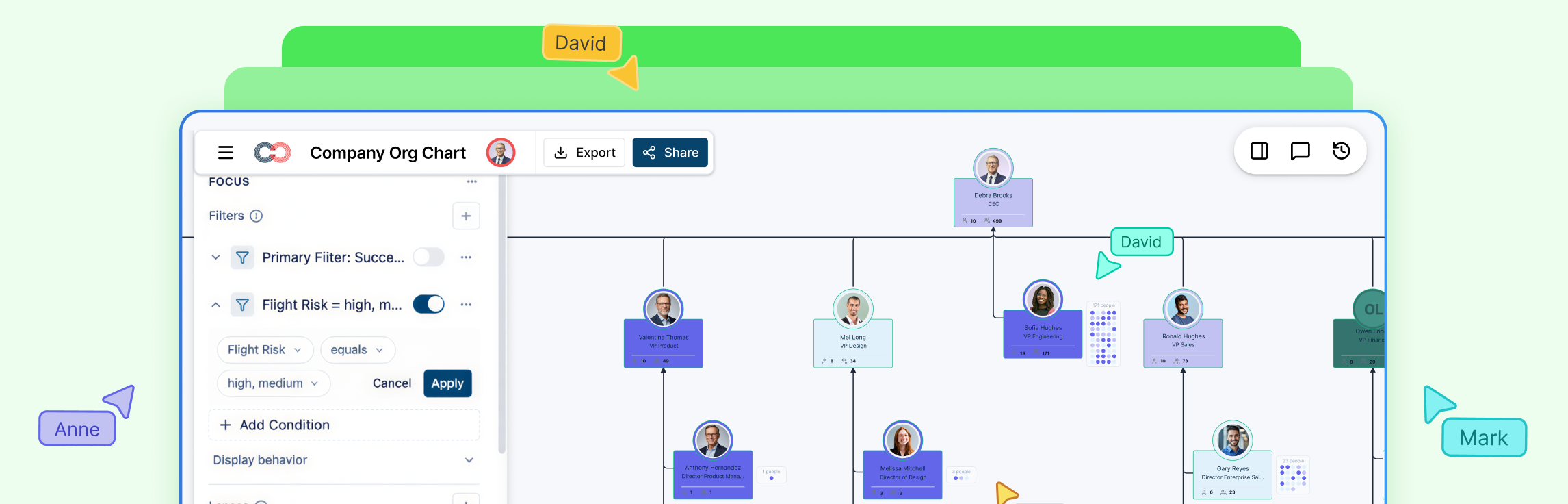
If you are choosing between structures during a reorg, growth phase, or workforce review, treat the org chart as a planning tool instead of a one-time diagram. The structure you choose affects span of control, hiring order, succession coverage, and how easily leaders can compare current and future states before changes go live. In Creately Atlas, teams can compare proposed structures through scenario overlays, retain department and position context, and query reporting chains or direct-report counts before applying a redesign.
What Is an Organizational Chart?
An organizational chart is a visual representation of how a company, team, or department is structured. It helps people quickly understand how the organization is arranged and how different roles connect to each other.
An organizational chart usually shows reporting lines, so it is clear who reports to whom. It can also show how employees are grouped into departments or teams, the different levels of authority across the organization, and cross-functional relationships where people work across teams or have dotted-line reporting connections.
1. Hierarchical Structure Organizational Chart
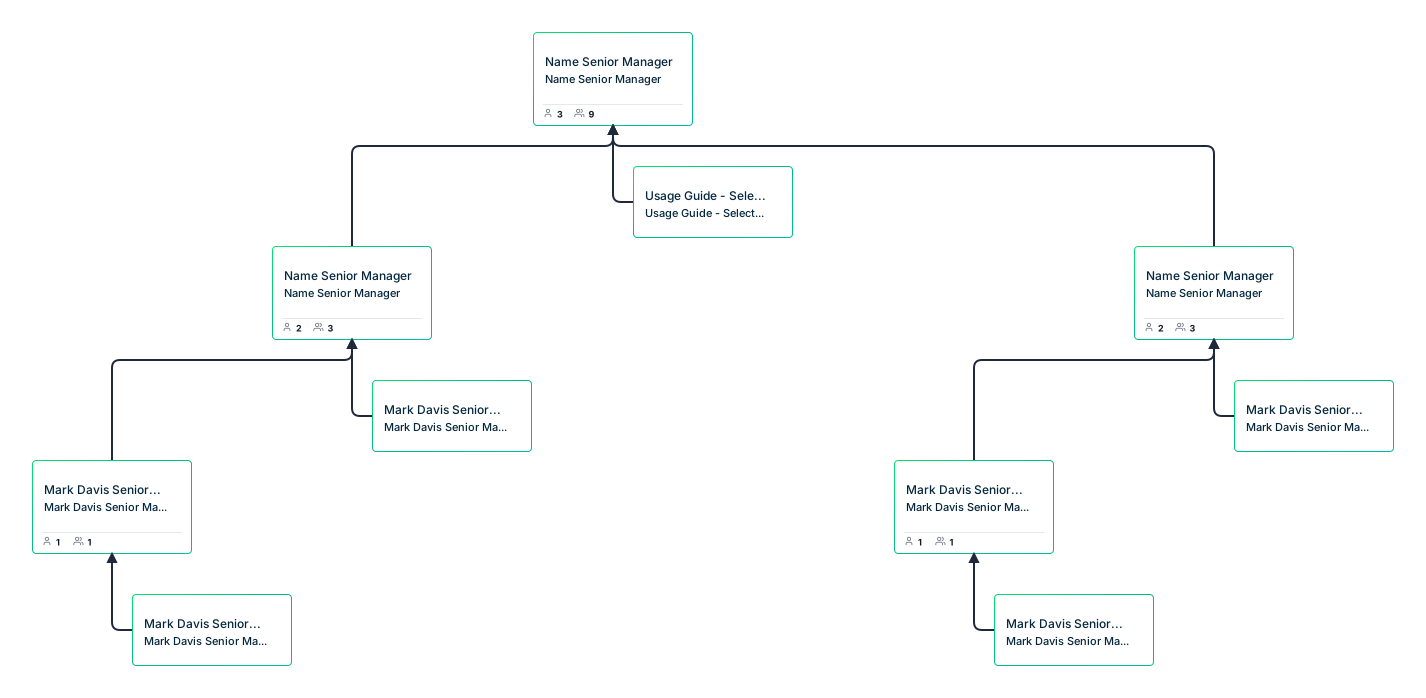
A hierarchical organizational chart shows a traditional top-down structure, where authority flows from senior leadership down through multiple levels of management to individual employees. It is best used when your organization has a formal chain of command, clear reporting levels, and decisions that move through leadership tiers.
What it looks like

Who should use it
This type is best for larger organizations, growing mid-sized companies, government bodies, schools, healthcare organizations, and traditional businesses that need clear reporting lines and defined management responsibilities.
Pros
- Clear chain of command
- Easy to understand and explain
- Strong role and reporting clarity
- Supports accountability at each level
- Works well for structured decision-making
Cons
- Communication can be slower across levels
- Departments can become siloed
- Less flexible in fast-changing environments
- Decisions may depend heavily on top-down approval
2. Flat Organizational Structure Chart
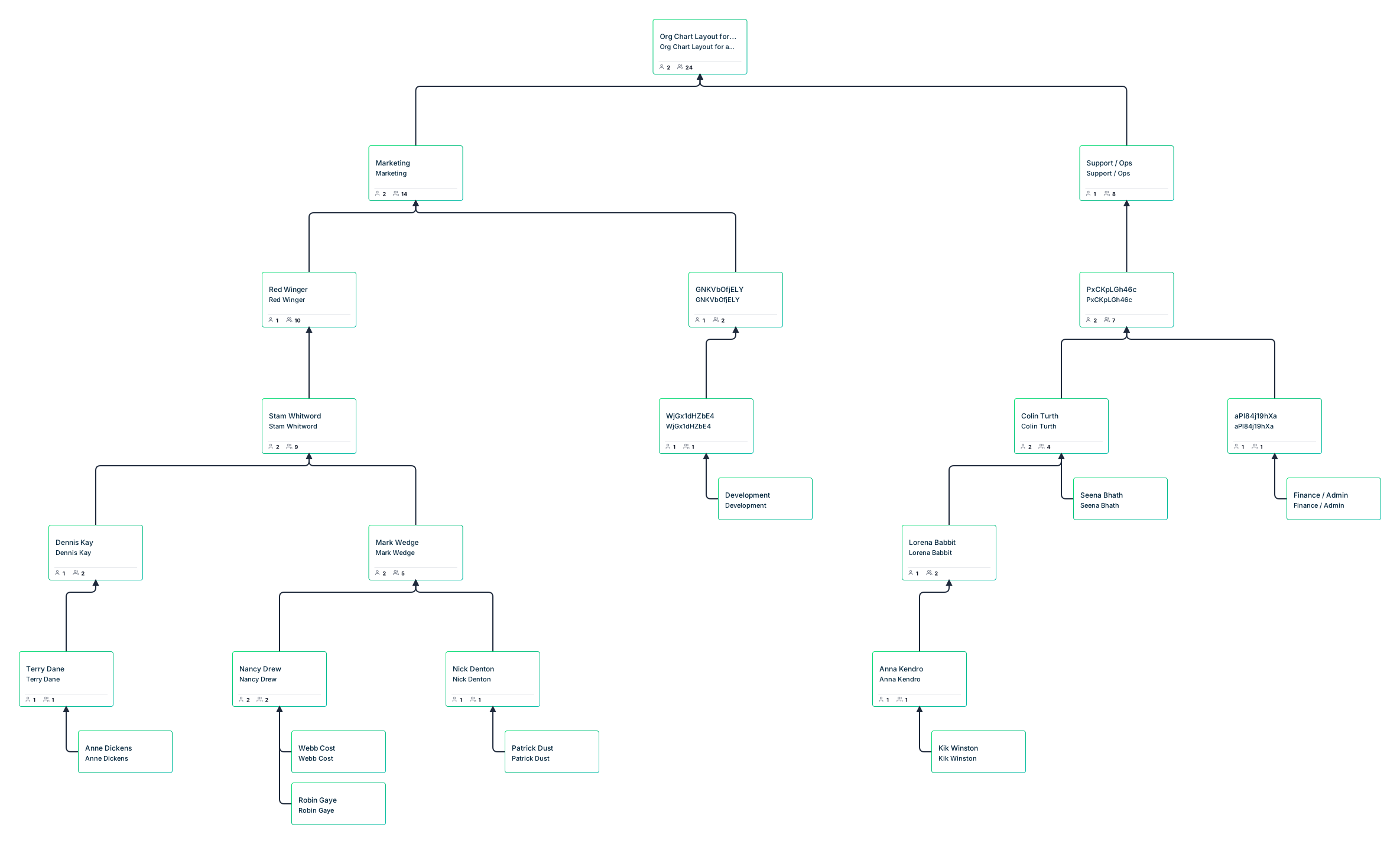
A flat organizational chart shows a structure with very few management layers between leadership and employees. It is best used when the organization wants faster communication, quicker decision-making, and more autonomy across teams instead of a highly layered chain of command.
What it looks like
Who should use it
This type is best for startups, small businesses, creative teams, and fast-moving companies that want to stay agile and keep leadership close to day-to-day work.
Pros
- Faster communication across the organization
- Quicker decision-making
- More employee autonomy and ownership
- Less management overhead
- Encourages a more open work environment
Cons
- Roles and responsibilities can become unclear
- Managers may have too many direct reports
- Can be harder to maintain as the company grows
- Limited advancement layers for employees
- May create confusion without strong coordination
3. Functional Organizational Structure Chart
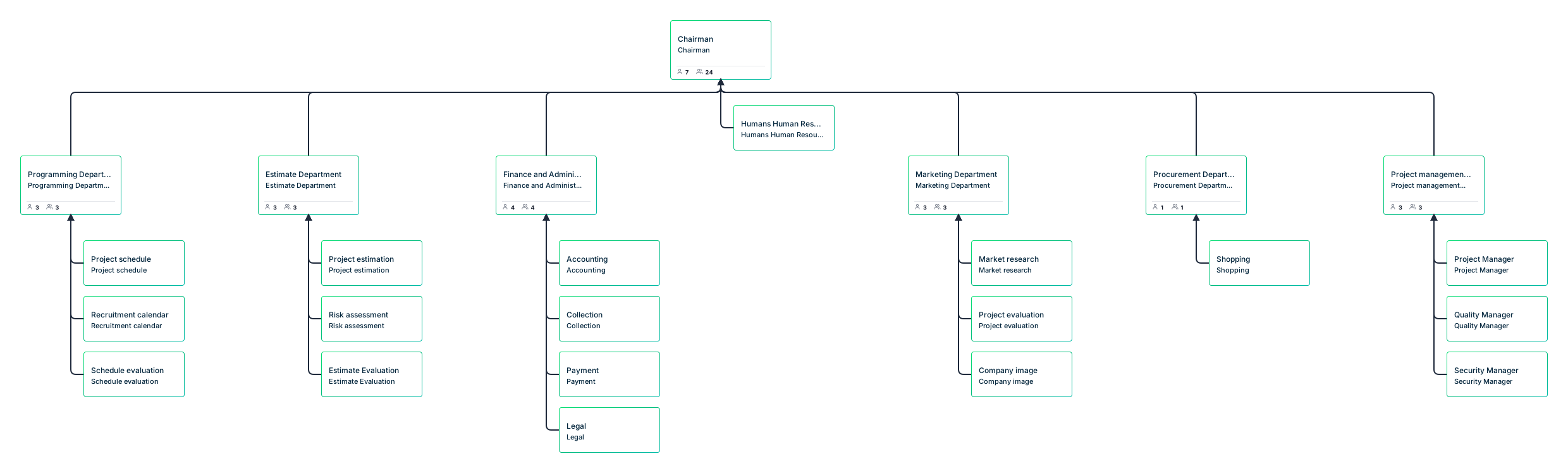
A functional organizational chart groups employees by department or area of expertise, such as marketing, sales, finance, HR, or operations. It is best used when the organization wants clear departmental ownership, specialized roles, and efficient management within each function.
What it looks like
Who should use it
This type is best for growing companies, mid-sized businesses, and larger organizations that rely on specialized teams and want to improve efficiency within each department.
Pros
- Builds strong expertise within functions
- Clear roles and responsibilities
- Improves efficiency and consistency
- Makes team management easier within departments
- Supports standardized processes
Cons
- Can create silos between departments
- Cross-functional collaboration may be slower
- Teams may focus more on department goals than company-wide outcomes
- Decision-making across functions can take longer
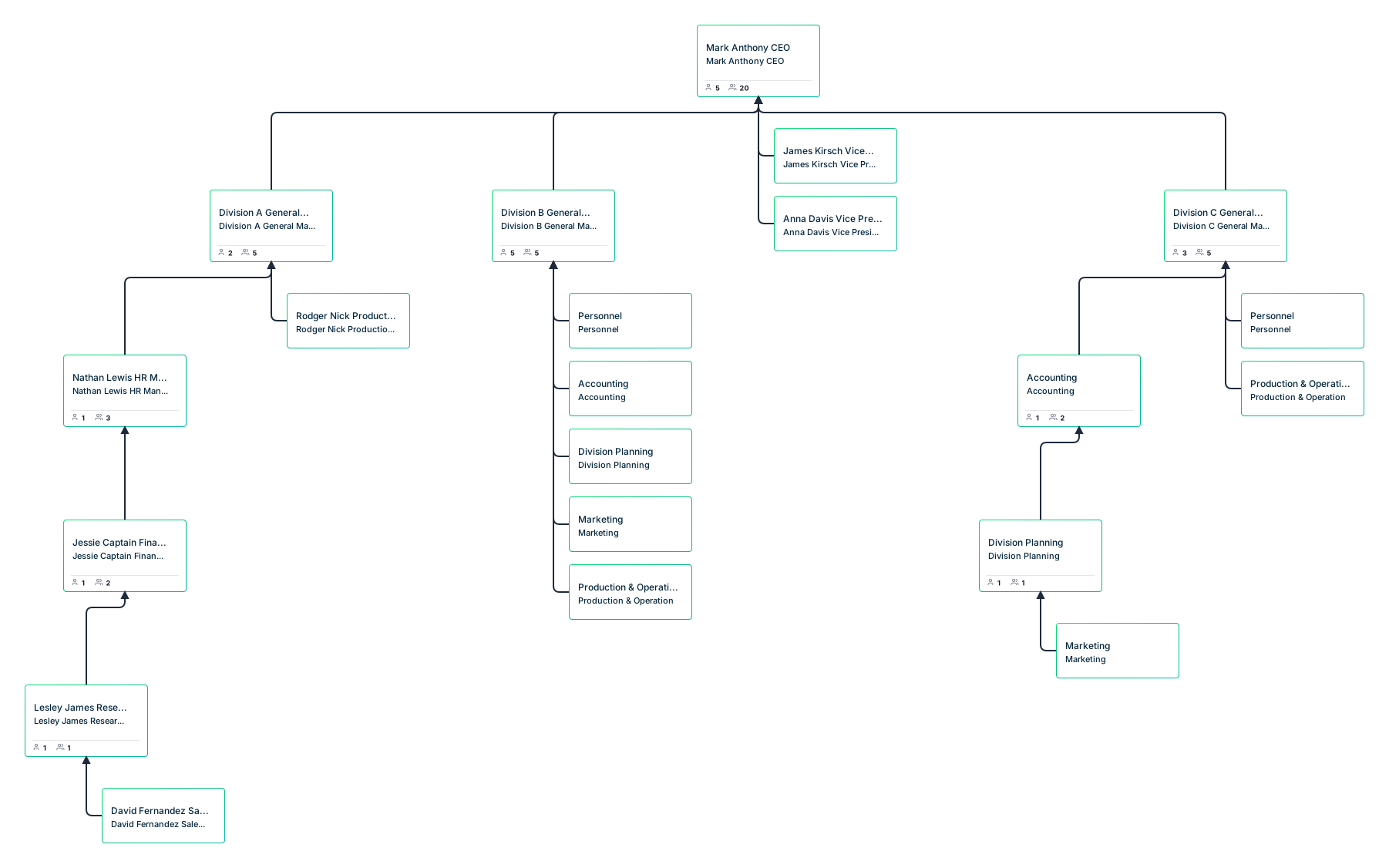
4. Divisional Organizational Structure Chart
A divisional organizational chart groups employees around a product line, region, service line, or customer segment instead of organizing everyone under one central functional structure. Common variations include product-based, geographic, and market-based divisional structures. It is best used when different parts of the business need their own leadership, resources, and faster decision-making to operate effectively.
What it looks like
Who should use it
This type is best for larger companies, multi-product businesses, regional organizations, and enterprises serving different customer groups or markets.
Pros
- Gives each division clearer ownership and accountability
- Supports faster decisions closer to the market or product
- Helps teams stay focused on specific customer or business needs
- Makes it easier to manage growth across products, regions, or segments
- Improves flexibility compared to a fully centralized structure
Cons
- Can duplicate roles across divisions
- Often increases management and operating costs
- Divisions may become siloed from one another
- Coordination across the business can become more difficult
- May lead to inconsistent processes between divisions
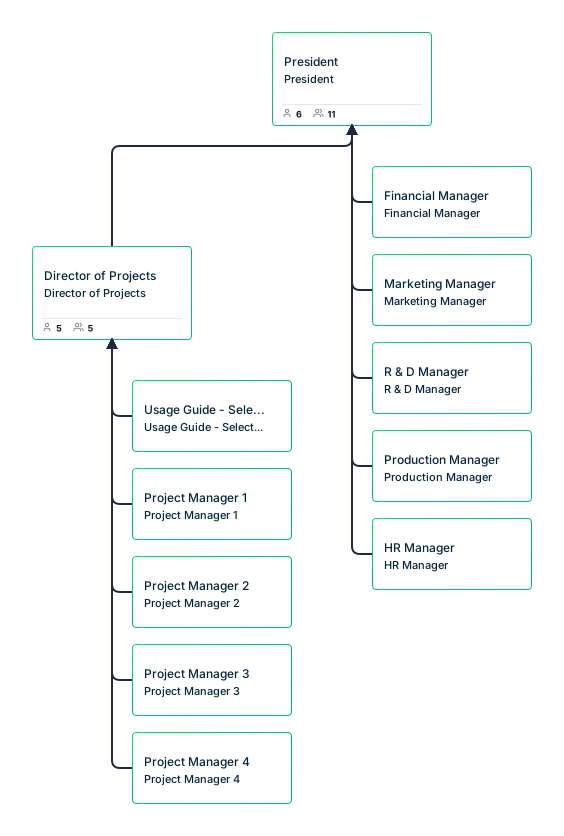
5. Matrix Organizational Structure Chart
A matrix organizational chart shows employees reporting to more than one leader, usually a functional manager and a project, product, or regional manager. It is best used when people need to work across departments and teams at the same time, while still keeping their functional expertise connected to the wider organization.
What it looks like
Who should use it
This type is best for larger organizations, project-driven companies, global businesses, and cross-functional teams that need to share talent and collaborate across multiple priorities.
Pros
- Supports cross-functional collaboration
- Makes better use of specialized talent
- Helps teams stay flexible across projects or business needs
- Balances functional expertise with delivery needs
- Works well for complex organizations with shared resources
Cons
- Reporting lines can be confusing
- Employees may receive conflicting priorities
- Accountability can become less clear
- Requires strong communication and coordination
- Can slow decisions if roles and authority are not clearly defined
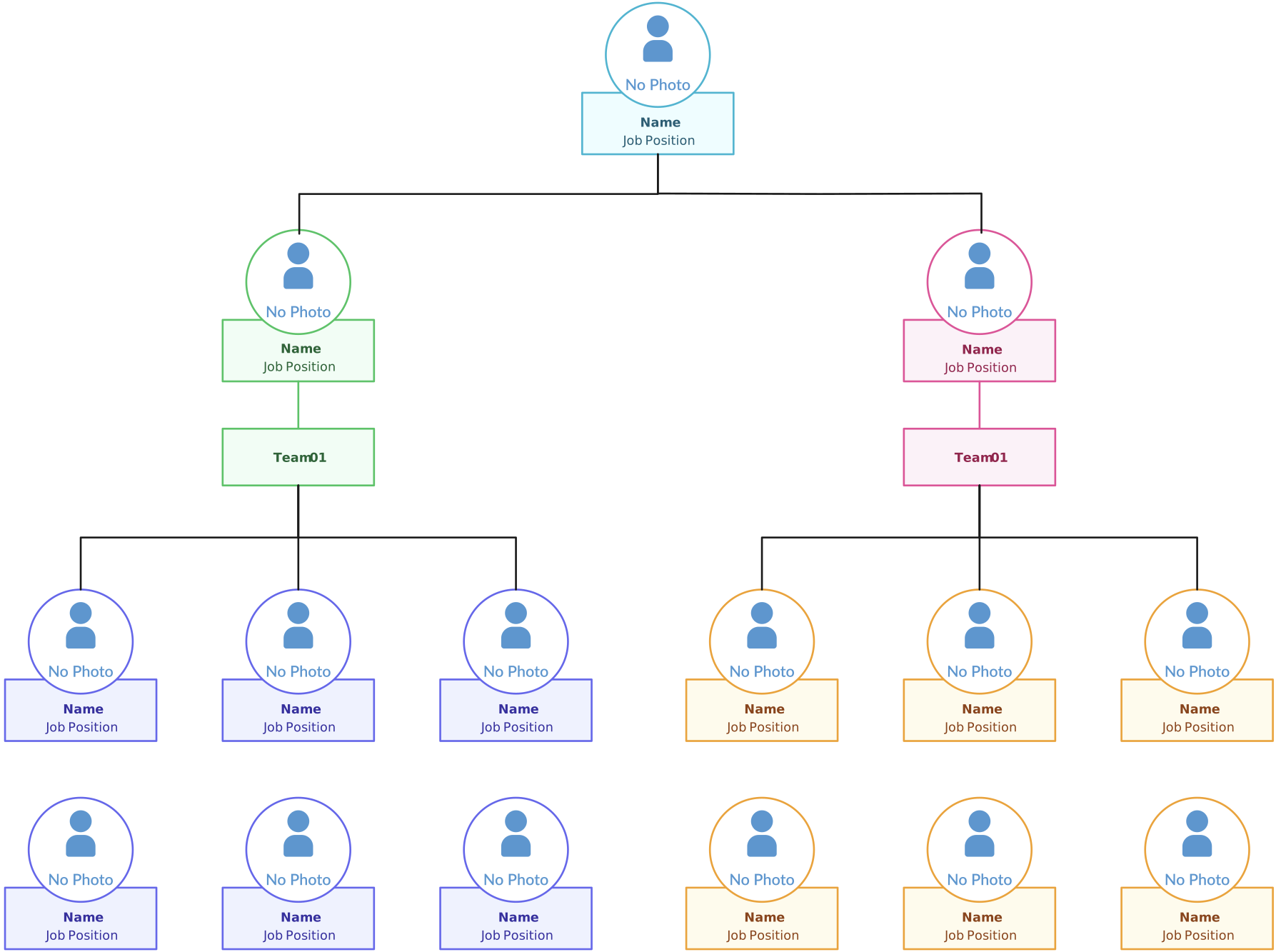
6. Team-Based Organizational Structure
A team-based organizational chart groups people around cross-functional teams, squads, or pods instead of relying mainly on traditional departments. It is best used when the organization wants teams from different functions to work closely together around shared goals, products, projects, or customer outcomes.
What it looks like
Who should use it
This type is best for agile organizations, product-led companies, innovation teams, and businesses that depend on close collaboration across functions.
Pros
- Encourages stronger cross-functional collaboration
- Aligns teams around outcomes instead of departments
- Improves flexibility and responsiveness
- Supports faster problem-solving and delivery
- Helps reduce functional silos
Cons
- Team boundaries can be less clear
- Functional oversight may weaken over time
- Coordination across multiple teams can be challenging
- Roles may overlap if responsibilities are not clearly defined
- Can become harder to manage as the organization scales
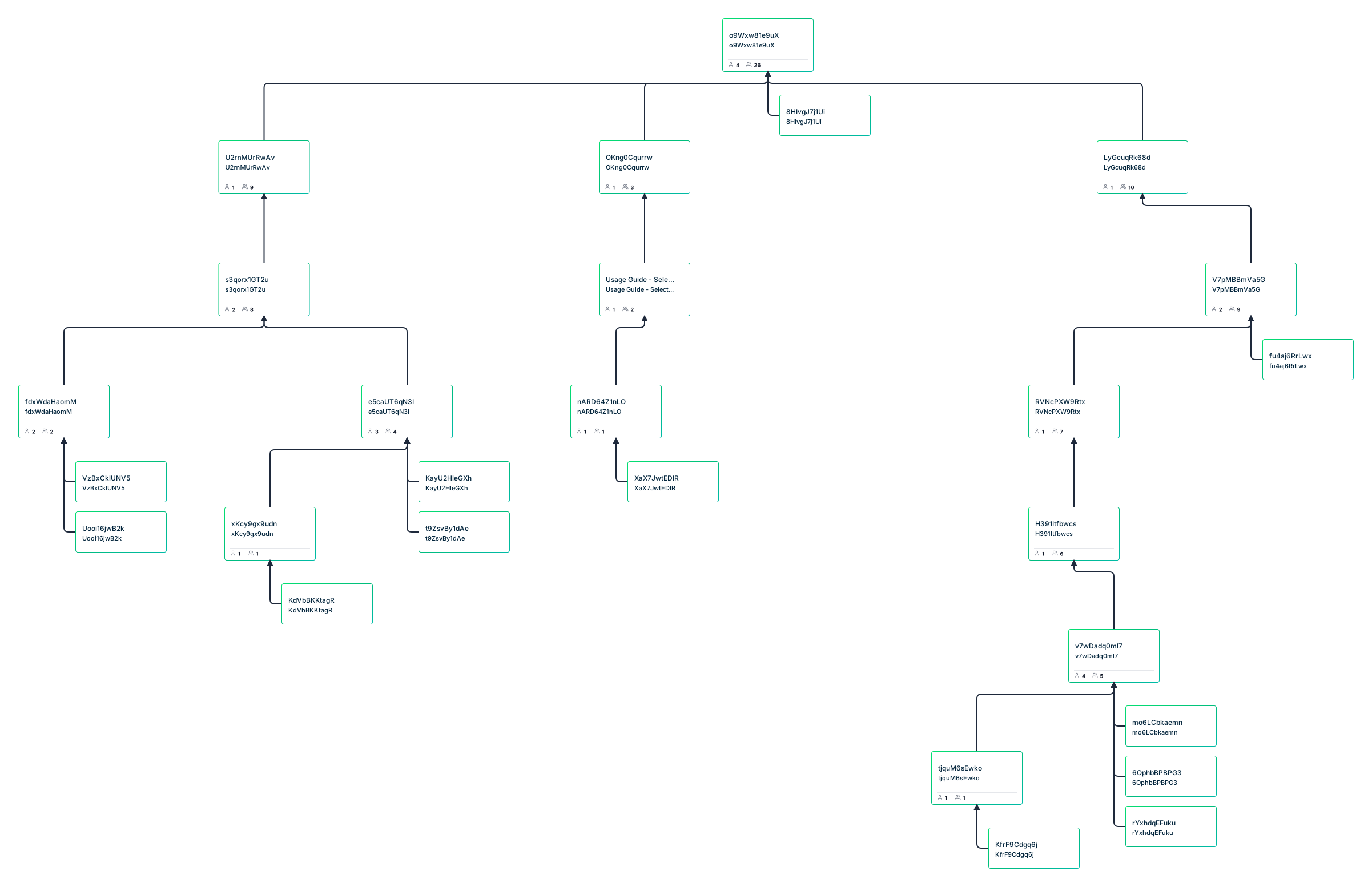
7. Network Organizational Structure
A network organizational chart shows how internal teams connect with external partners such as contractors, vendors, consultants, agencies, or outsourced service providers. It is best used when the organization relies on a mix of in-house teams and outside support to deliver work.
What it looks like
Who should use it
This type is best for distributed organizations, companies that outsource key functions, partner-led businesses, and organizations that work across multiple entities or external collaborators.
Pros
- Reflects how modern, distributed businesses actually operate
- Shows both internal and external dependencies clearly
- Supports flexibility and scalability
- Helps visualize collaboration across partners and providers
- Useful for businesses with outsourced or decentralized operations
Cons
- Can become visually complex
- Reporting lines and authority may be less clear
- Harder to maintain as partnerships change
- Coordination across internal and external groups can take more effort
- Not ideal for organizations with a strict traditional hierarchy
8. Process-Based Organizational Structure
A process-based organizational chart groups people and teams around core workflows or value streams instead of traditional departments. It is best used when the organization wants to improve how work moves across functions, reduce handoff delays, and align teams around end-to-end processes such as product development, order fulfillment, or customer service.
What it looks like
Who should use it
This type is best for operations-focused businesses, manufacturing companies, service organizations, and teams that want to improve efficiency across end-to-end workflows.
Pros
- Makes workflows and handoffs easier to understand
- Helps teams focus on end-to-end outcomes
- Reduces bottlenecks between departments
- Improves coordination across functions
- Supports process improvement and operational efficiency
Cons
- Can be harder to map than traditional department structures
- Roles may overlap across processes
- Requires strong coordination and clear ownership
- May be unfamiliar to teams used to functional hierarchies
- Can be difficult to maintain if processes change often
9. Line Organizational Structure
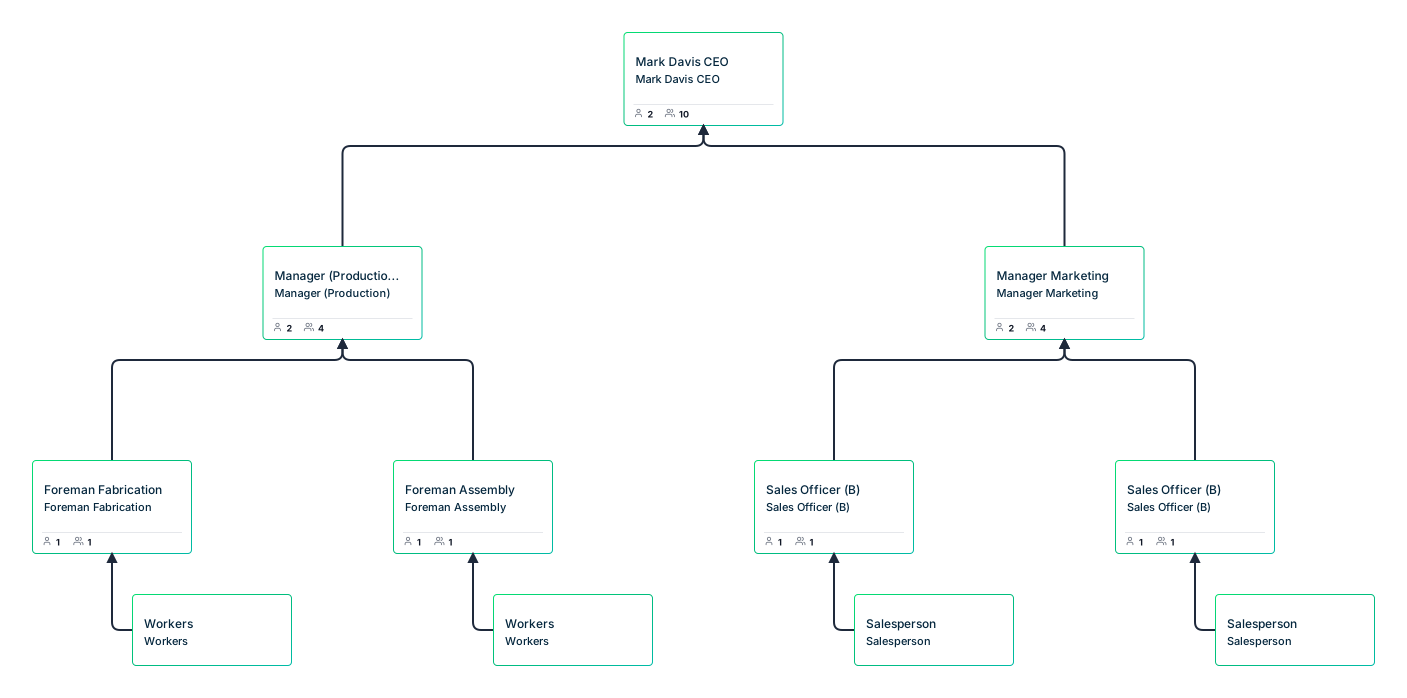
A line organizational chart shows a simple, direct chain of command where authority flows vertically from top management to frontline employees. Each person reports to only one manager, which makes responsibility and supervision easy to follow. It is best used when the organization needs clear control, straightforward reporting, and quick decisions within a stable operating environment.
What it looks like
Who should use it
This type is best for small businesses, traditional organizations, factory or operations teams, and environments where discipline, supervision, and clearly defined authority matter more than cross-functional flexibility. It is also more suitable for simpler organizations than for large, highly specialized companies.
Pros
- Clear authority and accountability
- Simple to understand and manage
- Faster communication along the chain of command
- Supports discipline and direct supervision
Cons
- Limited flexibility
- Weak cross-functional collaboration
- Managers can become overloaded because control is concentrated vertically
- Less suitable for complex or rapidly changing organizations
10. Circular Organizational Structure Chart
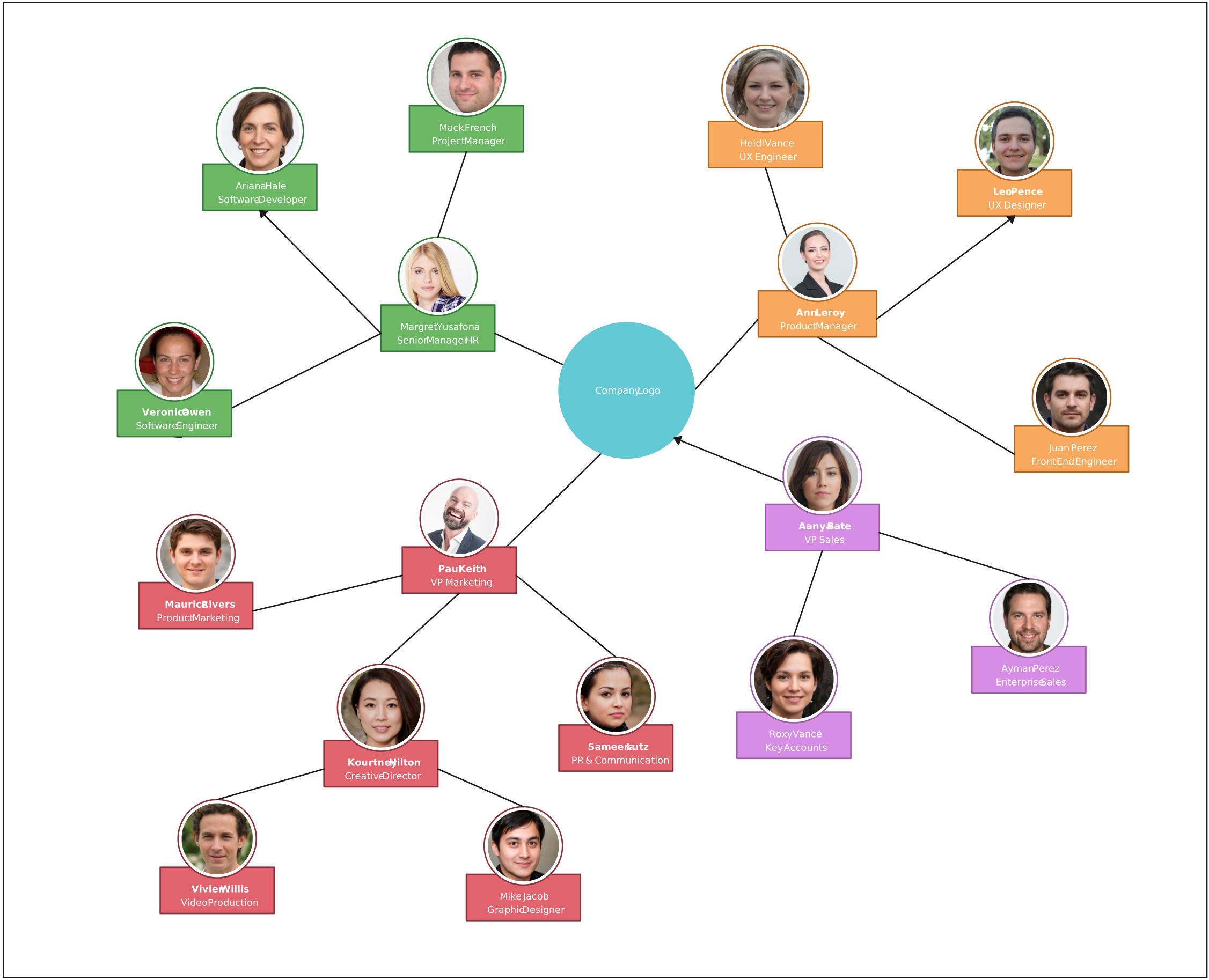
A circular organizational chart presents the organization in concentric circles rather than a top-down pyramid. Leadership is usually placed at the center, with managers and employees arranged in outer rings. It is best used when the organization wants to show structure while also emphasizing collaboration, communication, and a more connected flow of leadership across teams.
What it looks like
Who should use it
This type is best for organizations that want to communicate a more collaborative culture, such as innovation-focused companies, creative businesses, modern service organizations, or teams that want a less rigid visual alternative to a traditional org chart. It is more common as a communication and culture tool than as a standard core structure.
Pros
- Emphasizes collaboration and connection across teams
- Presents leadership as central and supportive rather than only top-down
- Offers a more modern visual alternative to a traditional pyramid chart
- Can help reinforce an inclusive or people-centered culture message
Cons
- Reporting lines can be less obvious at a glance than in a standard hierarchical chart
- Can be harder to read and scale in large or complex organizations
- Less familiar to most readers than traditional org chart formats
- It is not one of the most commonly used core structure types in mainstream management teaching, so it may work better as a visual variation than as the main structure model for most businesses.
Additional Resources
Learn how hierarchical structure org charts work and when a top-down reporting model is the right fit.
Explore how flat organizations can still use org charts to improve clarity, communication, and accountability.
Compare functional and divisional structures to understand when each organizational model works best.
Understand how matrix organizational structures work, including dual reporting lines and cross-functional coordination.
See how team-based organizational structures support squads, pods, and cross-functional collaboration.
Learn how network organizational structures show the relationship between internal teams and external partners.
Explore how process-based organizational structures align teams around workflows and end-to-end value streams.
Learn how a line organizational structure works with direct supervision and a simple chain of command.
See how circular organization structures present leadership and teams in a more connected, collaborative visual model.
How to Choose the Right Organizational Chart
Choosing the right organizational structure types depends on how your business works today and how it is likely to grow. The best fit is the one that gives you the right balance of clarity, collaboration, speed, and scalability. Here’s how to choose different types of organizational structures.
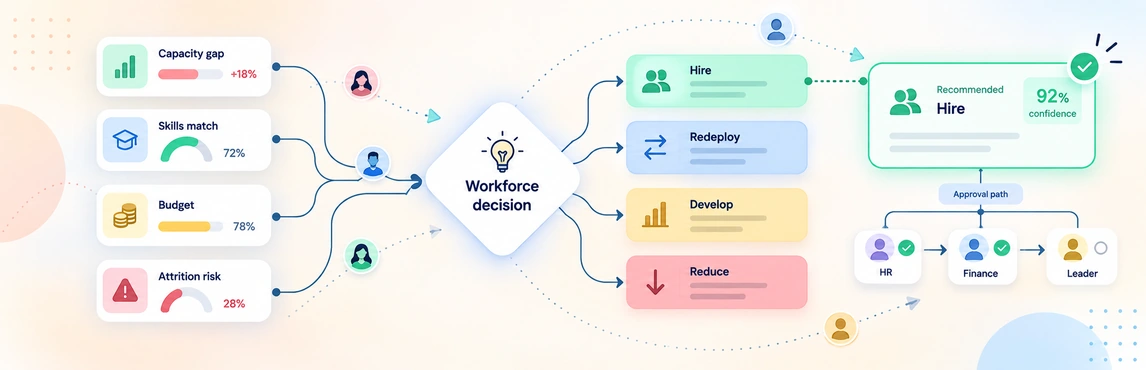
Once you choose a structure, HR can turn it into an operating plan by connecting reporting lines, proposed roles, and approved openings. See how HR teams use org charts for workforce planning and hiring alignment to keep recruiting priorities tied to the future organization. This becomes especially useful once that conversation becomes ongoing, because the same structure model can hold current-state views, future-state scenarios, and department-level planning context in one place.
| Company Stage or Model | What the Organization Usually Needs | Organizational Chart Types That Often Fit |
|---|---|---|
| Startups (0–20 employees) | Speed, flexibility, broad roles, minimal hierarchy | Flat, Team-Based, Circular |
| Scaling companies (20–200 employees) | Clear ownership, specialization, stronger coordination | Functional, Divisional, Hierarchical |
| Larger organizations (200+ employees) | Governance, reporting clarity, support for multiple teams, products, or markets | Hierarchical, Divisional, Matrix, Hybrid |
| Remote or hybrid teams | Visibility, accountability, and clearer collaboration across locations | Matrix, Network, Hybrid |
| Project-driven organizations | Clear project ownership, flexible staffing, cross-functional delivery | Project-Based, Matrix, Team-Based |
| Operations-focused organizations | Better handoffs, workflow visibility, and process efficiency | Process-Based, Functional, Line |
| Traditional or highly controlled environments | Direct supervision, clear authority, and simple reporting lines | Line, Hierarchical |
| Collaboration-focused or culture-led organizations | A structure that communicates openness, connection, and shared purpose | Circular, Team-Based, Network |