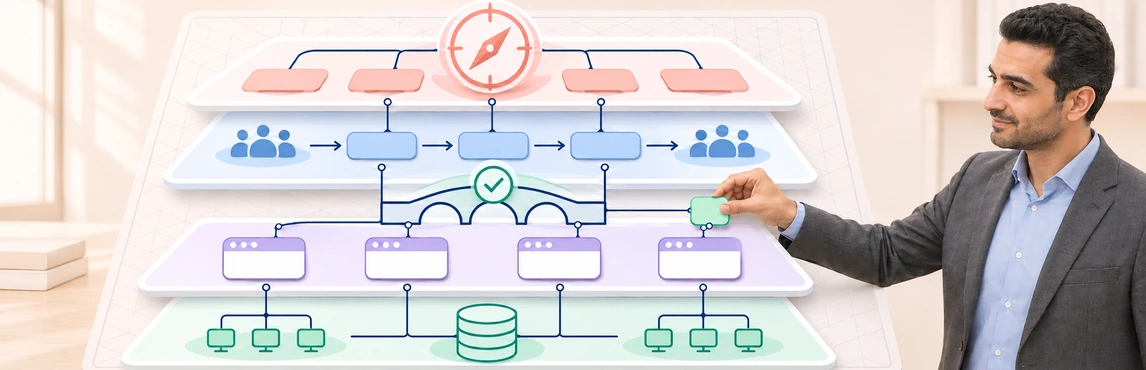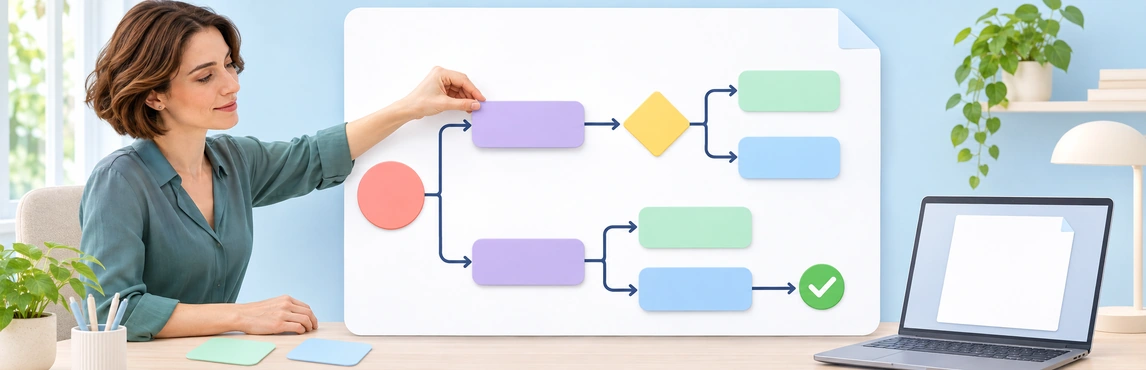
“Grow the business” is an ambition. “Launch three campaigns” is a list of activities. Neither tells a team which customers to serve, what value to offer them, or what work to decline. A strategy makes those choices explicit so people can make consistent decisions as circumstances change.
This guide explains what strategy is, how it differs from goals, tactics, plans, and roadmaps, and how to connect the choices to measurable execution. A running example shows how a team can move from evidence to a practical course of action.
What Is Strategy?
Strategy is a set of connected choices about how to reach an important outcome with limited resources. In a business, it usually clarifies who the organization will serve, what value it will create, how it will do so differently or better, and what it will prioritize over other options. A useful strategy also makes its assumptions visible: what must be true about customers, capabilities, costs, or the market for the choices to work?
Strategy is more specific than a vision such as “make work easier,” but broader than a quarterly task list. It provides a reason for choosing some activities and declining others. The same idea applies beyond competitive businesses: a nonprofit or public team can make deliberate choices about which people to support, which outcomes matter most, and how to use scarce capacity.
The three common levels are organization strategy (overall scope and priorities), business strategy (how a product or service creates value for its chosen audience), and functional strategy (how teams such as operations or marketing contribute). Those levels should reinforce one another rather than produce unrelated plans.
How Strategy Connects to Goals, Tactics, Plans, and Roadmaps
These terms describe different parts of the same decision chain. Confusing them can make a busy team appear aligned while its work points in different directions.
| Term | Question it answers | Example for a software company |
|---|---|---|
| Vision | What future are we working toward? | Small service teams can deliver dependable support without adding administrative work. |
| Goal | What result do we want? | Improve renewal among small service teams. |
| Strategy | Where will we focus, how will we create value, and what will we decline? | Focus on small service teams and win through faster setup and clearer support workflows, rather than adding features for every market. |
| Tactic | What specific action will we take? | Run guided onboarding sessions for new customers. |
| Plan | Who will do what, with which resources, and by when? | Assign the onboarding redesign, budget, owner, and delivery dates. |
| Roadmap | In what broad sequence will major changes happen? | First simplify setup, then improve support handoffs, then expand self-service help. |
| Execution | Are we delivering and learning? | Launch the changes, monitor renewal and setup time, and adjust the work. |
The distinctions are useful, but the parts remain connected. A tactic should advance a strategic choice; a roadmap should sequence the work required by that choice. For a deeper comparison, see strategy versus tactics and strategy versus a plan.
What Makes a Strategy Useful?
A practical strategy has five qualities:
- A defined audience and outcome. The team knows whom it serves and what change it seeks.
- A clear choice. It names a focus and a tradeoff. “Serve everyone better” does not decide much.
- A reason the choice could work. Customer evidence, a distinctive capability, or an unmet need supports the decision.
- Resource alignment. People, time, and investment follow the chosen direction.
- A way to learn. Measures and review points reveal whether the assumptions are holding.
A long document is optional. A concise statement that guides difficult decisions is more useful than a polished presentation no one uses. Strategic goals translate the direction into results, while the strategy explains why the chosen path is likely to reach them.
A Strategy Example: Improving Customer Retention
Imagine a software company that sells scheduling tools to both small service teams and large enterprises. Renewal is falling among small teams. Interviews show that these customers value a quick setup and dependable handoffs more than a wider feature set. The company has limited development capacity.
Its goal is to improve renewal among small service teams. Its strategy is to concentrate on that segment, simplify onboarding and handoffs, and pause enterprise-specific feature requests for this cycle. The tradeoff is explicit: some potential enterprise sales may wait while the company strengthens the experience for its chosen audience.
The team then tests that choice. Its product group simplifies setup, support maps recurring handoff failures, and marketing updates promises to match the experience. An outcome measure could be the renewal rate for that segment; supporting measures could include setup completion and time to resolve support requests. If these measures do not improve, the team revisits the assumptions before funding more of the same work.
A strategy map can show the proposed cause-and-effect chain: better onboarding capability → faster setup → stronger customer experience → higher renewal. The arrows are hypotheses to test, not proof of causation. This editable Creately template provides a starting structure for that conversation.


How to Build a Strategy Step by Step
1. Define the decision and gather evidence
Write the decision you need to make: which customer group to prioritize, which service to improve, or which market to enter. Gather evidence that could change that decision. A SWOT analysis organizes internal strengths and weaknesses alongside opportunities and threats; a PESTLE analysis surfaces wider external conditions.
Customer interviews, financial results, and operational data still matter. A framework helps organize evidence; it does not make the choice for you.
Use this SWOT template to separate a company’s capabilities from market conditions. In the example above, quick implementation support may be a strength, while pressure to build too many enterprise features may be a weakness or constraint.

2. Make a choice and state the tradeoff
Describe the audience, value proposition, and focus in plain language. Add what the team will not pursue for now. If every opportunity remains a priority, the statement cannot guide spending or scheduling. Check that the choice is plausible given the organization’s resources and constraints.
3. Link the choice to outcomes
Draw the few changes that must happen for the choice to succeed. A strategy map helps connect capabilities, processes, customer outcomes, and final results. Turn the most important results into measures; OKRs can express the desired outcome and measurable key results. Avoid treating a completed activity, such as “publish a help page,” as evidence that the customer outcome improved.
4. Sequence initiatives and assign owners
Choose initiatives that could change the measures and place them in a roadmap. Show dependencies and major checkpoints, then create a more detailed plan for owners, resources, and delivery dates. The roadmap communicates sequence; it should not become an exhaustive task list.
5. Review the evidence and adjust
Agree on when to review outcomes and the assumptions behind the strategy. If the chosen customers do not value the improvement, revisit the strategy. If the direction still makes sense but a project is late, change the plan or tactic.
This distinction prevents a delivery issue from being mistaken for a failed strategic choice. It also prevents teams from defending an outdated strategy just because projects are on schedule. The strategy cascade guide explains how to connect these choices to team objectives and operating reviews.
Use Creately to Make the Strategy Visible
Creately’s strategic planning workspace brings frameworks, diagrams, and team discussion onto a shared canvas. A team can place its evidence in a SWOT or PESTLE view, show the chosen logic in a strategy map, and then connect measurable objectives with a roadmap. The diagrams make assumptions and dependencies easier to inspect together; leaders still need to validate the evidence and make the tradeoffs.
Strategy Planning Templates for the Next Steps
The SWOT and strategy-map templates above support analysis and strategic choices. Use these different templates to examine external factors, make outcomes measurable, and sequence the work that follows.


Explore Strategy Planning in More Detail
See how specific actions support a broader strategic choice.
Learn how to connect objectives and test the logic behind them.
Compare tools for analysis, choices, and execution.