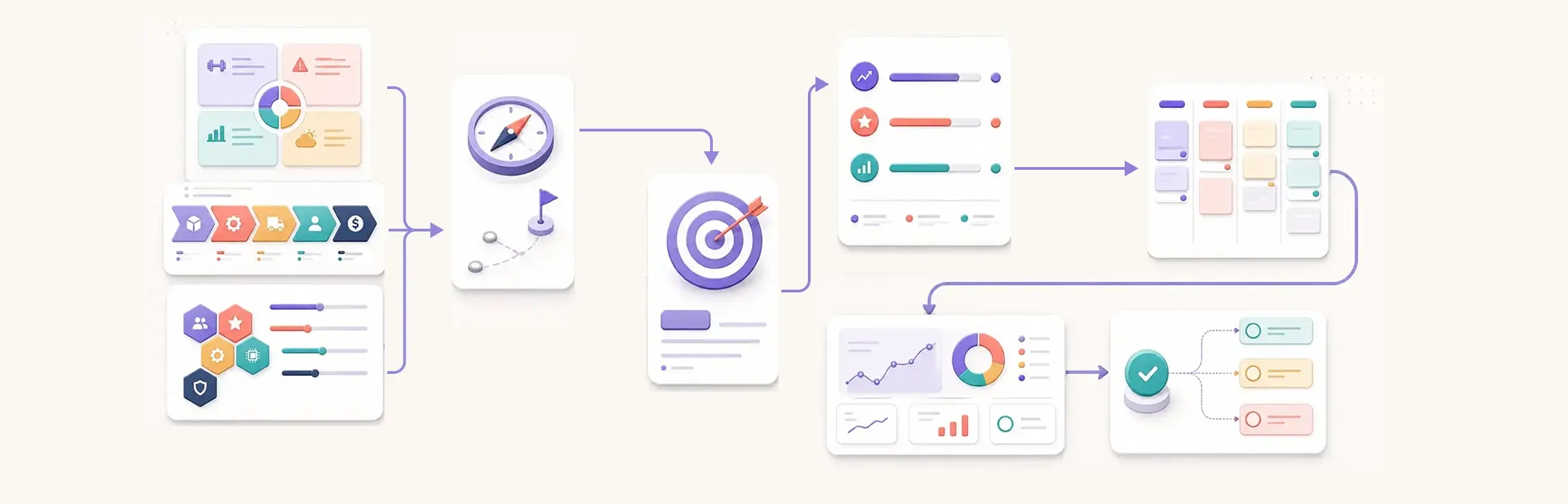
A strategy cascade turns strategic analysis into a connected execution system: choices → objectives → measurable key results → funded initiatives → operating reviews → board decisions. The goal is not to copy goals down the org chart. It is to preserve the logic of the strategy while making each team’s contribution, evidence, ownership, and next decision explicit.
What Is a Strategy Cascade?
A strategy cascade provides a practical translation layer between corporate strategy and day-to-day execution. It connects the reason for a strategic choice to the outcomes the organization needs, the measures that show progress, and the work teams will fund and deliver.
A useful cascade answers six questions:
- What did we learn? Summarize the external and internal evidence.
- What choices did we make? State where to play, how to win, and what not to prioritize.
- What must change? Define a small set of strategic outcomes.
- How will we measure progress? Set key results that measure outcomes rather than task completion.
- What will we do now? Fund initiatives with clear owners and dependencies.
- How will we adapt? Establish operating and board review cadences tied to decisions.
This sequence keeps analysis useful. A value chain analysis can identify where value is created or lost. A VRIO analysis template can test whether the resources behind those activities may support an advantage. The cascade converts those findings into coordinated action.
Start with Strategic Evidence, Not a Goal List
Begin with a concise decision packet. It should contain only evidence that can change a choice:
- customer, competitor, regulatory, and technology shifts;
- value-chain activities that drive cost, speed, quality, or differentiation;
- resources and capabilities that pass or fail the VRIO tests;
- current performance gaps and important constraints;
- assumptions that remain uncertain.
Separate facts from interpretations. Then record the decision each insight informs. This prevents a familiar failure mode: teams complete several frameworks but never show how the analysis changes priorities.
Turn Framework Findings into Strategic Choices
Frameworks organize evidence. They do not make the decision. Convert the analysis into a short choice set before writing OKRs.
| Decision layer | Question | Useful output |
|---|---|---|
| Ambition | What meaningful position are we trying to reach? | Time-bound strategic intent |
| Where to play | Which customers, markets, products, or channels matter? | Explicit scope choices |
| How to win | Why should the chosen audience prefer us? | Advantage thesis |
| Capabilities | What must we be unusually good at? | Priority capability set |
| Management system | What must change in structure, funding, data, or governance? | Operating-model decisions |
| Boundaries | What will we stop, defer, or avoid? | Non-priorities |
Keep the list small enough to govern trade-offs. If every opportunity remains a priority, the cascade has no decision logic to preserve.
Convert Strategic Choices into Objectives
An objective describes a meaningful change in business or customer reality. It should be directional, specific enough to guide teams, and durable for the planning period.
Use this pattern:
Verb + outcome + strategic context
For example: “Make enterprise onboarding fast enough to support the new partner channel.” This is stronger than “Improve onboarding” because it ties the change to a strategic choice.
Before accepting an objective, test it:
- Does it express an outcome rather than a project?
- Can teams explain which strategic choice it supports?
- Would achieving it materially improve the strategy’s odds?
- Is there a clear accountable executive?
Define Key Results That Measure Outcomes
Key results are evidence that the objective is becoming true. Use measures of behavior, economics, quality, risk, or capability. Avoid treating milestones such as “launch the dashboard” as results unless the launch itself is the required outcome.
Locke and Latham’s review of 35 years of goal-setting research found that specific, difficult goals generally produced higher performance than vague or easy goals when important conditions such as commitment and feedback were present. That supports a practical rule: make the target specific, but pair it with ownership, feedback, and the resources needed to act. Source: Edwin A. Locke and Gary P. Latham, “Building a Practically Useful Theory of Goal Setting and Task Motivation,” American Psychologist 57(9), 2002, DOI: 10.1037/0003-066X.57.9.705.
For each key result, record:
- the metric definition and data source;
- baseline, target, and deadline;
- accountable owner;
- update frequency;
- leading indicators and guardrails;
- assumptions that could invalidate the target.
Do not force every team to copy the enterprise key result. Let teams define the distinct outcome they control while showing the parent relationship.
Connect OKRs to Initiatives, Funding, and Ownership
OKRs describe outcomes. Initiatives are bets about how to produce them. Keep the two separate so leaders can stop or replace an initiative without abandoning the objective.
Use an initiative register with these fields:
| Field | Purpose |
|---|---|
| Linked objective and key result | Shows why the work exists |
| Hypothesis | States how the initiative should move the result |
| Owner | Establishes one point of accountability |
| Investment | Makes people, time, and budget visible |
| Milestones | Supports delivery management without replacing the outcome |
| Dependencies | Exposes cross-team coordination needs |
| Evidence date | Defines when the bet will be reviewed |
| Decision rule | Specifies when to continue, change, or stop |
This is where the cascade becomes operational. Strategy, portfolio funding, and delivery cannot remain separate conversations.
Use a Balanced Review, Not One Metric
Kaplan and Norton introduced the Balanced Scorecard as a way to view performance through financial, customer, internal-process, and learning-and-growth perspectives rather than relying only on financial measures. A strategy cascade can use the same principle to avoid improving one result while damaging the capability needed to sustain it. (Source: Robert S. Kaplan and David P. Norton, “The Balanced Scorecard—Measures That Drive Performance,” Harvard Business Review, January–February 1992.)
For each objective, pair the primary result with relevant guardrails. A growth objective may need margin, retention, service quality, or team-capacity guardrails. A cost objective may need customer and reliability guardrails.
Worked Strategy Cascade Example
Assume a B2B software company chooses to win in a regulated mid-market segment through faster, evidence-ready onboarding.
Strategic evidence
- Prospects value faster implementation but require stronger control documentation.
- The value-chain review finds repeated handoffs in onboarding.
- The VRIO review finds valuable domain expertise, but the organization has not encoded it into a repeatable process.
Strategic choice
Focus the next two quarters on a standardized onboarding path for the selected segment. Defer broad customization that does not improve compliance readiness or time to value.
Objective
Make regulated-customer onboarding fast, predictable, and evidence-ready.
Key results
- Reduce median signed-to-live time from 45 days to 28 days by quarter end.
- Increase onboarding milestones completed on schedule from 62% to 85%.
- Reach 90% completion for the required control-evidence package before launch.
- Hold 90-day customer retention at or above the current baseline.
Initiatives
- Map and remove redundant approval handoffs.
- Create a standard evidence checklist with named owners.
- Pilot the new path with five customers before wider rollout.
- Instrument milestone timing and exception reasons.
Review decision
Review delivery signals every two weeks and outcome movement monthly. After the five-customer pilot, continue, redesign, or stop each initiative based on cycle time, evidence completeness, and retention risk.
Set the Operating Review Cadence
Different questions need different cadences:
- Weekly or biweekly: delivery signals, blockers, and dependencies.
- Monthly: key-result movement, initiative evidence, and resource shifts.
- Quarterly: strategic assumptions, choice validity, and portfolio trade-offs.
- At material change: customer, competitor, regulatory, or capability evidence that could invalidate the strategy.
Use reviews to make decisions, not collect status. Every review should end with recorded changes to priorities, funding, ownership, assumptions, or escalation.
Make Executive and Board Collaboration Decision-Ready
Boards need a clear line from strategy to evidence. A useful board view includes:
- the strategic choices and what has changed since approval;
- outcome trends and guardrails;
- the assumptions most likely to change the plan;
- material initiative and investment decisions;
- cross-functional dependencies and risks;
- the decision or support required from the board.
Do not turn the board pack into a complete project dashboard. Show the logic, exceptions, and decisions. Keep operating detail linked and available for follow-up.
Common Strategy Cascade Mistakes
- Copying identical OKRs down the hierarchy: this hides each team’s distinct contribution.
- Writing projects as key results: shipping work does not prove the outcome changed.
- Skipping non-priorities: teams cannot make trade-offs if leaders never state what stops.
- Separating goals from funding: unfunded objectives are aspirations.
- Reviewing only lagging results: teams learn too late to adapt.
- Using frameworks as conclusions: the output of analysis must become an explicit choice.
- Reporting without decisions: status meetings consume time without changing execution.
Build a Shared Strategy-to-Execution View
Creately Workspace can keep analysis, choices, objectives, initiatives, owners, dependencies, and review notes connected in a shared visual workspace. Use that common view to run workshops and maintain decision context without replacing the systems teams already use for delivery and measurement.
This workflow also provides a practical bridge to Creately Strategy, which is designed for strategy modeling, scenario testing, cascading OKRs and KPIs, and board-ready plans. The immediate job remains simple: make the strategy’s logic visible and keep execution evidence connected to it.