VRIO Analysis Template
Test Which Resources Can Create Lasting Advantage
Use the editable VRIO matrix to assess value, rarity, imitability, and organization. Compare resources in one view and turn the result into clear strategic priorities.
- Editable VRIO matrix ready for your resources and capabilities
- A consistent four-question test for comparing strategic assets
- Real-time collaboration for strategy workshops and reviews
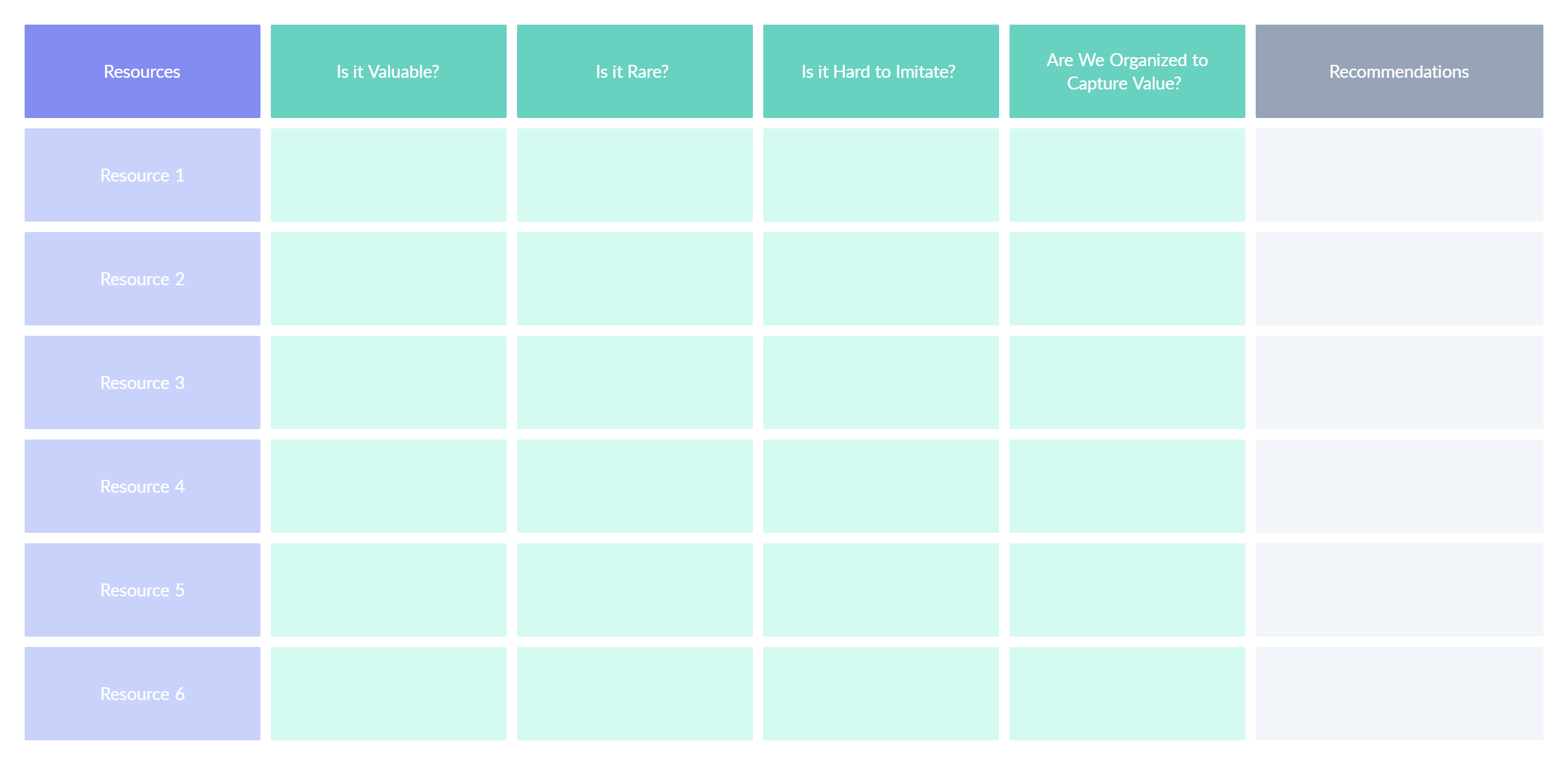
Editable VRIO Analysis Template
What Is a VRIO Analysis Template?
A VRIO analysis template is a decision matrix that tests whether a resource or capability is valuable, rare, costly to imitate, and supported by the organization. Enter one resource per row, record evidence for each test, and use the pattern of answers to identify competitive disadvantage, parity, temporary advantage, unused advantage, or sustained advantage.
The method builds on Jay Barney’s resource-based view. His 1991 Journal of Management paper identifies four resource attributes associated with sustained advantage: value, rareness, imperfect imitability, and non-substitutability (DOI: 10.1177/014920639101700108). His 1995 Academy of Management Executive article connects internal resource analysis to practical questions managers use to look inside the firm (DOI: 10.5465/ame.1995.9512032192).
How to Use the VRIO Matrix
- List specific resources and capabilities. Assess concrete items such as a proprietary data set, supplier relationship, operating process, patent portfolio, brand reputation, or specialist team.
- Test value. Ask whether the resource exploits an opportunity, reduces a threat, lowers cost, improves willingness to pay, or makes an important process work better.
- Test rarity. Determine how many current and potential competitors control an equivalent resource.
- Test imitability. Record whether competitors can buy, build, copy, or substitute for it, and what doing so would cost.
- Test organization. Check whether structure, incentives, governance, processes, data, and ownership let the business capture the value.
- Choose an action. Protect strong resources, invest where organizational support is missing, and stop overfunding resources that do not pass the value test.
How to Read VRIO Analysis Results
| Valuable | Rare | Costly to imitate | Organized | Strategic implication |
|---|---|---|---|---|
| No | — | — | — | Competitive disadvantage |
| Yes | No | — | — | Competitive parity |
| Yes | Yes | No | — | Temporary competitive advantage |
| Yes | Yes | Yes | No | Unused competitive advantage |
| Yes | Yes | Yes | Yes | Potential sustained competitive advantage |
Treat the result as a decision prompt, not a permanent label. Competitors, substitutes, customer needs, and internal execution change. Revisit the matrix when the market or operating model changes.
Worked VRIO Analysis Example
Consider a regional manufacturer assessing a proprietary production process.
| VRIO question | Evidence | Assessment |
|---|---|---|
| Is it valuable? | The process cuts material waste and shortens lead time for a priority customer segment. | Yes |
| Is it rare? | No direct regional competitor currently operates an equivalent process at scale. | Yes |
| Is it costly to imitate? | Replication requires tacit operator knowledge, redesigned tooling, and several years of process data. | Yes, based on current evidence |
| Is the company organized to capture value? | The process has an accountable owner, trained teams, quality controls, and incentives tied to throughput and waste. | Yes |
The matrix suggests a potential sustained advantage. The next action is to protect the know-how, retain trained operators, monitor competing processes, and track whether the cost and lead-time gains persist.
VRIO Questions to Ask in a Strategy Workshop
Value
- Which customer outcome or business constraint does this resource improve?
- What measurable cost, revenue, speed, quality, or risk effect supports the rating?
Rarity and Imitability
- Which competitors have an equivalent resource now?
- Can it be purchased, reverse-engineered, or replaced by a substitute?
- Does it depend on accumulated learning, culture, relationships, or ambiguous cause-and-effect?
Organization
- Who owns the resource and the result it should produce?
- Do processes, incentives, data, funding, and governance support it?
VRIO vs. SWOT and Value Chain Analysis
Use SWOT to frame the wider strategic situation. Use a value chain analysis to locate activities that create cost or differentiation. Then use VRIO to test whether the resources behind those activities can support an advantage.
Turn the VRIO Matrix into Action
Finish with an owner, evidence gap, action, and review date for every important row. Creately Strategy can keep the analysis, supporting evidence, decisions, and follow-up work connected in a shared visual workspace. This adds an execution layer without replacing the practical VRIO job the template is designed to do.
Use the strategy cascade guide to translate the prioritized resources into objectives, measurable key results, funded initiatives, and an operating review cadence.