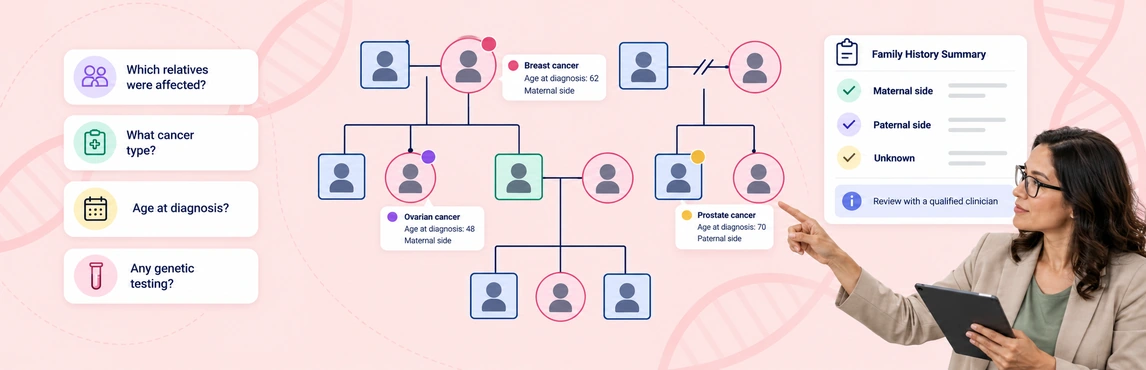
Cancer genetics family history questions should establish which biological relatives had cancer, the cancer types, ages at diagnosis, and any known genetic testing results. Organize the answers by family branch, record what remains unknown, and keep the source of each detail visible. A genogram in Creately Clinical Maps can help document these answers for a clinician’s review.
The CDC’s family health history guidance emphasizes collecting specific diagnoses and ages from blood relatives, including both sides of the family. Use the broader genetic counseling genogram guide for clinical pedigree structure; use this page to prepare the cancer-family-history intake details that feed into that map.
Questions to Ask About Family Cancer History
Use these prompts to organize an intake conversation, alongside your clinical team’s assessment process. Ask the patient to distinguish what they remember from information supported by a report.
| Topic | Questions to ask | What to record |
|---|---|---|
| Personal history | Have you had cancer? What type, and at what age? | Each reported diagnosis and its date or age |
| Affected relatives | Which biological relatives had cancer? On which side of the family? | Relationship to the patient and family branch |
| Diagnosis details | What was the original cancer site? Was another cancer a separate diagnosis? | Exact wording available; questions needing clarification |
| Timing | How old was each person at diagnosis? | Age or an explicitly labeled estimate |
| Living and deceased relatives | How old are they now? If deceased, at what age and from what cause? | Current age, or reported age and cause of death |
| Prior testing | Has anyone had genetic testing? Is the report available? | Report reference and whether the result has been reviewed |
The questions about relatives, diagnoses, and ages follow CDC guidance; the NCI professional assessment summary adds primary cancer sites, prior testing, and supporting documentation.
Copy this intake worksheet into the approved case record and complete one row per relative. Leave unavailable details marked unknown rather than guessing.
| Relative | Family branch | Cancer type and original site | Age at diagnosis | Source or report | Unknown or follow-up |
|---|---|---|---|---|---|
| [Relationship] | [Maternal/paternal/unknown] | [Specific site or unknown] | [Age or unknown] | [Person/report/date] | [Question to check] |
Avoid replacing an uncertain answer with a precise-looking label. “Abdominal cancer, site unknown” preserves a useful question for follow-up; silently converting it into ovarian or colorectal cancer changes the information.
Add the Family Structure and Clinical Context
NCI describes a three-generation pedigree covering both parental branches, with additional relatives where useful. It also identifies ancestry, adoption, donor conception, and relevant nonmalignant conditions as information that may matter to the assessment. Ask sensitively and document missing information explicitly. Source: NCI cancer genetics assessment guidance.
For your documentation workflow, keep four distinctions visible:
- Biological relationships and caregiving relationships.
- A reported diagnosis and a diagnosis checked against a source record.
- “No cancer reported” and “history unavailable.”
- A genetic test mentioned in conversation and a reviewed laboratory report.
A reunion lineage chart can help identify relatives. Add the clinical information separately and review the notation before treating the chart as a clinical pedigree. A broader genogram may also show social relationships; those connections must not imply biological inheritance.
Which Answers Need Closer Clinical Review?
NCI lists early cancer onset, multiple primary cancers, bilateral cancers, clustering among relatives, and unusual presentations among features that can suggest hereditary susceptibility. These are prompts for professional evaluation, not a stand-alone testing rule or a diagnosis. Source: NCI assessment summary.
About 5%–10% of all cancers are thought to result from harmful inherited genetic changes, according to NCI’s genetic testing fact sheet. Cancer in several relatives does not by itself prove an inherited syndrome or establish an individual’s risk.
Record the information for review rather than assigning a “high-risk” label from the diagram alone. Current professional criteria and the patient’s full clinical context guide the next steps.
Turn Intake Answers into a Genogram with Creately Clinical Maps
Creately Clinical Maps supports drawing family relationships and generating a draft from pasted text or supported PDF, Word, and text documents. Use it to organize the information collected during intake, then verify the map before clinical use. The following is a suggested documentation workflow, not an automated assessment.
- Collect the permitted source information. Follow the organization’s intake and data-handling process. Keep source dates and unresolved questions in the notes.
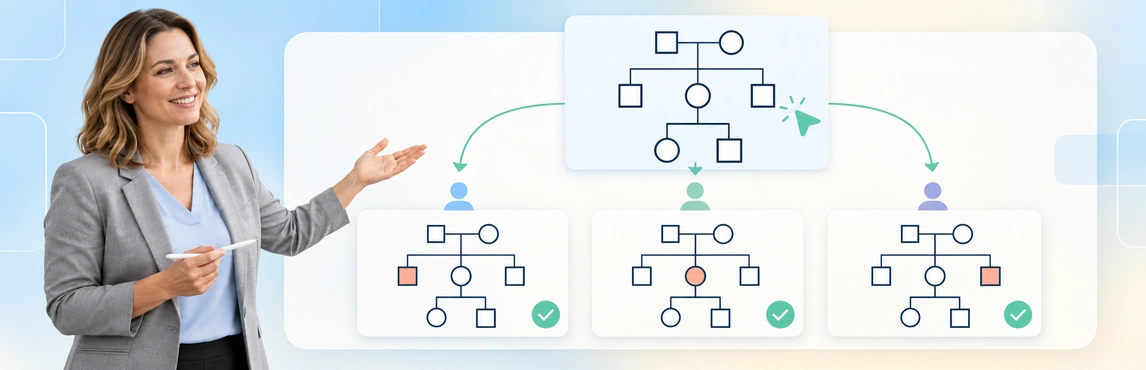
- Create the draft family structure. Draw the relationships or use AI text-to-genogram drafting. State biological, adoptive, and step relationships clearly in the input.
- Check the draft against the source. Review each person, family branch, diagnosis, age, and unknown. Use the clinical team’s pedigree conventions; a genogram symbol reference does not replace that review.
- Prepare the reviewed copy. Confirm the intended recipient, contents, and available export format. Keep clinical interpretation and decisions in the appropriate patient record.
Fictional Intake Example
A patient reports: “My mother had breast cancer at 42. Her brother had pancreatic cancer at 55. I do not know my father’s family history. My mother mentioned a genetic test, but I have not seen the report.” This example is fictional and makes no claim about a particular syndrome.
| Intake detail | Document in the draft | Check before review |
|---|---|---|
| Mother’s reported breast cancer | Maternal relationship; reported diagnosis at 42 | Source and available diagnosis documentation |
| Maternal uncle’s reported pancreatic cancer | Correct sibling connection to the mother; reported age 55 | Relationship, diagnosis, and age |
| Paternal history unavailable | Explicit unknowns on the paternal branch | Whether further history can be obtained |
| Genetic test mentioned | “Result not available” | Obtain and review the report through the approved process |
Do not add a BRCA result, inheritance pattern, or unaffected status that the notes do not establish. The useful output is a reviewable map plus a short list of missing information.
Features and Access for This Workflow
| Documentation task | Creately Clinical Maps capability | Access and interpretation |
|---|---|---|
| Draw a family map | Basic drawing and relationship notation | Basic is included on every plan |
| Draft from intake text | Text-to-genogram generation | Basic assisted outcomes are metered |
| Add structured medical details | Medical & Genetic field pack | Advanced requires an eligible Enterprise Genogram workspace and approved protected-data arrangements; confirm access with your administrator or Creately |
| Review recorded conditions | Health view and pattern observations | Advanced; observations are heuristic, not diagnosis or risk scoring |
| Prepare an output | Basic image export or Advanced reports | Confirm format and access for the intended output |
Enterprise alone does not grant every Advanced capability. For sensitive records, confirm your organization’s approved use and sharing arrangements; see the digital genogram storage guide for related considerations.
Templates for Organizing Family History
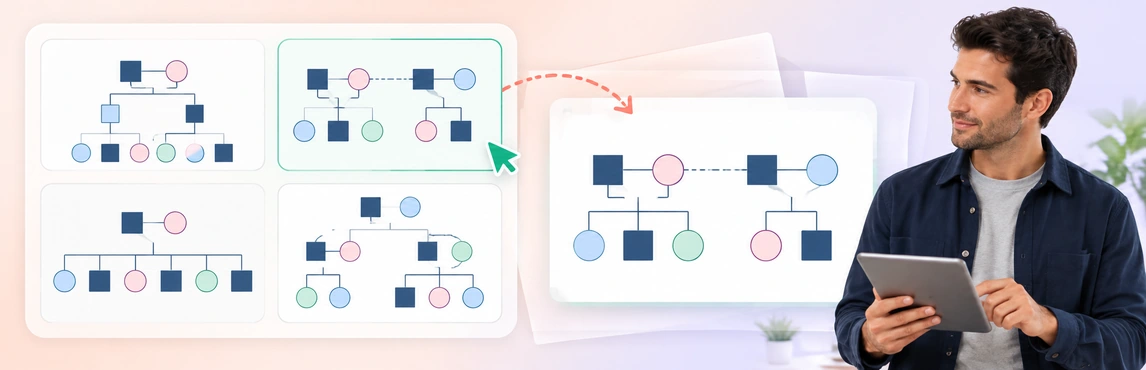
Start with a medical family-map layout and replace its sample information with the permitted intake details. These templates provide a structure to adapt; their example diagnoses and symbols are not a cancer assessment protocol.
- Medical Genogram with Genetic Conditions: A starting layout for recording family members and health information.
- Pedigree Chart with Genetic Conditions: An alternative family-history layout to review against your clinical team’s notation.


What Happens After the History Is Recorded?
The clinician reviews the history and discusses whether testing is appropriate, including its benefits, limitations, and possible results. NCI distinguishes inherited-risk testing from tumor testing and notes that tumor testing does not replace testing for inherited risk. Source: NCI genetic testing guidance.
For the documentation handoff, identify:
- Which information was checked and which remains reported.
- Which records or relatives need follow-up.
- Who reviewed the map and the review date.
- Where the clinical assessment and any testing discussion are recorded.
Use Creately Clinical Maps to organize the map for this review. The diagram supports the conversation; the clinician provides the assessment.