Ancestry research for therapists is most useful when family records and client accounts remain distinguishable in the genogram. Look for a way to map relationships, record sources and uncertainty, and add the client’s account of what family events mean today. Creately Clinical Maps supports this documentation work with family mapping, annotations, and AI-assisted drafting.
Use cultural genogram guides for identity and heritage mapping examples; use this page when the therapy task is reviewing ancestry records, client accounts, and uncertainty before adding them to a clinical genogram.
A historical record may establish that someone moved or married. It cannot establish how that person felt, why a relationship ended, or what a later generation experienced. Keep those questions open for discussion with the client.
What Should Therapists Look for in an Ancestry-Mapping Tool?
Prioritize a map you can explain and correct during review. For family therapists, clinical psychologists, and couples counselors, the useful distinction is between evidence about a family and an interpretation of that evidence.
| Requirement | What to look for | Why it matters to the review |
|---|---|---|
| Relationship detail | Separate biological, adoptive, foster, step, and emotional connections | A caregiving connection should not imply biological lineage |
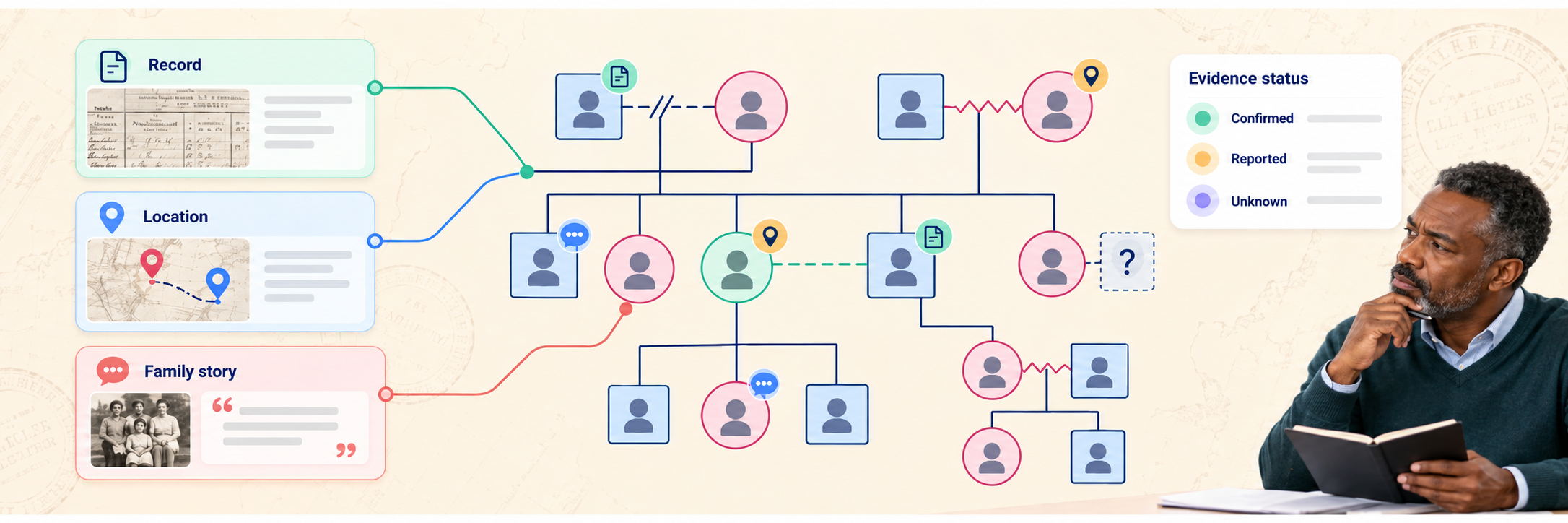
| Source context | Space to identify a record, interview, or reported account | Another reviewer can see where the information came from |
| Visible uncertainty | Labels for unknown, approximate, disputed, or not collected | A polished diagram should not hide gaps |
| Different perspectives | Attributed notes instead of one unqualified relationship label | Partners or relatives may describe the same relationship differently |
| Review and sharing | Editable maps and appropriate recipient permissions | The copy shared must fit the agreed purpose |
For the broader distinction between the two diagram types, see genograms and family trees. The workflow here concerns bringing existing ancestry information into a therapy discussion. With the client’s agreement, possible sources include family documents, civil records, and the client’s own account. Check names, dates, places, and relationship claims before treating two records as referring to the same person; retain a citation or record identifier for each source used.
Translate Family Records into Questions, Not Conclusions
Use a source register before adding sensitive interpretations to the map. It can be a short table in the approved case record, with a reference beside the corresponding person or relationship.
| Source information | Record in the genogram | Question to explore separately |
|---|---|---|
| A record lists an ancestor’s birthplace | Place, source, and relevant date | Does that place have meaning for the client? |
| A family account describes a move | Reported relocation and approximate date | What changed in support, contact, or opportunity? |
| Two relatives disagree about contact | Both attributed accounts | How does each person describe the relationship? |
| A caregiver differs from the biological parent | Distinct caregiving and biological connections | Which relationships does the client want included? |
| A family story mentions illness | Reported condition, source, and uncertainty | Is further information relevant to the therapy goal? |
Use neutral descriptions and avoid filling gaps with diagnostic labels. If medical history needs specialist interpretation, keep that question separate from the relational discussion.
For a copyable source register, use one row for each claim rather than merging conflicting accounts into a single fact:
| Claim on map | Source and record ID | Source date | Status | Client’s account or meaning | Unresolved question |
|---|---|---|---|---|---|
| [Person/event/relationship] | [Record, interview, or document ID] | [Date] | [Confirmed/reported/disputed/unknown] | [Attributed account, if relevant] | [Question or next check] |
For example, in a fictional case, a family document labeled F-17 lists Lila’s grandfather as living in Harbor Town in 1978. Lila recalls being told he lived elsewhere that year. Enter “Harbor Town, 1978—document F-17” and “different location—Lila’s reported family account” as distinct notes; mark the location disputed. Ask which source or family member could clarify the difference. Neither account establishes why he moved or what the event meant to Lila.
Explore Heritage Without Assuming a Shared Experience
Migration is one possible part of family history. It can involve separation, continuity, new opportunities, community ties, or experiences that family members understand differently.
If a source records a move, note who moved, the approximate date, and where the information came from. Ask the client whether this event matters to the purpose of the session. Birthplace and ancestry do not determine how a client identifies or experiences family life.
Ask which traditions, languages, places, communities, or family stories the client considers relevant. Record strengths and sources of belonging alongside difficulties. The cultural genogram guide offers related mapping examples.
SAMHSA’s trauma-informed framework emphasizes safety, collaboration, voice and choice, and attention to cultural and historical context. Apply those principles when agreeing what to explore, when to pause, and how to record sensitive material. Source: SAMHSA’s Concept of Trauma and Guidance for a Trauma-Informed Approach.
Three Fictional Scenarios for Reviewing the Map
These examples illustrate documentation choices, not clinical findings or treatment recommendations.
Relocation Across Generations
A client describes a grandparent’s migration, a parent’s later move, and their own relocation. Record the three events and sources separately. Ask what each move meant to the people involved before describing a recurring relational pattern; geographic distance alone does not establish emotional cutoff.
Adoption and Caregiving
A client was raised by adoptive parents and knows only part of their birth-family history. Show the known connections, label missing information, and include significant caregivers as the client wishes. Do not imply an attachment disruption merely because an adoption or foster placement appears on the map.
Different Accounts in Couples Counseling
One partner describes regular contact with their parents as supportive; the other experiences it as intrusive. Preserve each account with attribution rather than choosing a single “enmeshed” label. A useful next question is what each partner wants to understand or change about current boundaries.
For interview prompts beyond ancestry documentation, use the existing genogram questions for therapy.
Build and Review the Genogram in Creately Clinical Maps
The following is a suggested documentation workflow to adapt to your organization’s practice and data-handling requirements.
- Agree on the purpose and boundaries. Identify the question for this session, which information is relevant, and who may see the resulting map.
- Organize the permitted sources. Distinguish historical records, client accounts, and therapist observations. Retain dates and unresolved questions.
- Create a draft family structure. Draw manually or use text-to-genogram drafting with permitted text or supported PDF, Word, and text documents. GEDCOM import is not currently a user-facing workflow.
- Review the map together. Check identities, relationship types, dates, unknowns, and the meaning of symbols. Correct AI-generated connections against the sources and use an agreed legend.
- Prepare the appropriate review copy. Check its contents and recipient permissions. Record the next questions in the case record rather than presenting a diagram-generated interpretation as a finding.
Creately Clinical Maps supports 60+ relationship types, including distinct biological, adoptive, foster, and step relationships. Its Family Therapy field pack includes areas such as family roles, trauma history, and treatment goals; use these fields for relevant documented information, not assumptions about absent relatives.
| Workflow need | Available capability | Access boundary |
|---|---|---|
| Draw or draft the family map | Basic drawing and text-to-genogram | Basic is on every plan; assisted outcomes are metered |
| Record therapy-specific details | Family Therapy field pack | Advanced requires an eligible Enterprise Genogram workspace and approved protected-data arrangements; confirm access with your administrator or Creately |
| Review possible patterns | Pattern observations | Advanced; heuristic, never diagnosis or risk scoring |
| Prepare material for review | Basic image export or Advanced reports | Confirm the available format and required access |
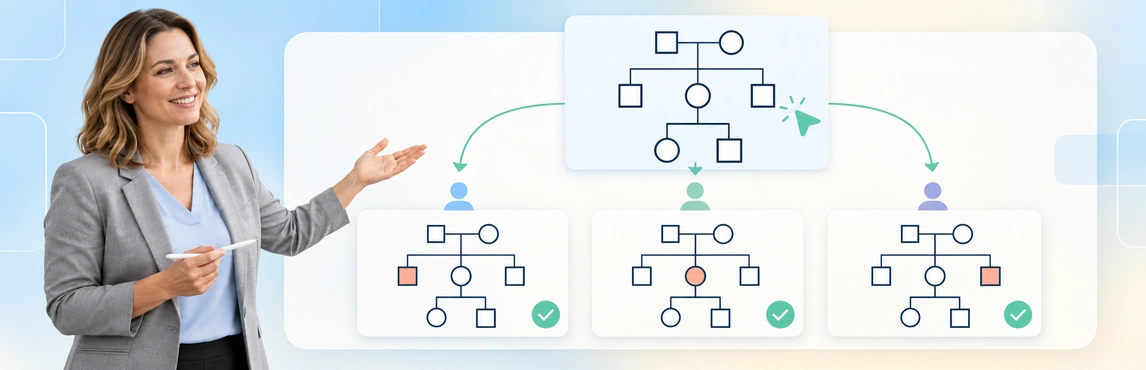
| Share a map for review | Role-based sharing, including Viewer access | Read-only does not mean sensitive information is hidden |
Confirm approved handling arrangements before entering identifiable client information. The digital genogram storage guide provides related considerations; a role setting alone does not resolve consent or disclosure requirements.
Templates for Ancestry and Heritage Discussions
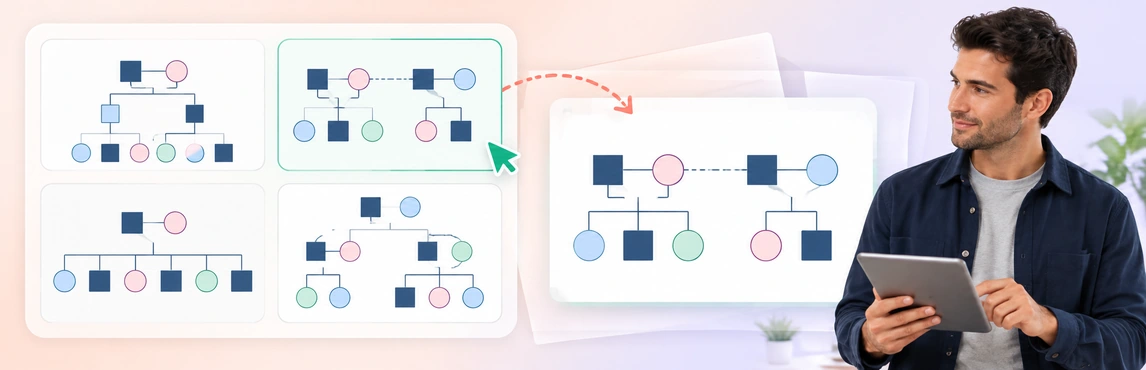
Choose a starting layout and replace its sample content with the permitted information. These examples are editable diagrams, not standardized assessments or automatic interpretations of culture.
- Three-Generation Cultural Genogram: Start with a bounded family structure when reviewing a small set of sources.
- Bi-Cultural Genogram: Discuss the client’s own account of cultural connections and identity without assuming two fixed categories explain their experience.
- Multi-Generation Cultural Genogram: Extend the historical map when additional generations are relevant to the agreed question.


End the Review with Specific Questions
Summarize what the client confirmed, what remains uncertain, and which themes they want to explore next. Keep a distinction between “several moves are recorded” and “the client associates these moves with loss of support.” The second statement belongs to a particular person’s account.
Use Creately Clinical Maps to prepare a map that can be revisited as information changes. The goal is a shared reference for the conversation, with enough source context to correct it.