Complex B2B opportunities involve more than identifying a prospect and presenting a solution. Sales teams also need to understand measurable value, buying authority, evaluation criteria, the customer’s decision process, business pain, and the people who can help build internal support.
MEDDIC provides a consistent qualification framework for gathering and validating that information. It does not guarantee a win, but it can expose gaps and risks before a team commits more time and resources to an opportunity.
This guide explains what MEDDIC stands for, how the framework works, how to apply it, and which implementation challenges sales teams should prepare for.
- What Is MEDDIC?
- Why Should Sales Teams Use MEDDIC?
- How Does the MEDDIC Process Work?
- How to Implement the MEDDIC Sales Process
- Challenges When Using the MEDDIC Sales Process
- Conclusion
What is MEDDIC?
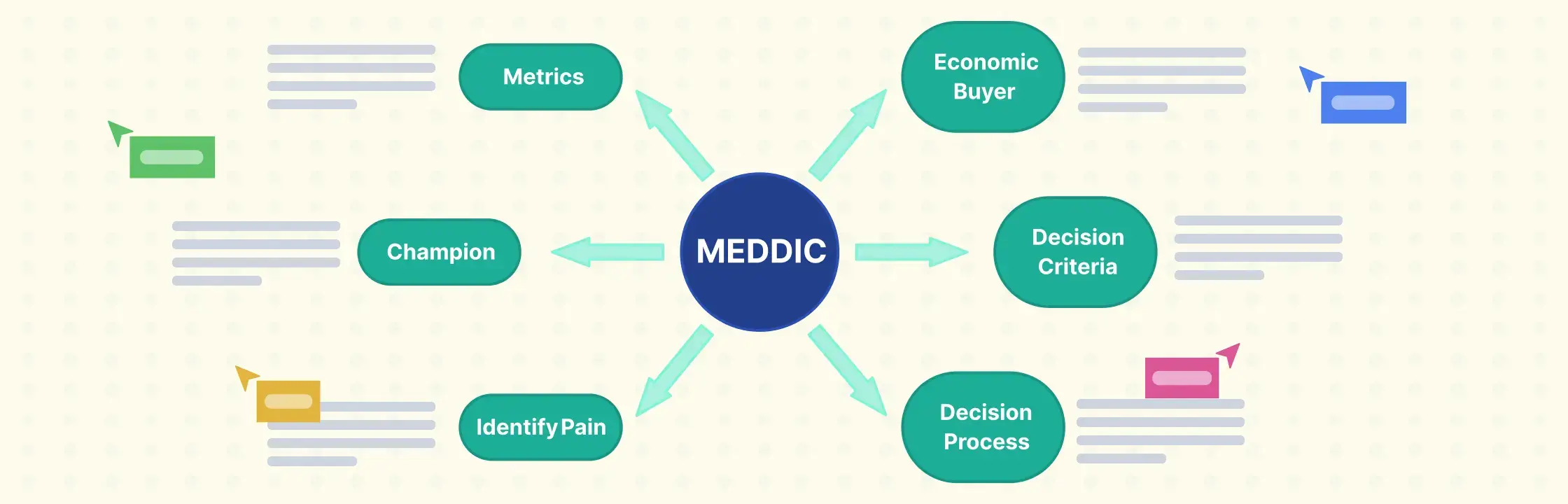
MEDDIC is an acronym that stands for:
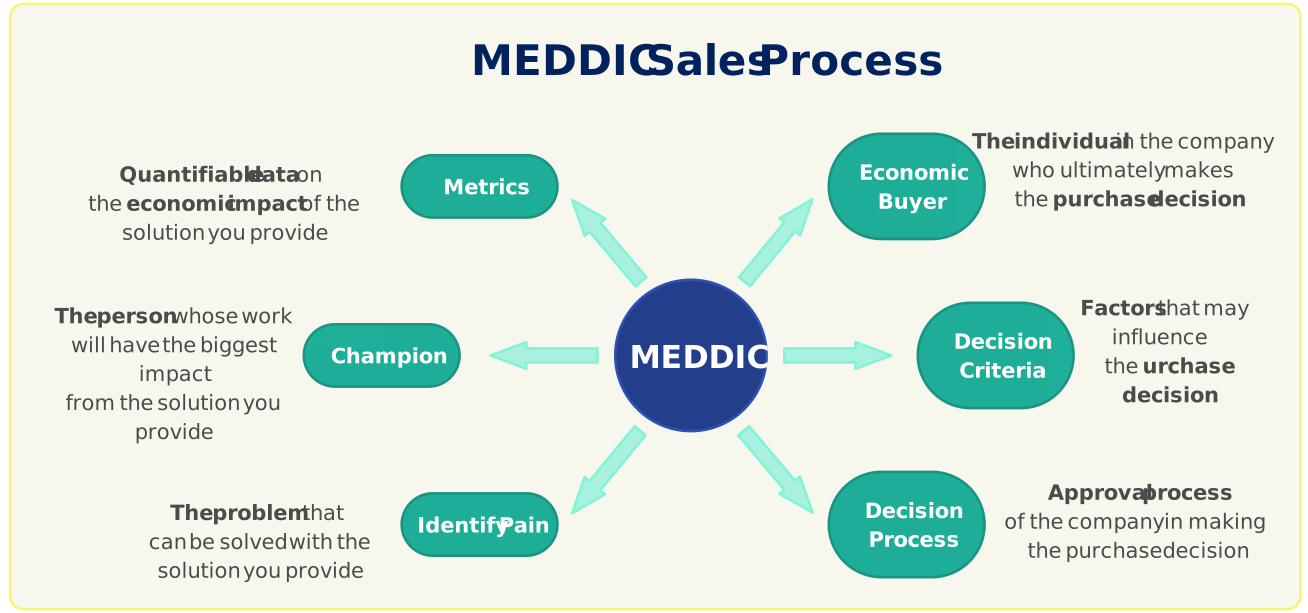

- Metrics: The measurable business outcomes the customer expects and the baseline used to evaluate change.
- Economic Buyer: The person with overall business authority for the purchase and access to the required budget.
- Decision Criteria: The technical, business, financial, security, and other requirements used to compare options.
- Decision Process: The people, evaluation stages, approvals, procurement steps, and timeline involved in reaching a decision.
- Identify Pain: The business problem, its consequences, and the urgency or priority attached to solving it.
- Champion: An influential customer-side contact who benefits from the change and is willing to advocate for it internally.
MEDDIC is a sales qualification framework for understanding an opportunity’s business value, stakeholders, requirements, process, and risks. Treat each element as a hypothesis to validate with the customer, not as a box to check using assumptions.
Why Should Sales Teams Use MEDDIC Sales Methodology?
- To compare opportunities using a consistent set of qualification signals.
- To identify gaps and risks before investing additional time and resources.
- To surface risks, objections, missing stakeholders, and unclear requirements earlier.
- To connect the proposed solution to measurable outcomes and the customer’s documented criteria.
- To improve internal sales alignment around what has been confirmed, what remains unknown, and what evidence is needed.
- To coordinate sales activity with the customer’s known decision process and timeline.
How Does the MEDDIC Sales Process Work?
MEDDIC is not a fixed sequence. Teams may discover and validate its elements in different orders as an opportunity develops. The following questions provide a practical way to investigate each element and document qualification consistently:
First, identify the metrics that matter to your customer. What are their business goals? What are their key performance indicators (KPIs)? How do they measure success? How can your solution help them improve their metrics?
Identify the economic buyer in your customer’s organization. Who has the final say on buying your solution? Who controls the budget? How can you reach them? How can you convince them of the value of your solution?
Discover the decision criteria the customer will use to evaluate options. Which requirements are mandatory? How are the criteria weighted? Who assesses them, and what evidence will they need?
Determine the decision process that your customer will follow to make a decision. What are the steps involved? Who are the other decision-makers or influencers involved? What is the timeline? How can you align your sales activities with their decision process?
Examine the pain points that your customer is facing, and how they affect their business goals. What are their problems or challenges? What are the root causes? What are the consequences? How can your solution solve their pain points?
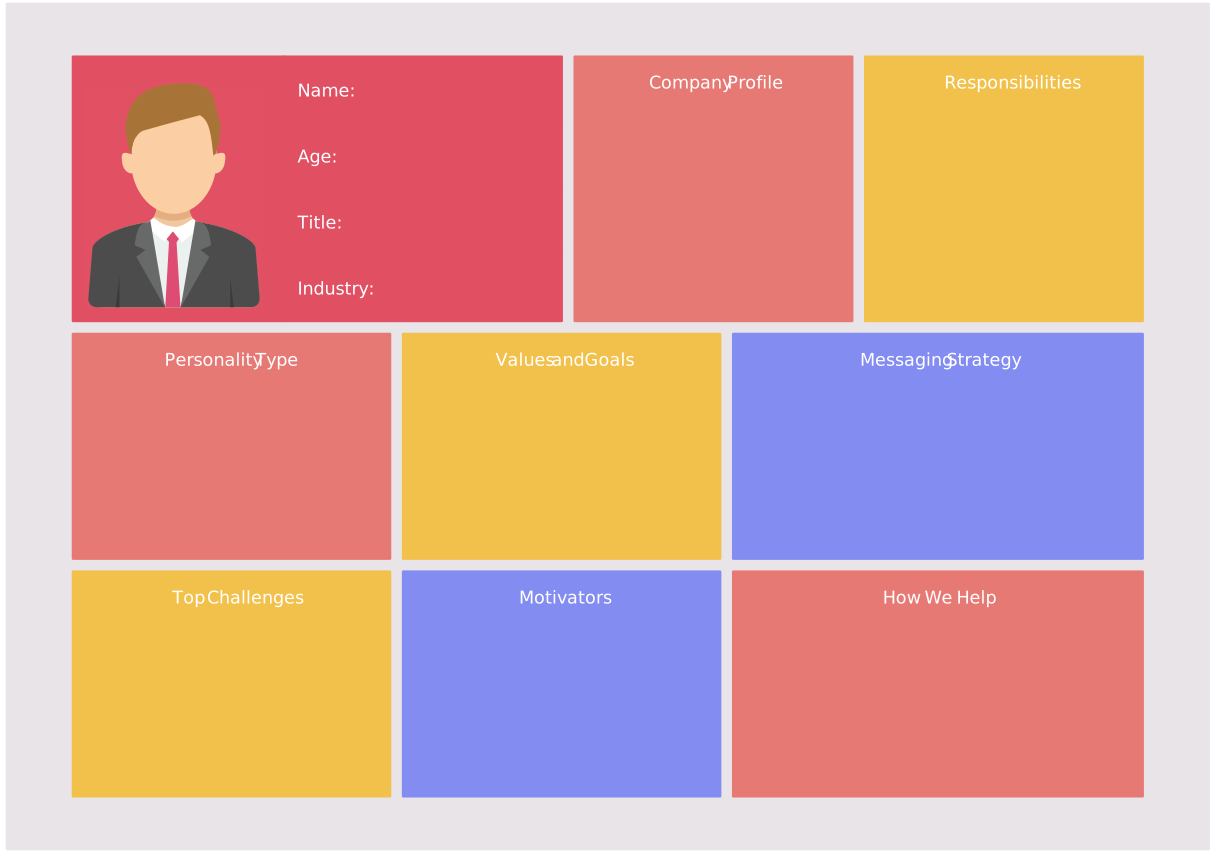
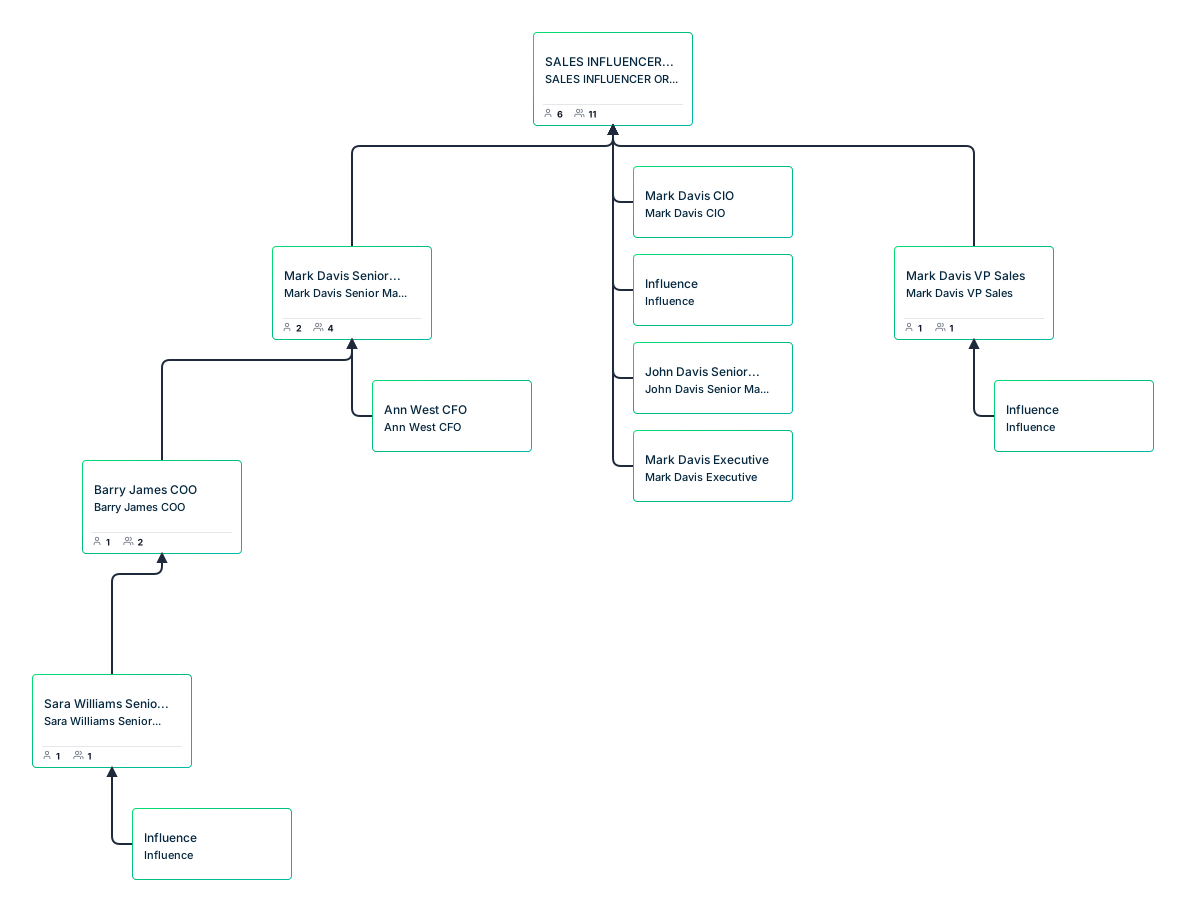
- Identify a potential champion in the customer’s organization. Who can influence decision-makers and other stakeholders? Who has a credible reason to support change, can help you understand the decision process, and is willing to advocate internally?
How to implement the MEDDIC sales process
Implementing the MEDDIC sales process requires some preparation, research, and planning. Here are some tips on how to implement the MEDDIC sales process effectively:
Use a variety of sources and methods to gather information about your customer’s metrics, economic buyer, decision criteria, decision process, pain points, and champion. You can use online research, social media, referrals, cold calls, emails, surveys, webinars, demos, presentations, proposals, etc.
Validate and verify the information you collect with your customer. Don’t assume or guess. Ask open-ended questions, listen actively, and confirm your understanding. Use the information to tailor your sales pitch and proposal to your customer’s specific situation, needs, and goals.
Record verified account, contact, opportunity, and activity data in the CRM or designated sales system. Distinguish confirmed information from assumptions, note the source and review date, and apply appropriate access and data-handling controls.
Review and update the information regularly as the sales cycle progresses. The information you collect might change over time as your customer’s situation, needs, and goals evolve. You need to stay on top of the changes and adjust your sales strategy accordingly.
Use Creately’s process mapping software to document the qualification workflow around the CRM: map discovery steps, evidence requirements, owners, review points, and handoffs. Structured process details and connected subprocess diagrams can keep supporting context with the map, while real-time editing, threaded comments, and @mentions support contextual feedback. This shared map can serve as living process documentation, but it should not replace the CRM, formal approval system, or authoritative customer record.
Use the validated information to decide what needs to happen next, who owns the follow-up, which stakeholder should be involved, and what evidence is still missing. Keep the CRM as the authoritative record for the opportunity.
Challenges when using the MEDDIC sales process
MEDDIC does not guarantee that an opportunity will close. Its value depends on the quality of discovery, evidence, customer access, CRM discipline, and judgment used to interpret the information. Common challenges include:
Finding and accessing the economic buyer and the champion. They might be hard to identify, reach, or engage. They might be busy, unresponsive, or reluctant. You need to use different strategies and tactics to get their attention, interest, and trust.
Dealing with complex decision processes and criteria. Your customer might have a long, complicated, or unclear decision process that involves multiple stakeholders, stages, or approvals. Your customer might also have vague, changing, or conflicting decision criteria that make it hard to demonstrate your value proposition.
Handling competition and objections. You might face strong competition from other vendors who offer similar or better solutions. You might also encounter objections from your customer or other decision-makers or influencers who have doubts, concerns, or reservations about your solution.
Maintaining momentum and urgency. Your customer might delay or postpone their decision for various reasons, such as budget constraints, organizational changes, competing priorities, etc. You need to keep them engaged and motivated throughout the sales cycle.
Conclusion
MEDDIC gives sales teams a consistent way to investigate measurable value, buying authority, evaluation criteria, the decision process, business pain, and internal support. Use it to reveal uncertainty and guide better discovery—not to force every opportunity through a rigid checklist.
Keep customer and opportunity data in the CRM, validate MEDDIC information with the customer, and review it as stakeholders or requirements change. A current, evidence-based qualification record helps the team decide whether to advance, rework, pause, or disqualify an opportunity.