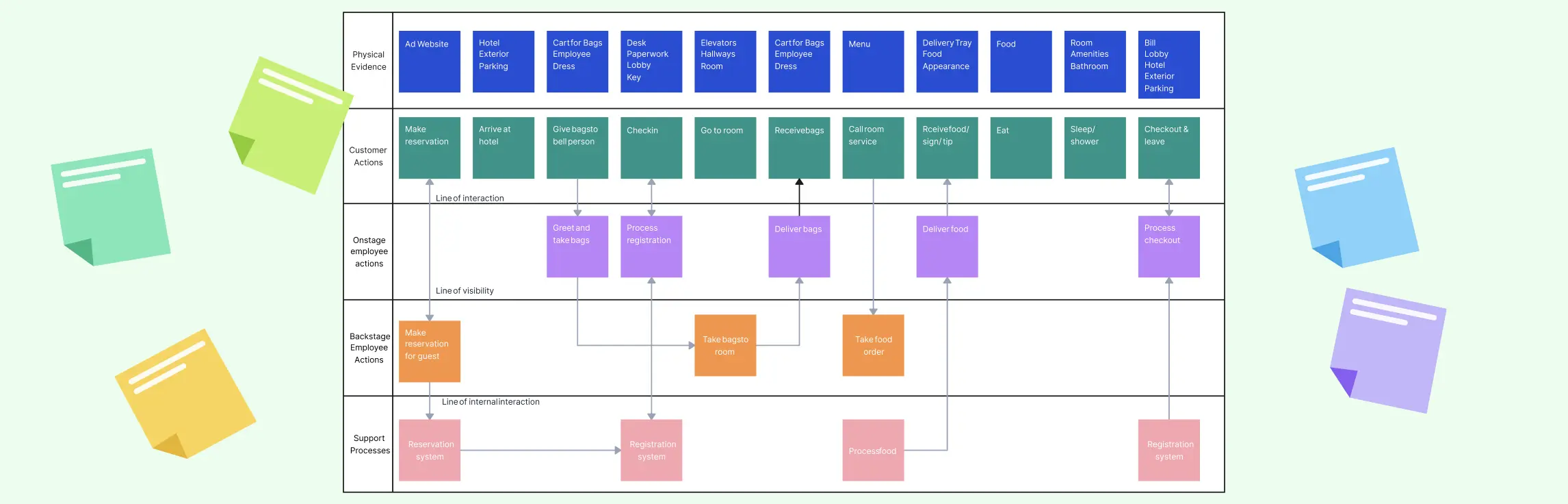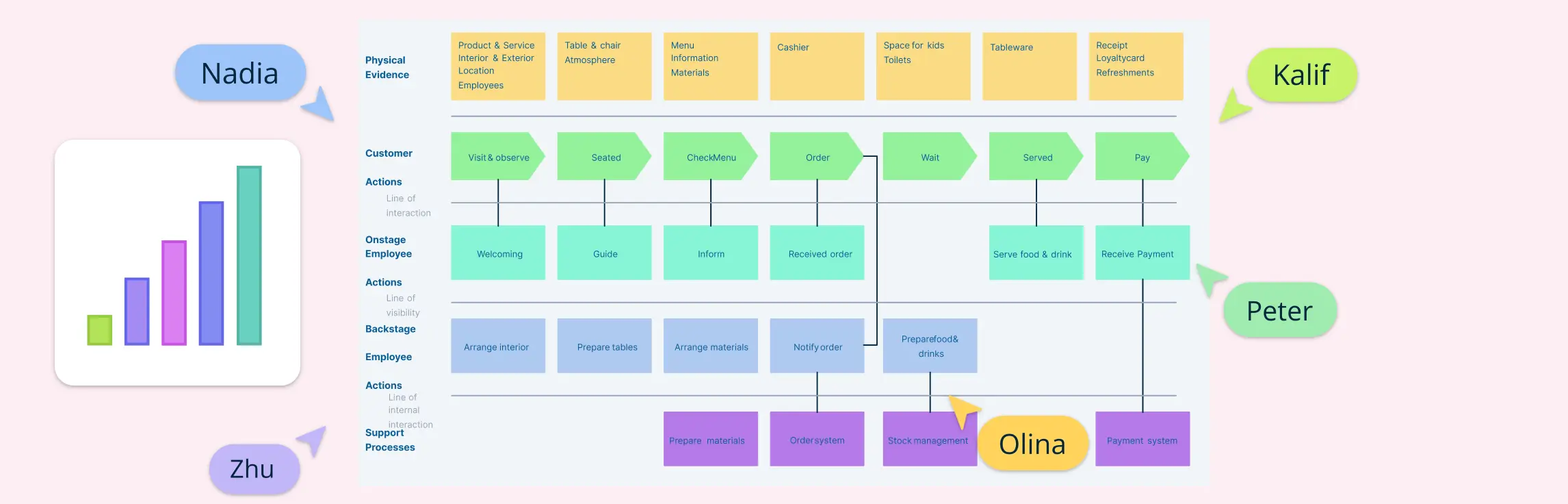
A service blueprint is a visual map that shows how a service works—from what the customer experiences to what happens behind the scenes. It helps teams see the full picture, align better, and improve how services are delivered.
By mapping customer actions alongside frontstage interactions, backstage activities, and support processes, a service blueprint makes it easier to identify gaps, dependencies, and improvement opportunities.
In this guide, we’ll break down the top benefits of service blueprinting and why they’re a smart tool for any team.
The Top 10 Benefits of Service Blueprints
1. Aligns teams across functions
One of the biggest challenges in delivering a consistent service is keeping different teams on the same page. With a service blueprint, everyone—from customer support and marketing to IT and operations—can see how their work connects.
It becomes a shared reference that can reduce ambiguity, align goals, and support cross-functional collaboration. This visual context is especially useful when ownership and handoffs span several teams.
2. Improves customer experience (CX)
When you can visualize every step a customer takes and what supports it behind the scenes, it’s easier to identify where things go wrong. Service blueprints help teams spot friction points—like long wait times, confusing handoffs, or gaps in support—and fix them before they affect the customer.
This analysis helps teams prioritize changes that may improve the customer experience. Teams should validate the effect of those changes with customer feedback and service-performance data.
3. Highlights operational inefficiencies
Many service issues don’t show up until you lay out the full process. Service blueprints help uncover hidden inefficiencies like duplicate tasks, unnecessary approvals, disconnected tools, and unclear handoffs between teams.
By visualizing backstage activities and support processes, a service blueprint makes it easier to review where work passes between teams, identify areas to streamline operations, reduce waste, and improve speed and quality across service delivery.
4. Supports better service design and innovation
Service blueprints make it easier to imagine “what if” scenarios by showing how a service currently functions. This creates space for innovation—whether it’s adding a new channel, rethinking a step, or simplifying a complex journey.
Teams can use the blueprint to explore proposed changes before implementation, making dependencies and assumptions easier to review. The blueprint supports planning but does not replace service testing or risk assessment.
5. Reduces risk in service delivery
Service blueprints reveal how different parts of your service depend on each other. This makes it easier to spot vulnerabilities—like delayed handoffs, system failures, or breakdowns in communication—and address them early.
Understanding these dependencies helps teams identify where contingency plans, clearer ownership, or stronger controls may be needed.
6. Enhances cross-channel consistency
Modern services often run across multiple channels—websites, apps, call centers, physical stores. Without a clear map, it’s easy for experiences to feel disconnected.
A service blueprint lets teams compare touchpoints across channels and identify inconsistencies in roles, processes, information, or supporting systems. It provides a basis for improvement rather than guaranteeing a seamless experience.
7. Enables empathy and customer-centricity
At its core, a service blueprint anchors operational detail to the customer’s actions and touchpoints. A customer journey map or research evidence can add the customer’s motivations, emotions, and pain points; linking that evidence to the blueprint helps teams make more informed service-design decisions.
Together, these views build a shared understanding of user needs and customer pain points alongside the operations that shape the experience.
8. Acts as a training and onboarding tool
New employees often struggle to understand how complex services work. A service blueprint offers a clear visual guide that shows how everything connects, who does what, and where they fit in.
It can also support knowledge transfer between teams or during role transitions by giving employee onboarding a clear view of the service context.
9. Facilitates AI and automation planning
When planning to automate parts of a service, it’s critical to know which tasks are repetitive and rule-based—and which ones need a human touch. Service blueprints help identify automation opportunities while clarifying how human and machine roles work together.
They’re especially useful when designing AI-enhanced services, allowing you to integrate automation without disrupting customer experience.
10. Informs metrics and continuous improvement
Once your service is clearly mapped, it becomes easier to identify where measurement is needed and which indicators may be relevant—whether that is customer satisfaction, response time, or service quality. The underlying metrics still need to be collected and monitored in the appropriate analytics or operational system.
They also support ongoing improvements by helping teams revisit and refine their workflows over time.
Creately Service Blueprint Examples to Get Started
Now that you’re familiar with the service blueprint advantages, you can start designing your own. Whether you’re mapping a simple customer service flow or a complex omnichannel journey, Creately’s service blueprint creator provides a shared visual workspace for connecting customer actions with frontstage, backstage, and support processes. Teams can document handoffs and ownership, keep supporting context attached to relevant elements, and review changes together as the service evolves.
With Creately, you can:
- Use ready-made service blueprint templates to kick-start your design
- Access a full library of drag-and-drop shapes for mapping frontstage, backstage, and support processes
- Use in-app AI assistance to expand or refine ideas while building the blueprint, then validate the output with people who understand the service
- Add notes, links, files, and data to relevant blueprint elements for richer context
- Collaborate in real time and use threaded comments or @mentions to gather contextual feedback
- Share a live workspace for continued review or export the blueprint as a fixed reference when needed
AI service blueprint


Blank service blueprint

Restaurant service blueprint

Hospital service blueprint

Starbucks service blueprint

References
Abugeddida, R.A. and Donnellan, P. (2021). Service Blueprint Technique for Designing and Improving Service: A Literature Review. [online] ResearchGate. doi:https://doi.org/10.13140/RG.2.2.16423.88482.
Shahin, A. (2010). Service Blueprinting: An Effective Approach for Targeting Critical Service Processes – With a Case Study in a Four-Star International Hotel. Journal of Management Research, 2(2). doi:https://doi.org/10.5296/jmr.v2i2.352.
Experience, W.L. in R.-B.U. (n.d.). Service Blueprinting in Practice: Who, When, What. [online] Nielsen Norman Group. Available at: https://www.nngroup.com/articles/service-blueprinting-practice/.
FAQs About Benefits of Service Blueprints
Why is creating a blueprint for a test helpful?
How do service blueprints improve customer experience?
Can AI tools help create service blueprints?
How do service blueprints support continuous improvement?
Are service blueprints only for external customer services?
How do service blueprints relate to process maps?