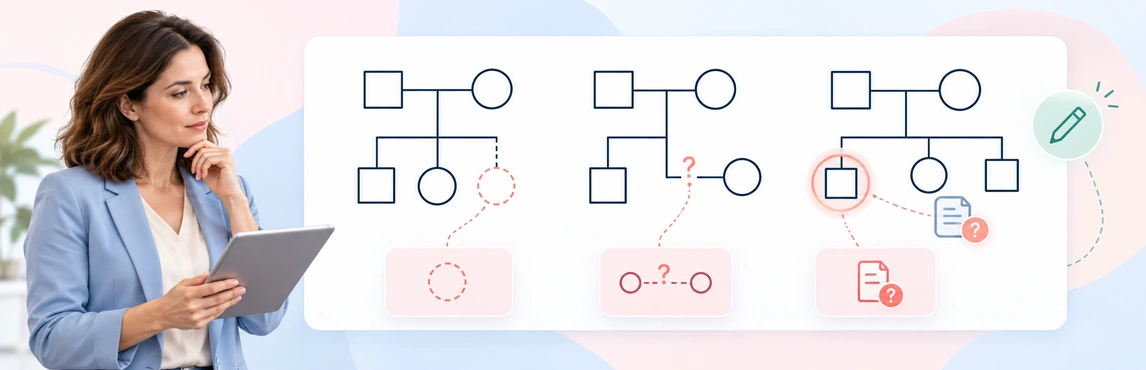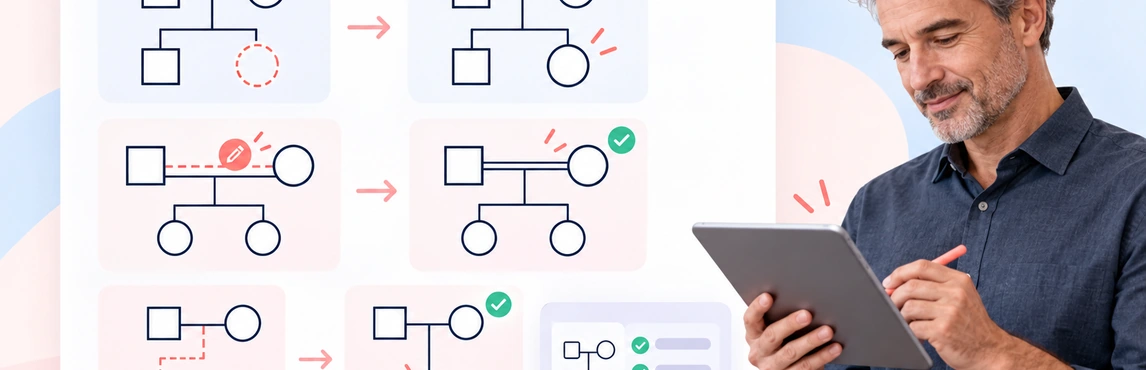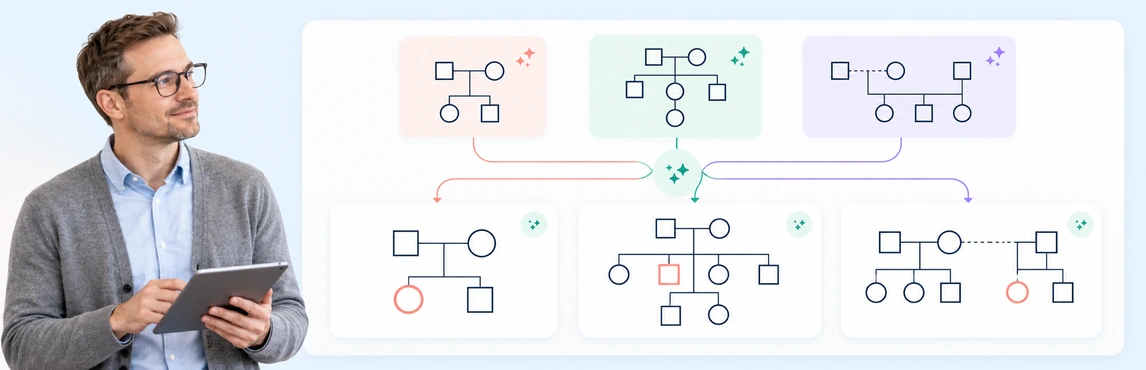
Use these copyable AI genogram prompts as starting points for different kinds of family mapping. Replace the bracketed text with fictional, de-identified, or otherwise approved information, then review the generated diagram against the source before using it. These examples focus on what to include in a prompt; the header links to a separate step-by-step AI genogram workflow.
Prompt basics
A useful prompt states the purpose of the genogram, the people and relationships to include, and what the AI should leave unknown. Keep each prompt limited to the information needed for that diagram. The blue boxes below isolate the complete prompt text so you can copy it. Every example includes a no-inference instruction; retain it when you replace the sample notes.
Use only the information I provide. Do not infer missing people, relationship status, parentage, diagnoses, emotions, causes, or risk. Leave unclear details blank or mark them for my review. Do not add an interpretation or recommendation.
Then paste the relevant family note after the prompt. Keep confirmed information separate from reports, estimates, and details that still need checking.
To test a prompt, use fictional details in a Genogram workspace, then check the draft against the review checklist below.
Family therapy prompts
Family relationship discussion
Prompt
Create a genogram draft for a family therapy discussion from these [fictional/de-identified] notes. Show the family structure and only the emotional relationships that are explicitly described. Do not infer people, relationships, diagnoses, attachment styles, motives, or causes that are not stated. Leave unclear connections unlabelled for me to review.
Notes: [Add the approved family details here.]
Use this when the diagram needs to distinguish the family structure from reported closeness, conflict, or distance. Review the relationship lines with the people involved before treating them as an accurate account. The related guides below include visual examples and a symbol reference for checking notation.
Counseling student case exercise
Prompt
Create a genogram for this fictional counseling case exercise. Include only the people, generations, relationships, and events stated in the case. Use standard genogram symbols where the information supports them; leave uncertain details blank for my review. Do not infer missing people or relationships, diagnose anyone, or write an interpretation of family patterns. Keep the diagram clear enough for me to analyze separately.
Case notes: Nila (38) and Arun (40) are married. Their daughter is Tara (12). Nila’s parents are Meera (64) and Suresh (67), who are married. The case gives no details about Arun’s parents, health conditions, or emotional relationships.
This keeps the diagram separate from a student’s analysis. The expected draft has five people: Meera and Suresh as married partners and Nila’s parents; Nila and Arun as married partners and Tara’s parents. Tara is their child. Arun’s parents, health details, and emotional relationships are absent because the note does not provide them.
Social work and child welfare prompts
Social work family and support map
Prompt
Create a social work genogram draft from these [fictional/de-identified] notes. Show the family relationships, caregiving roles, and support connections only when they are stated. Distinguish biological, adoptive, foster, step, and guardian relationships only when the notes identify them. Do not infer missing people or relationships, safety, neglect, custody, or risk. Leave unclear or conflicting details for me to verify.
Notes: [Add the approved case details here.]
Use this for organizing information to review with a client or team. A genogram can show reported connections, but it does not establish a legal relationship or make a safeguarding assessment. The related social work guide offers more practice context.
Child welfare case review
Prompt
Build a genogram draft from this fictional child welfare case summary. Show documented household membership, caregiving and placement relationships, siblings, and kin connections. Label each connection only with details present in the source. Do not infer missing people or relationships, biological parentage, legal custody, abuse, safety, or a placement recommendation. Mark missing or conflicting information as unknown for caseworker review.
Case summary: [Paste fictional or approved de-identified details here.]
Keep this diagram as an aid for organizing documented information. Check every relationship and status against the case record and your organization’s review process.
Medical history prompt
Prompt
Create a medical history genogram from these [fictional/de-identified] family notes. Include only conditions, age or date of diagnosis, and maternal or paternal relationships that are explicitly stated. Preserve whether a detail is confirmed, reported, or unknown. Do not infer missing people or relationships, a diagnosis, cause, inheritance pattern, or an individual’s medical risk. Leave missing information blank for clinician review.
Notes: [Add only the approved family history details here.]
Use the prompt to organize reported history, not to request a diagnosis or risk assessment. A clinician should verify the source and clinical meaning of each health detail. The related medical genogram guide shows how to map family health history.
Blended-family prompt
Prompt
Create a genogram draft for this [fictional/de-identified] blended family. Show partner, parent-child, sibling, and household relationships exactly as described. Distinguish biological, adoptive, foster, step, and guardian connections only when identified in the notes. Include separation, divorce, or remarriage only when stated. Do not infer missing people or relationships, where a child lives, who has custody, or how family members feel about one another. Leave unclear details for my review.
Notes: [Add the approved family details here.]
Review each parent-child and partner connection carefully. If the family uses terms that do not fit a standard symbol, keep the original wording in a note and explain the notation in a legend.
Genealogy prompt
Prompt
Create a family genogram from these genealogy notes. Arrange documented relatives across generations and include names, dates, and relationships only as recorded in the sources. Mark uncertain dates or relationships for my review; do not infer missing people or relationships, parentage, or dates to fill gaps. Do not add health, emotional, or behavioral details unless they appear in the notes.
Source notes: [Add the relevant records or a summary of them here.]
For family history research, retain the source of each detail alongside your working notes so you can distinguish documented relationships from family stories or estimates.
Genogram templates to use with these prompts
Choose a starting diagram that matches the information you want to map. Open a template to make an editable copy, then adapt its labels and relationships to your scenario.


Review the generated genogram
Before using the diagram, compare it with the source notes and check:
- Each person appears once and is placed in the right generation.
- Parent, partner, sibling, caregiving, and household relationships match the source.
- Emotional lines or health details appear only when explicitly provided.
- Unknown, estimated, and conflicting information remains clearly marked for review.
- Symbols and labels follow the notation you intend to use; add a legend for custom terms.
- The diagram does not contain an interpretation or conclusion that was not in the source.
Use the AI genogram how-to guide linked above for the full workflow, from preparing a note through editing and sharing the output.
Protect sensitive information
Do not paste identifiable client or patient information into a public demo or any tool that your organization has not approved for that information. Use fictional details for practice examples. For professional work, follow consent, data-minimization, retention, and access rules that apply in your setting, and check sharing permissions before sending a diagram. Remove details that the intended audience does not need.
Related Genogram Guides
Understand how written family descriptions become a first-pass genogram and how to review the result.
Explore visual examples for family, health, cultural, and other genogram use cases.
Review the information a genogram can represent and how it differs from a family tree.
Check common genogram symbols and relationship lines before reviewing a generated diagram.
Learn how social workers use genograms to organize family and support-system information.