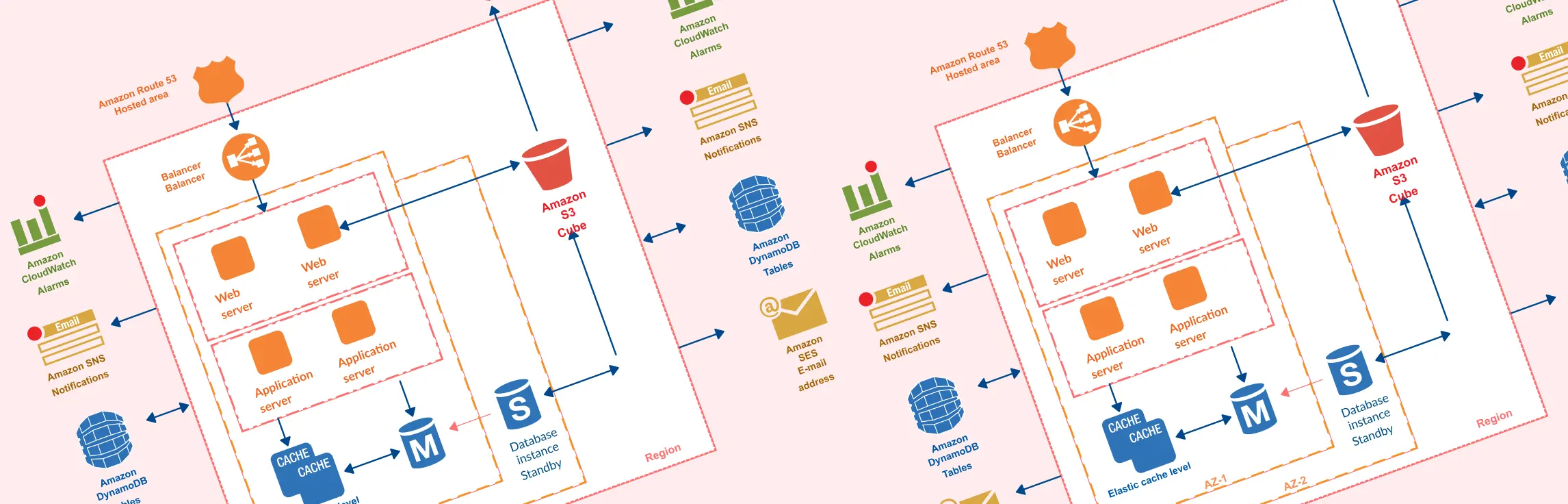
Diagrams-as-code is a good fit for architecture reviews when the diagram belongs with the code, changes through pull requests, and is maintained by engineers. Mermaid is usually the simpler choice for Markdown-native flowcharts and sequence diagrams. PlantUML is often better for detailed UML models. Neither is automatically the best review surface.
Use a collaborative visual canvas when the review needs live discussion, flexible spatial thinking, comments from non-developers, or context that cannot be expressed cleanly in syntax. Many teams need both: a versioned diagram for durable technical truth and a shared visual workspace for reaching the decision.
The Short Verdict
| Review need | Best starting point | Why |
|---|---|---|
| A small diagram beside code or an ADR | Mermaid | Low-friction Markdown workflow and native rendering on common developer surfaces |
| Detailed UML behavior or structure | PlantUML | Broad UML syntax for sequence, class, component, deployment, state, and related views |
| A live, cross-functional architecture workshop | Collaborative visual canvas | Faster participation, annotation, rearrangement, and discussion without syntax knowledge |
| A diagram generated in CI | Mermaid or PlantUML | Text source can be validated and rendered through an automated pipeline |
| A decision with diagrams, notes, owners, evidence, and follow-up actions | Combined workflow | Code handles the durable model; the review workspace handles the conversation and context |
The honest answer is not “code beats drawing” or “visual tools beat code.” Choose based on what must remain authoritative after the meeting.
What Diagrams-as-Code Actually Means
Diagrams-as-code stores a text definition of a diagram in a repository or documentation system. A renderer turns that definition into an image or interactive view. The source can be reviewed, versioned, searched, copied, and generated like other text artifacts.
That creates several useful properties:
- Changes can appear in the same pull request as the implementation.
- Reviewers can inspect a line-level diff.
- CI can render or validate the source.
- Teams can reuse patterns and generate diagrams from structured inputs.
- The diagram has a clear storage location and change history.
It does not make the diagram correct. A clean diff can still describe the wrong boundary. A successful render can still omit a critical dependency. The architecture review must evaluate the decision and the model, not only the syntax.
GitHub documents native Mermaid rendering in issues, discussions, pull requests, wikis, and Markdown files. That makes Mermaid especially practical when those surfaces already contain the team’s technical review.
See GitHub’s supported diagram workflowMermaid vs. PlantUML for Architecture Reviews
Mermaid and PlantUML overlap, but they optimize for different levels of modeling depth and workflow complexity.
| Dimension | Mermaid | PlantUML |
|---|---|---|
| Easiest entry point | Markdown documents and developer portals | UML-heavy documentation and engineering toolchains |
| Architecture coverage | Flowchart, sequence, class, state, ER, C4 integrations, and a native architecture syntax | Class, sequence, component, deployment, state, activity, use case, object, timing, and other formats |
| Typical source | Fenced Mermaid block or .mmd file | @startuml source in a supported text file |
| Review experience | Compact syntax and convenient embedding | More expressive UML syntax with more concepts to learn |
| Layout control | Primarily renderer-directed | Renderer-directed with additional layout engines and controls |
| Best use | Explanatory diagrams close to Markdown | Detailed software models and established UML practices |
| Main risk | Complex diagrams become hard to read and tune | Syntax and styling can become a specialist concern |
Mermaid added a dedicated architecture diagram syntax in version 11.1.0. Its model uses services, groups, edges, and junctions, which suits cloud and CI/CD relationship views.
Review Mermaid’s architecture diagram syntaxPlantUML documents nine standard UML diagram families on its main reference: sequence, use case, class, object, activity, component, deployment, state, and timing. That breadth matters when an architecture review moves beyond one high-level topology.
Review PlantUML’s supported diagram typesThese are capability facts, not a winner announcement. Rendering support, security constraints, theme consistency, accessibility, and the team’s existing workflow can matter more than the length of a feature list.
Where Diagrams-as-Code Works Well
The diagram changes with the implementation
Keep the diagram beside the service, infrastructure definition, or ADR when the same engineers own all of them. A pull request can update the design explanation and implementation together. Reviewers see that the architecture changed before the old diagram becomes accepted folklore.
The architecture can be expressed as a stable model
Sequence, component, dependency, state, and deployment views usually have repeatable structures. Text syntax works well when the team agrees on the level of detail and the renderer can represent the required relationships without layout gymnastics.
The review is asynchronous
A repository-based workflow is useful across time zones. The author explains the decision, commits the diagram source, and attaches or embeds the rendered view. Reviewers comment on the proposal without scheduling a drawing session.
The source can be generated
Text is a useful intermediate format when a tool derives relationships from code, configuration, or a database schema. Generation reduces manual transcription, but it does not remove the need to select a useful view. A complete dependency graph is often less reviewable than a deliberately bounded diagram.
Where Diagrams-as-Code Breaks Down
The syntax becomes the meeting
An architecture review has failed when participants spend more time debating arrows, parser errors, and layout hints than examining the decision. Fix syntax before the meeting. If live exploration is the purpose, use a surface that lets the group change the model without waiting for a render loop.
The audience cannot participate
Security, product, operations, finance, and business stakeholders may have essential information without knowing Mermaid or PlantUML. A rendered diagram lets them read. It does not necessarily let them contribute. Comments, notes, voting, free-form annotations, and direct manipulation can be more important than source control during a cross-functional review.
One file is forced to answer every question
An executive context view, a container view, a deployment view, and a detailed sequence diagram serve different readers. Combining them into one source produces an artifact that is technically complete and practically unusable. Create one view per review question.
Layout carries meaning
Code-based renderers calculate positions. That is a strength until the architecture depends on deliberate spatial grouping, a workshop evolves through loose clusters, or the team needs to compare several scenarios side by side. A visual canvas gives authors direct control over that reasoning space.
The diagram has nowhere to store the decision
An architecture review produces more than boxes and lines. It produces assumptions, rejected options, risks, owners, evidence, and follow-up work. Keep those in an ADR, issue, or connected review workspace. Do not hide the decision in diagram comments that nobody reads.
A Concrete Mermaid Example
This example is intentionally small. It states the review question: should requests reach the order service synchronously, or should the API publish work to a queue?
flowchart LR
    Client --> API
    API --> OrderService
    API -. proposed .-> Queue
    Queue -. proposed .-> OrderService
    OrderService --> Database
The source diff is easy to review. The rendered view exposes the proposed asynchronous path. The ADR still needs to explain why the queue is being considered, how retries and ordering work, and what operational cost the team accepts.
Mermaid’s syntax reference notes that an unknown word or misspelling can break a diagram, while some invalid parameters fail silently. Treat rendering and visual inspection as separate checks.
Read the Mermaid syntax referenceA Concrete PlantUML Example
PlantUML is a natural fit when the same review needs a UML component view with explicit interfaces and dependencies.
If the team wants to sketch that view collaboratively before encoding it, start with the component diagram maker.
@startuml
component "Public API" as API
component "Order Service" as Orders
queue "Order Queue" as Queue
database "Orders DB" as DB

API --> Orders : current
API ..> Queue : proposed
Queue ..> Orders : consume
Orders --> DB
@enduml
PlantUML defines component diagrams with text descriptions and supports UML component notation. The review should still include the rendered output. A textual diff can show that a relationship changed, while the image shows whether the overall model remains understandable.
See PlantUML component diagram syntaxHow to Run an Architecture Review With Diagrams-as-Code
1. State the decision before drawing
Write one question at the top of the ADR or review request. For example: “Should checkout call inventory synchronously or reserve stock through an event?” A diagram without a decision question invites an unbounded design critique.
2. Choose one view
Use a context view for boundaries, a component view for responsibilities, a sequence view for runtime behavior, or a deployment view for infrastructure placement. Add another view only when it answers a different review question.
3. Keep the first version small
Show the elements and relationships needed for the decision. Hide utility services, framework details, and exhaustive data fields unless they change the outcome. Reviewers need a truthful abstraction, not an inventory dump.
4. Commit source and rendered output together
Where the platform renders Mermaid or PlantUML natively, link directly to that view. Otherwise, generate a stable SVG or PNG in CI. Review both. The source proves what changed; the image proves what readers will see.
5. Review architecture, not formatting
Ask:
- Is the system boundary explicit?
- Are current and proposed states distinguishable?
- Are important dependencies and trust boundaries visible?
- Does the model match the written decision and constraints?
- Which failure modes or operating responsibilities change?
- What evidence would invalidate the proposal?
Capture layout or syntax cleanup separately unless it prevents comprehension.
6. Record the decision outside the diagram
An ADR should state status, context, considered options, decision, consequences, and follow-up actions. Link the diagram source to the ADR and the ADR back to the implementation. The diagram explains the structure or behavior; the ADR explains why the team chose it.
7. Define the update trigger
Name an owner and a condition that requires an update: a changed public interface, new data store, trust-boundary change, deployment-model change, or material dependency change. “Keep this current” is not an operating process.
When a Collaborative Visual Canvas Is Better
Use a shared visual canvas for the review phase when participants need to:
- Move between technical and business views without rewriting syntax
- Add comments, questions, evidence, owners, and action items in context
- Sketch competing options before the model stabilizes
- Include product, security, operations, and business reviewers directly
- Group information spatially during discovery
- Present the same architecture at different levels of detail
Creately Workspace is a visual collaboration and diagramming platform for teams to plan, design, and align work on an infinite canvas. For architecture teams, the practical role is the review surface: bring a durable technical model into a space where people can discuss it, add context, and converge on a decision.
Creately System Design is intended as an engineering design system of record for ADRs, architecture, ERD, sequence, class, and state views kept in sync with codebase and database sources. That direction does not make every hand-built canvas authoritative. Teams should still label generated facts, human annotations, proposals, and approved decisions clearly. For data-model reviews, the existing ER diagram tool provides the safest current pathway.
If the immediate need is to create or review standard software models with a broader group, use Creately’s UML diagram tool. Keep the diagrams-as-code source in the repository when it is the maintained technical artifact.
A Practical Hybrid Workflow
A hybrid workflow separates exploration from durable documentation:
- Open the review with the decision question.
- Explore options on a shared canvas. Capture assumptions, risks, evidence, and reviewer comments.
- Select the architecture and record it in an ADR.
- Encode the stable technical view in Mermaid or PlantUML.
- Commit the ADR and diagram source with the implementation.
- Link the repository artifact back to the review context.
- Regenerate and inspect the diagram when the relevant architecture changes.
This avoids two common mistakes. The canvas does not become an unowned picture that drifts away from the system. The code diagram does not become a gate that excludes the people needed to make the decision.
Decision Checklist
Choose Mermaid when:
- The diagram belongs in Markdown.
- The team needs a lightweight flowchart, sequence, state, class, ER, or architecture view.
- Native rendering already exists in the documentation or repository platform.
- Contributors value simple source more than detailed UML control.
Choose PlantUML when:
- The team relies on formal UML views.
- Component, deployment, class, and sequence details must use consistent notation.
- The engineering toolchain already renders and validates PlantUML.
- Contributors are willing to maintain a more expressive diagram language.
Choose a collaborative visual canvas when:
- The architecture is still being discovered.
- The review is synchronous or cross-functional.
- Comments, evidence, owners, and alternatives must stay visible around the model.
- Direct layout and free-form spatial organization carry meaning.
Use both when the review conversation and the maintained technical model are equally important.
FAQs About Diagrams as Code
Is diagrams-as-code good for architecture reviews?
Should an architecture team use Mermaid or PlantUML?
Can diagrams-as-code replace a visual architecture canvas?
How should a team review a diagram change?
How do you keep architecture diagrams current?