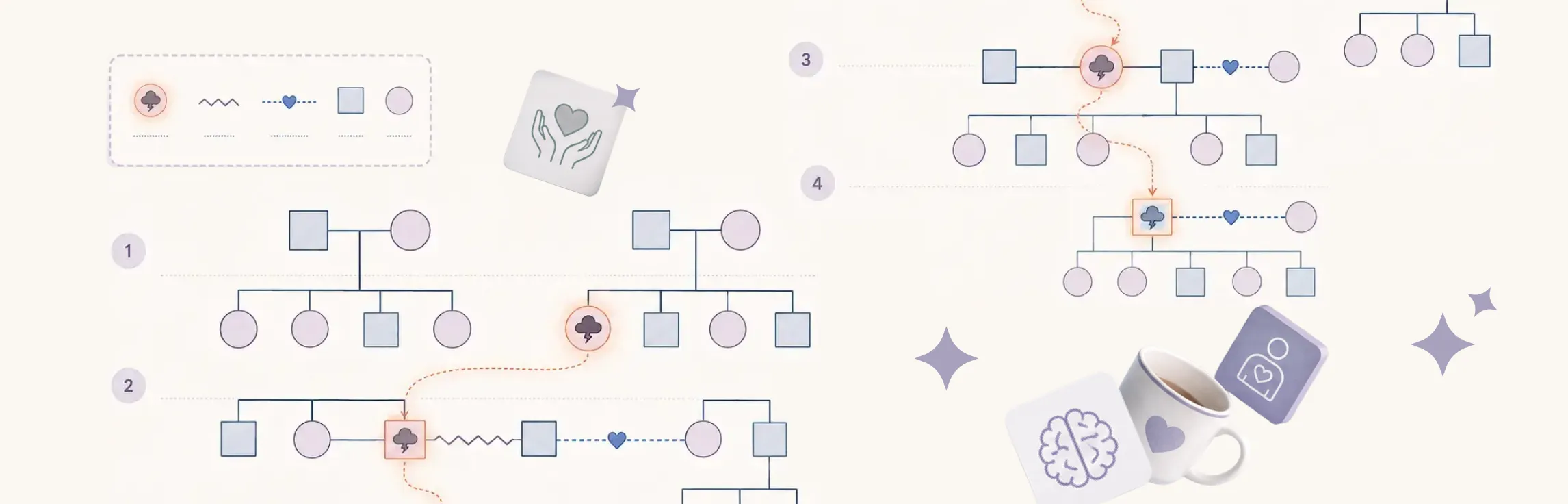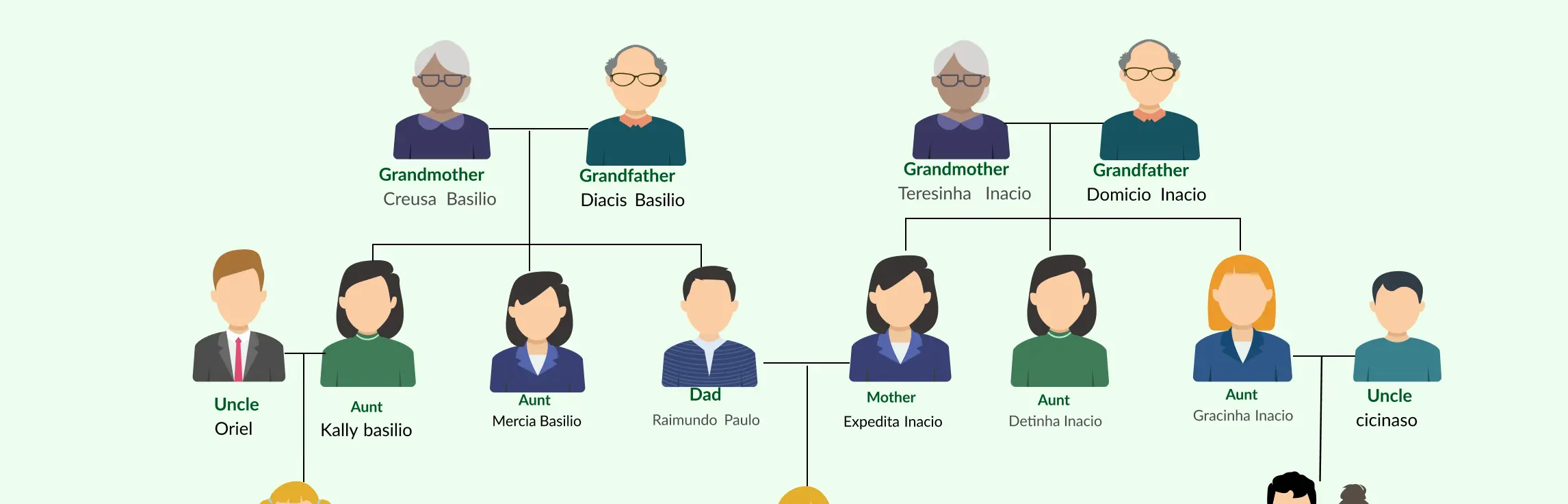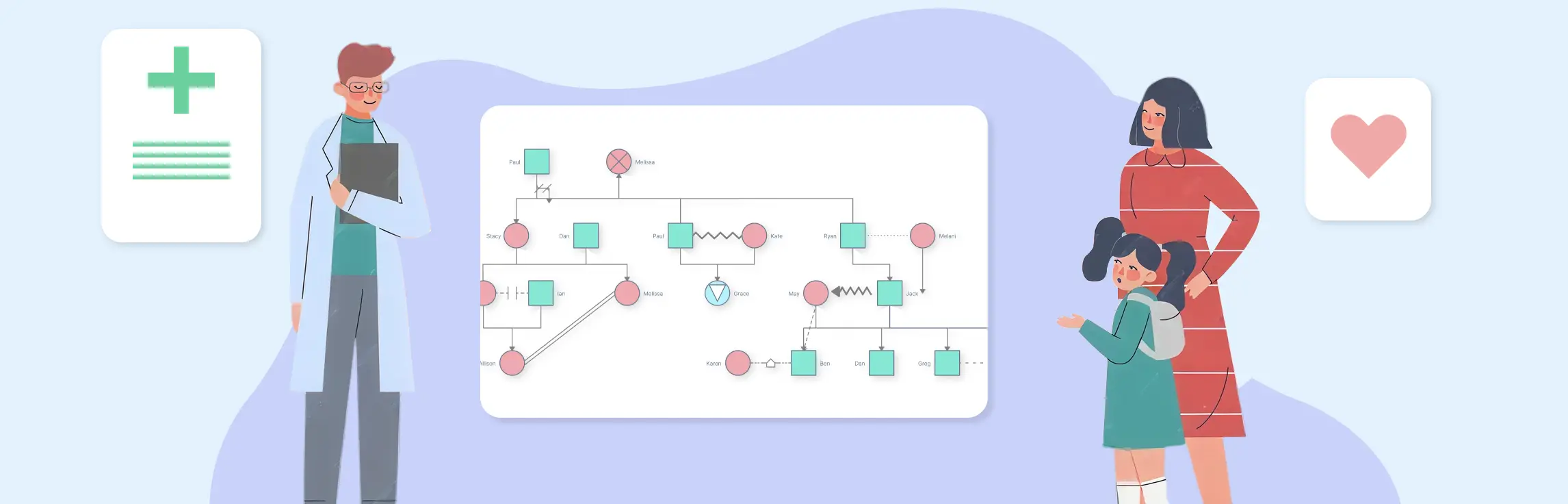
A clinical genogram helps therapists organize complex family information into a map that can be reviewed with the client and updated over time. It can show family structure, important relationships, major events, risks, strengths, and possible patterns across generations.
This guide explains how to use consistent notation, build the genogram collaboratively, document uncertainty, explore patterns without overclaiming, and turn relevant findings into a clear clinical report.
What Makes a Genogram Clinical?
A clinical genogram is more than a family tree. It combines family structure with information that matters to assessment or treatment: emotional relationships, caregiving roles, significant losses, health or behavioral patterns, protective factors, and changes over time.
The diagram becomes clinically useful when every element answers a question. Who is the identified client? Which people form the current client system? What information is reported, observed, or confirmed? Which relationships affect the presenting concern? What strengths could support change?
A genogram is not a diagnosis. Repetition across generations may justify further inquiry, but it does not establish causation. A cutoff line, for example, records a described relationship pattern. It does not explain why the cutoff occurred or determine what intervention is appropriate.
A Quick Notation Guide for Therapy Sessions
Use the smallest symbol set that captures the session’s purpose. Add a legend whenever your organization or client may interpret a line differently.
| Clinical information | Common notation | Session note |
|---|---|---|
| Identified client | Double border around the person’s symbol | Orient every reader to the focus of treatment |
| Deceased person | X through the person’s symbol | Add dates only when relevant and known |
| Marriage or formal union | Solid partner line | Note the convention used for other partnerships |
| Separation | One slash through the partner line | Add a date when timing affects the formulation |
| Divorce | Two slashes through the partner line | Distinguish legal status from current emotional connection |
| Close relationship | Double relationship line | Record whose account supports the description |
| Conflict | Zigzag relationship line | Add direction only when the notation supports it |
| Emotional cutoff | Interrupted relationship line | Do not treat cutoff and low contact as automatically equivalent |
| Index pregnancy or loss | Practice-approved symbol plus annotation | Use sensitive, client-led language |
| Unknown information | Explicit question mark or “unknown” note | Never fill gaps with assumptions |
Modern identity and relationship documentation requires care. Traditional notation systems do not always represent gender identity, chosen family, polyamorous relationships, or culturally specific kinship structures consistently. Ask clients how they identify people and relationships, document the convention, and avoid forcing lived relationships into an inaccurate symbol.
Before the Session: Set Scope, Consent, and Access
Define the clinical purpose before opening a canvas. A focused first-session map might capture the household, caregivers, major relationships, immediate risks, and strongest supports. A later formulation session may extend the map across three generations and add emotional patterns or significant events.
Tell clients what the genogram is, why you are creating it, whether it becomes part of the clinical record, who may see it, and how they can correct it. Family and couple work creates special confidentiality questions because the diagram may contain information about several people.
The AAMFT Code of Ethics, effective January 1, 2026, requires therapists to protect client confidences and clinical records. Its record-access provisions also require attention to the confidentiality of other people identified in family and couple records. Apply your jurisdiction’s law, licensing rules, organizational policy, and informed-consent procedure rather than relying on the diagramming method alone.
During the Session: Build the Genogram Collaboratively
1. Begin With the Current Client System
Place the identified client and current household first. Ask who the client considers family, who provides care, who makes decisions, and who is emotionally important. Legal, biological, and lived family structures may differ.
2. Add Only Relevant Generations
Three generations is a common clinical starting point, not a mandatory quota. Expand the map when earlier relationships or events may help answer the clinical question. Mark missing information as unknown instead of pressing for details that are not necessary or safe to explore.
3. Separate Structure From Emotional Relationships
Map parent-child and partner connections before adding closeness, conflict, cutoff, or abuse. This keeps the structural skeleton readable and reduces the risk of placing an emotional line on the wrong relationship.
4. Add Dates and Turning Points
Timing often matters more than the number of annotations. Record approximate dates for deaths, separations, migrations, diagnoses, placement changes, relapses, reconciliations, and other events linked to the presenting concern.
5. Record Strengths Alongside Problems
Include stable bonds, recovery, caregiving competence, community ties, cultural resources, and successful adaptations. A pathology-only map can distort the family system and weaken treatment planning.
6. Review the Map Before Interpreting It
Ask: What is wrong? What is missing? Which label feels unfair or incomplete? What would another family member draw differently? Client correction is part of the clinical method, not a final proofreading step.
How to Document Uncertainty and Conflicting Accounts
Clinical genograms often contain several kinds of information. Treating them as equally certain creates a misleading record.
Use a simple evidence key:
- Client report: information provided by the identified client.
- Collateral report: information provided by a partner, family member, or other source.
- Record-supported: information supported by an authorized record.
- Clinician observation: behavior or interaction directly observed.
- Hypothesis: an interpretation to explore, not an established fact.
- Unknown: information that has not been obtained or cannot be confirmed.
If family members disagree, preserve the difference. “Client describes the relationship as distant; partner describes weekly supportive contact” is more accurate than selecting one definitive line. The disagreement may itself become useful clinical information.
Interpreting a Clinical Genogram Without Overreaching
Interpretation should produce questions and treatment hypotheses, not verdicts.
Repetition Across Generations
Repeated losses, substance use, caregiving roles, separations, or mental health concerns may indicate a pattern worth exploring. Ask how family members understand it and what interrupted the pattern in other branches.
Relationship Patterns
Cutoffs, conflict, alliances, and triangles may show how stress moves through the family system. Check whether the pattern is current, context-specific, or described differently by each person.
Timing and Transitions
Symptoms or conflict may intensify around deaths, births, moves, illness, migration, deployment, job loss, or children leaving home. A timeline beside the genogram can be clearer than crowding every date into the diagram.
Strength and Recovery Patterns
Look for people who sought help, repaired relationships, maintained stability, or created new support. These patterns can inform treatment as directly as risks do.
From Session Genogram to Clinical Report
A report should not narrate every symbol. It should preserve the information needed for continuity, accountability, and the treatment plan.
Use this structure:
- Purpose and scope: why the genogram was created, the generations covered, and the date.
- Sources: who contributed information and which records, if any, were reviewed.
- Current family structure: household, significant relationships, and relevant caregiving roles.
- Clinically relevant patterns: concise observations linked to the presenting concern.
- Strengths and protective factors: relationships and resources that support treatment.
- Risks and uncertainties: concerns, conflicting accounts, and information still required.
- Clinical hypotheses: clearly labeled interpretations that guide further assessment.
- Plan and review: agreed actions, referrals, consent boundaries, and update date.
The NASW health-care practice standards state that documentation should include pertinent assessment, intervention, and outcome information while safeguarding privacy and confidentiality. Although professional requirements differ by discipline and location, the principle is useful: document what supports care, and secure the record appropriately.
Example: A Session-to-Report Workflow
A couple presents with recurring conflict about parenting. The therapist maps the partners, their children, each partner’s parents, and significant sibling relationships. One partner describes a close but intrusive relationship with a parent. The other describes long-term cutoff after repeated criticism.
The map suggests questions about boundaries, conflict avoidance, and competing expectations of family loyalty. It does not prove enmeshment or identify a cause. During review, one partner changes “cutoff” to “limited contact,” and both identify a sibling who provides reliable childcare.
The report records the current household, relevant family-of-origin relationships, each partner’s account, the supportive sibling relationship, and a hypothesis that different boundary expectations may intensify parenting conflict. The plan is to clarify shared parenting boundaries and revisit the map after four sessions. Sensitive details unrelated to treatment are omitted.
Common Clinical Genogram Mistakes
- Starting with every known relative. Begin with the clinical question and expand only when useful.
- Mixing notation systems without a legend. Consistency matters more than decorative complexity.
- Recording interpretations as facts. Label the source and certainty of information.
- Ignoring chosen family and cultural kinship. Ask how the client defines their family system.
- Mapping only pathology. Add strengths, recovery, and protective relationships.
- Sharing the complete map by default. Apply consent, minimum-necessary disclosure, and access rules.
- Treating the first map as final. Date versions and update the diagram as information and relationships change.
Using Creately Genogram Across the Workflow
Creately helps therapists create, review, and document clinical genograms in one visual workspace.
- Create the first draft: Use AI Text-to-Genogram or manual tools to build the family structure.
- Apply consistent notation: Add person shapes and relationship types that match the client’s family system.
- Add relevant context: Record significant events, health information, caregiving roles, strengths, and other details connected to the clinical question.
- Review with the client: Update missing people, relationships, labels, and differing accounts collaboratively.
- Use focused views: Switch between Standard, Health, and Culture views to organize different types of information.
- Prepare documentation: Generate reports or export the diagram for approved clinical use.
Always review AI-generated content, include only clinically relevant information, and follow your organization’s privacy, consent, access, retention, and disclosure requirements.
Clinical Genogram Review Checklist
Before finalizing the map or report, confirm that:
- the identified client and purpose are clear;
- the notation is consistent and explained;
- chosen family and culturally relevant relationships are represented accurately;
- sources, unknowns, and conflicting accounts are labeled;
- risks and strengths are both visible;
- interpretations are written as hypotheses;
- the client had an opportunity to review the map;
- access, consent, and disclosure requirements were checked;
- the report contains only clinically relevant information; and
- the diagram has a date, version, and next review point.