A reorganization planning software evaluation should make every shortlisted product complete the same representative workflow. Require each tool to model several future-state scenarios without changing the live organization, reconcile structural and cost totals, protect sensitive people data, preserve an audit trail, support controlled review, and produce a decision-ready comparison.
A polished org chart is not enough. The evaluation must prove that the product can support a high-stakes restructuring decision under real data, access, and governance constraints.
Reorg Software Evaluation at a Glance
Use this six-phase process:
- Define the reorg problem, decision rights, data boundaries, and success measures.
- Translate the chosen org design framework into software requirements.
- Select the software category that matches the reorg’s frequency and complexity.
- Score products against functional, technical, and adoption criteria.
- Run the same realistic scenario in every vendor demo and hands-on trial.
- Validate references, total cost, implementation risk, and the replace-versus-layer decision.
Three mistakes weaken most evaluations:
- Teams score visible features while ignoring data freshness and governance.
- Vendors demonstrate a clean future-state chart but not the transition from current to future.
- Buyers test the software with toy data instead of the ambiguity, permissions, and exceptions in their real organization.
The fastest evaluation is not the one with the shortest feature list. It is the one with a clearly defined decision.
If you need a baseline for the current-state model, start with Creately’s org chart software or an existing organization chart template. Keep the source model separate from every proposed scenario.
Phase 1: Define the Evaluation Case
Start with the organizational problem. The type of reorg determines what the software must prove.
| Reorg type | Core planning question | Capabilities to test |
|---|---|---|
| Merger integration | How should two organizations become one operating model? | Duplicate-role analysis, reporting conflicts, combined headcount and cost, Day 1 and target-state views |
| Divestiture | Which roles, services, and dependencies move with the separated business? | Entity filters, dependency mapping, shared-service identification, transitional-state scenarios |
| Functional realignment | Should work be organized by function, product, geography, customer, or a hybrid? | Alternative structures, matrix relationships, span and layer analysis, side-by-side comparison |
| Cost restructuring | Where can layers or roles change without damaging critical capabilities? | Position-level cost, vacancy modeling, scenario deltas, sensitive-access controls |
| Growth scaling | Which structure supports the next stage of headcount and market complexity? | Planned positions, hiring scenarios, capacity assumptions, phased future states |
Use an existing reorg charter to create a one-page evaluation case. If the organization has not defined the underlying reorg yet, complete that work with the restructuring guide before comparing software. The evaluation case should name:
- the decision to be made;
- the executive owner;
- the people who will model options;
- the people who approve or advise;
- the organizational units in scope;
- the effective date and planning horizon;
- the measures used to compare scenarios;
- the people-data fields permitted in the evaluation; and
- the conditions that would stop or redirect the reorg.
This boundary prevents the software evaluation from turning into a second, competing guide to reorg planning. It also prevents the vendor process from becoming a contest for the longest feature list.
Define Requirements by Stakeholder
The CHRO, strategy lead, HR business partner, finance partner, security team, and executive reviewer do not need the same interface.
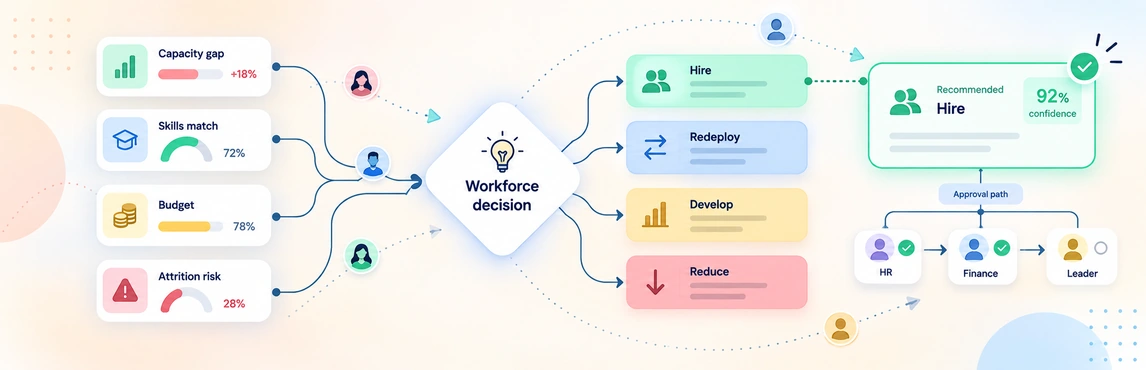
The CHRO needs decision-ready comparisons, risk visibility, and a defensible record of why one design was selected.
The strategy or org design lead needs fast scenario creation, reusable assumptions, structural analytics, and freedom to explore without affecting the source organization.
HR business partners need local context, controlled editing, comments, and a clear path from an approved design to implementation.
Finance needs consistent position, compensation, and cost-center logic across scenarios.
Security and privacy teams need least-privilege access, retention controls, traceability, and clear data flows. This is not administrative detail. People data can reveal compensation, performance, health, demographic, or succession information. The GDPR’s data-minimization principle requires personal data to be adequate, relevant, and limited to what is necessary. See Article 5 of the GDPR.
Separate Must-Haves from Preferences
A must-have should describe a testable outcome.
Weak requirement: “The tool should be easy to use.”
Testable requirement: “An HR business partner who has not received vendor coaching can duplicate the current organization, move 20 positions, compare spans and cost, request review, and export a summary within two hours.”
Write requirements as observable tasks. This makes scoring less subjective and exposes differences that a sales demonstration can hide.
Turn the Org Design Framework into Test Criteria
Do not use this page to select an org design framework. Use the framework already chosen by the reorg team to create observable software tests.
| Framework already in use | What the software evaluation should prove |
|---|---|
| Galbraith’s Star Model | Reviewers can connect proposed structure changes to strategy, processes, rewards, and people instead of assessing reporting lines alone. |
| McKinsey 7S | A scenario can retain evidence about systems, skills, staff, leadership, and shared assumptions alongside the proposed structure. |
| Nadler-Tushman Congruence Model | Evaluators can record and compare misalignment among work, people, formal structure, and informal organization. |
These are not separate product modules. They are tests of whether the platform can preserve the decision context behind a proposed structure.
Span, Layers, Cost, and Accountability
Regardless of the framework, include four practical tests in the buyer’s scorecard:
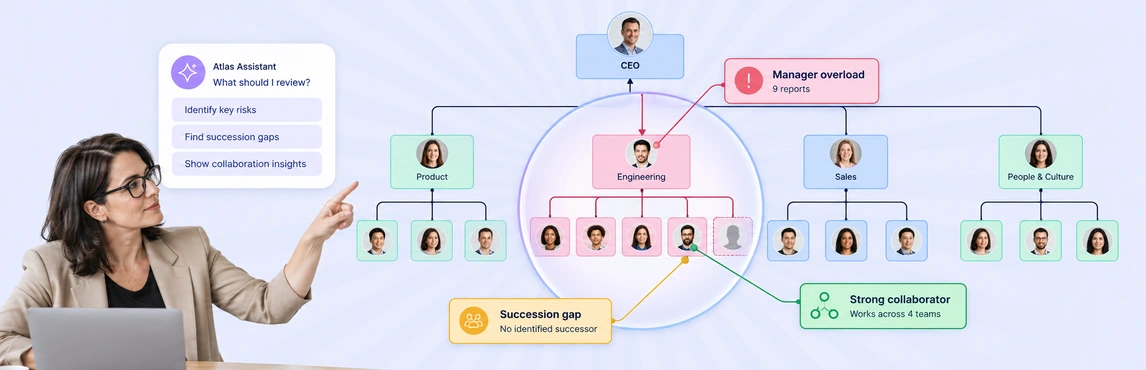
- Span: How many direct reports does each manager have, and where are spans unusually narrow or wide?
- Layers: How many management levels sit between the frontline and the accountable executive?
- Cost: How do headcount, position cost, and management cost change by scenario?
- Accountability: Does each critical outcome have a clear owner, and are decision rights understandable?
Do not treat a “recommended” span as a universal benchmark. Appropriate spans vary with work complexity, standardization, team maturity, geographic distribution, and the amount of coordination a manager must perform. Good software makes outliers visible and lets leaders examine context.
For the hands-on method of branching and comparing proposed structures, use Creately’s scenario planning for reorgs guide.
Creately’s organizational design software page shows how structure comparison, workforce data, people-versus-position modeling, and scenario planning come together in the product. Treat it as a product input, then verify each requirement in your own evaluation, including dated historical relationships, field-level sensitivity, and the old and new values recorded for scenario changes.
Phase 2: Choose the Right Reorg Software Category
Category labels are inconsistent. Evaluate the operating model behind the product.
| Category | Data model | Scenario depth | Typical strength | Typical limitation | Best fit |
|---|---|---|---|---|---|
| Diagramming and org chart tools | Shapes, connectors, and imported records | None to basic | Fast communication and familiar visual editing | Manual refresh, limited analytics, weak governance | Small or occasional reorgs with limited data |
| HRIS-native organization tools | Current people and position records | Basic to moderate | Trusted source data and existing permissions | Proposed-state modeling may be constrained by the live system | Teams whose HRIS already covers most planning needs |
| Org design and planning platforms | People, positions, units, scenarios, and metrics | Moderate to advanced | Purpose-built comparison, workforce analysis, and controlled planning | Integration and adoption effort | Recurring or complex reorgs |
| Enterprise planning suites | Multidimensional planning models | Advanced | Financial modeling, scale, and configurable logic | Specialist skills, longer setup, indirect visual workflow | Large enterprises with mature planning teams |
The correct category depends on two dimensions: reorg frequency and decision complexity.
- A one-time, small-team restructure may be managed with a visual workspace and disciplined data handling.
- A recurring planning cycle across several business units needs durable data connections, scenario governance, and repeatable analysis.
- A global transformation with complex workforce and financial models may need an enterprise planning layer, even if a simpler visual tool remains useful for stakeholder collaboration.
Phase 3: Build a Weighted Evaluation Scorecard
Use a 1-to-5 scale:
- 1: Cannot complete the requirement.
- 2: Possible only through a fragile workaround or heavy services.
- 3: Completes the basic task with meaningful limitations.
- 4: Completes the task well with manageable limitations.
- 5: Completes the task cleanly with strong controls and evidence.
Require a written justification and a link to test evidence for every score. A number without evidence is an opinion.
Functional Criteria: 40%
| Criterion | Weight | Evidence required |
|---|---|---|
| Current-state import and validation | 5% | Import representative records and identify missing or conflicting fields |
| Future-state modeling | 7% | Build a proposed structure without changing the current state |
| Multi-scenario comparison | 7% | Compare at least three options side by side |
| Span, layer, and structural analysis | 5% | Identify agreed outliers and trace them to positions |
| Headcount and cost impact | 5% | Reconcile totals to the evaluation dataset |
| Position and role modeling | 4% | Represent vacant, planned, and occupied positions correctly |
| Review and approval workflow | 4% | Route a scenario through comments, revision, and approval |
| Decision-ready output | 3% | Export an understandable executive summary with assumptions |
Technical and Data Criteria: 30%
| Criterion | Weight | Evidence required |
|---|---|---|
| HRIS and file integration | 6% | Connect or import through a repeatable, documented process |
| Refresh cadence and reconciliation | 5% | Show how stale, failed, and conflicting updates are handled |
| Role-based access and SSO | 5% | Demonstrate evaluator, reviewer, and restricted-data roles |
| Audit trail and version history | 5% | Identify who changed what, when, and in which scenario |
| API and export portability | 4% | Export core structures and assumptions in usable formats |
| Privacy, retention, and residency | 5% | Document data fields, subprocessors, retention, deletion, and residency |
Auditability should be tested, not inferred from a checkbox. NIST SP 800-53 identifies event logging, audit record content, review, retention, and protection as distinct controls. The practical lesson is simple: confirm that the platform records the events your team needs and that authorized users can retrieve and protect those records. See NIST SP 800-53 Rev. 5.
Organizational and Adoption Criteria: 30%
| Criterion | Weight | Evidence required |
|---|---|---|
| Time to first usable scenario | 6% | Measure elapsed effort from data receipt to reviewed scenario |
| Independent evaluator usability | 5% | A real user completes the test without vendor control |
| Stakeholder collaboration | 5% | Reviewers comment, compare, and sign off without full edit access |
| Implementation and support model | 5% | Named responsibilities, service levels, and escalation process |
| Customer relevance | 4% | Recent references with similar scale, data, and reorg type |
| Product direction and transparency | 3% | Clear treatment of gaps, roadmap items, and deprecations |
| Change and training support | 2% | Role-based onboarding and administrator documentation |
Calculate the weighted score, but do not let the total hide a critical failure. Define pass/fail gates for security, data accuracy, scenario isolation, and auditability before the evaluation begins.
Phase 4: Run Structured Vendor Demos
Do not ask vendors to “show the platform.” Give every vendor the same scenario and test script.
Prepare a Representative Dataset
Use synthetic or appropriately de-identified records that preserve the complexity of the real organization:
- multiple legal entities or business units;
- solid-line and dotted-line relationships;
- occupied, vacant, and planned positions;
- shared services;
- contractors and employees;
- missing or conflicting fields;
- several currencies or locations, if relevant; and
- access restrictions for sensitive fields.
Include known data-quality problems. A flawless sample proves little about how the product behaves when the source is imperfect.
Use This Five-Part Demo Script
1. Establish the current state. Import the dataset, reconcile record counts, find deliberate errors, and explain how updates are refreshed.
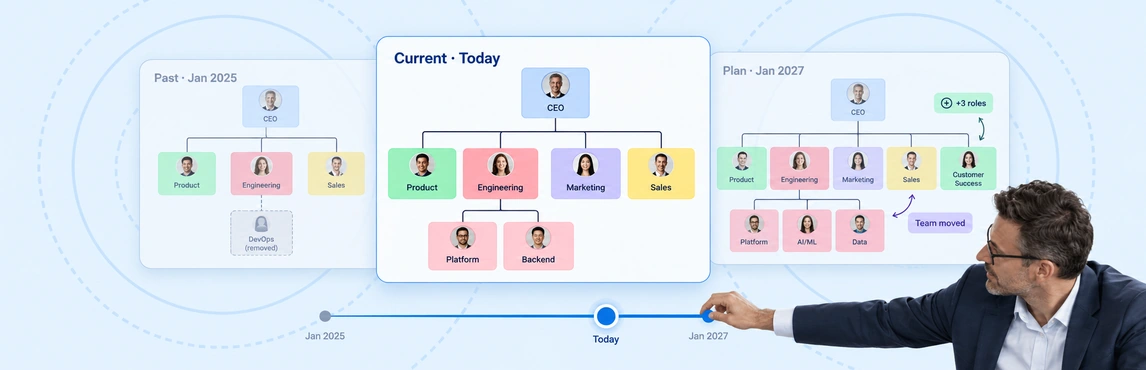
2. Create three scenarios. Model a conservative cost option, a balanced operating-model option, and a growth option. Confirm that changes remain isolated from the current state and from one another.
3. Analyze impact. Compare headcount, position cost, spans, layers, vacancies, and the movement of critical roles. Trace totals back to records.
4. Review and govern. Give an HR business partner limited editing rights, give finance access to cost data, and give an executive read-only comparison access. Request a change, revise the scenario, approve it, and retrieve the history.
5. Produce the decision package. Export an executive summary that states assumptions, material changes, financial impact, unresolved risks, and approval status.
Demo Red Flags
Pause the evaluation when:
- the vendor avoids using your representative dataset;
- “real-time” means a manual export and re-upload;
- the proposed structure cannot be separated cleanly from the live organization;
- totals cannot be traced to records;
- scenario comparison is a slide assembled outside the product;
- sensitive fields use the same permissions as basic org-chart fields;
- history records only the latest state, not meaningful actions;
- a promised requirement exists only on the roadmap; or
- independent users cannot repeat the demonstrated workflow.
After the vendor-led session, give the strategy lead or HR business partner two hours alone with the product. Observe where the workflow fails. Do not let the vendor drive.
Phase 5: Validate References and Total Cost of Ownership
Ask for three references that completed a similar reorg in the previous 12 months. A recognizable logo is not a relevant reference.
Use the same questions with each customer:
- How long did it take to produce the first trustworthy current-state model?
- What data problem consumed the most effort?
- Which capability worked differently from the sales demonstration?
- How much vendor or consultant help was required for the first reorg?
- How did business users respond after the initial project team left?
- What broke or slowed down during the reorg?
- Which recurring administration tasks were not obvious during selection?
- If you repeated the purchase, what would you test more carefully?
Build the TCO Model
Model at least three years. Include:
- subscription or license cost;
- implementation and configuration services;
- integration development and ongoing maintenance;
- data cleansing and reconciliation;
- security, legal, and procurement effort;
- administrator and analyst time;
- training and change support;
- report or export customization;
- migration from the current tool;
- contract growth assumptions;
- exit and data-export cost; and
- the cost of keeping overlapping systems.
Keep internal labor visible. If six HR analysts spend four weeks cleaning data, that is an implementation cost even when it does not appear on the vendor invoice.
Treat Implementation Estimates as Hypotheses
Implementation time depends on source-system complexity, data quality, security review, customization, and availability of decision makers. Replace broad promises with a dated plan that names:
- the owner of each data source;
- the required data fields;
- transformation and reconciliation rules;
- security and privacy approvals;
- configuration decisions;
- user-acceptance tests;
- training cohorts;
- go-live criteria; and
- rollback or exit conditions.
Phase 6: Decide Whether to Replace, Upgrade, or Add a Layer
The software decision is not always a replacement decision.
Upgrade the Existing System
Upgrade or configure the current HRIS when it already meets most requirements and the gaps come from setup, training, or an unused native module. This is often the lowest-risk path when the organization needs better current-state reporting but only limited future-state modeling.
Add an Org Intelligence Layer
Add a specialized planning layer when the HRIS is a reliable system of record but cannot support safe scenario modeling, visual comparison, structural analytics, or cross-functional review.
This is the role Creately Atlas is designed to serve: an org intelligence layer with distinct people and positions, scenario overlays, and sensitivity-controlled fields that helps HR leaders plan without replacing the HRIS. Creately Workspace provides the visual collaboration surface for working through structures and shared context. Evaluate Atlas against the same scorecard and demo script as every other shortlisted option.
Replace the Current Platform
Full replacement is justified when the existing system has fundamental data integrity, access, integration, scalability, or vendor-lifecycle problems that configuration cannot solve. Do not replace a system of record solely because a specialized planning tool offers a better scenario experience.
| Situation | Likely path |
|---|---|
| Reliable HRIS; occasional, simple reorg | Configure existing tools or use a controlled visual workspace |
| Reliable HRIS; recurring complex scenarios | Add an org design or org intelligence layer |
| Mature enterprise planning team; multidimensional workforce and finance model | Consider an enterprise planning suite plus a visual collaboration layer |
| Unreliable or unsupported system of record | Assess replacement as a separate transformation program |
Four Standardized Vendor Demo Cases
These cases are evaluation scripts, not instructions for designing the reorg. Run the most relevant case in every shortlisted product using the same sample data, assumptions, user roles, and expected outputs.
Merger Integration
Require the vendor to import two organizations and create a combined target state. Score duplicate-role handling, reporting conflicts, combined cost, Day 1 and target-state separation, access controls, and the traceability of each change.
Functional Realignment
Give the vendor a geography-led baseline and a product-led target. Score the speed and accuracy of role movement, matrix relationships, preserved history, management-layer comparison, and decision-ready output.
Growth Scaling
Require conservative, expected, and aggressive growth scenarios. Score planned-position support, cost reconciliation, assumption visibility, scenario isolation, and whether an independent evaluator can reproduce the result.
Cost Restructuring
Require a layer-reduction scenario with restricted compensation data. Score field-level access, record traceability, span analysis, alternative comparison, approval history, and export controls.
The 10 Most Common Reorg Software Selection Mistakes
- Starting with features instead of the reorg decision. Requirements become a vendor-shaped list instead of a description of the work.
- Confusing visualization with planning. A clean org chart can still rely on stale data and weak assumptions.
- Ignoring the current-to-future transition. The final structure is only one state in a longer organizational change.
- Testing one scenario. Real org design compares alternatives and makes trade-offs visible.
- Using toy data. Clean samples conceal reconciliation, permissions, and exception handling.
- Letting one function own the evaluation. HR, strategy, finance, technology, privacy, and business leaders see different risks.
- Skipping independent use. A vendor-controlled demo does not test whether internal users can perform the work.
- Treating roadmap promises as current capability. Score only what can be tested under the proposed contract.
- Comparing license prices instead of TCO. Data, integration, administration, and change effort can exceed the visible fee.
- Treating the reorg as a one-time drawing exercise. Even a one-time restructure creates ongoing decisions, history, and governance needs.
Evaluate the Work, Not Just the Software
A defensible reorg software evaluation begins with a fixed decision case and consistent evidence. Translate the existing reorg requirements into tests for scenario isolation, structural and cost analysis, data controls, collaboration, auditability, implementation, and total cost. Then require every vendor to complete the same workflow.
The best-looking interface does not automatically produce the best organizational decision. The stronger platform is the one that keeps source data trustworthy, proposed changes safely separated, trade-offs visible, sensitive information controlled, and the final decision understandable.