A talent calibration meeting should produce consistent, traceable decisions, not just adjusted ratings. To run one well, define the decisions in scope, collect comparable evidence before the meeting, discuss only meaningful differences, and finish with named actions, owners, and review dates. A focused agenda keeps the group from debating every employee equally. A decision log preserves what was decided, why it changed, and what must happen next.
What Happens in a Calibration Session?
A talent calibration meeting is a structured conversation in which leaders compare employee assessments against shared definitions and available evidence. Its purpose is to improve consistency across teams, record exceptions, and agree on accountable follow-up.
Calibration is not a forced-ranking exercise. It should not require a fixed number of employees in each category, and it should not reward the manager who argues most confidently. A useful session tests whether similar evidence leads to similar decisions across teams.
The meeting usually answers five questions:
- Are the agreed rating criteria being applied consistently?
- Where do managers disagree, and what evidence would resolve the difference?
- Which decisions can be confirmed, changed, or deferred?
- Which evidence gaps or exceptions need escalation?
- Who owns each follow-up action, and when will it be reviewed?
When to Calibrate Talent
Run a calibration session when decisions need to be comparable across managers or teams. Common triggers include:
- The end of a performance-review cycle
- Cross-team talent or workforce reviews
- Promotion and internal-mobility decisions
- Program-selection or internal-mobility reviews
- Reorganization or rapid team growth
- Evidence that ratings vary significantly between managers
- A critical-role vacancy or emerging bench-strength risk
Do not use a large calibration meeting to solve an individual conduct issue, replace a performance conversation, or decide compensation without the appropriate process. Keep the purpose explicit so participants know which decisions are in and out of scope.
Roles in the Meeting
Assign roles before inviting participants. Clear responsibilities prevent the session from becoming an unstructured management discussion.
Facilitator
The facilitator, often an HR Business Partner or talent leader, owns the process rather than an employee rating. This person:
- Restates the criteria and evidence standard
- Keeps discussion tied to the decision in scope
- Invites quieter perspectives
- Challenges vague or inconsistent judgments
- Names potential bias without assigning blame
- Confirms the decision and next action before moving on
People Managers
Managers bring evidence about employees and remain accountable for follow-up. They should explain the context behind an assessment without treating tenure, visibility, or confidence as proof that a rating is correct.
Decision Owner
The decision owner resolves genuine deadlocks and confirms tradeoffs that affect the function. This is often the functional leader, talent leader, or executive accountable for the population being reviewed.
Process Owner or Note Taker
The process owner maintains the decision log, captures evidence gaps, and records owners and dates. This role allows the facilitator to focus on the conversation.
Talent Calibration Prework Checklist
Send the prework package early enough for managers to challenge their own initial assessments. A useful package includes:
- The employee population and decisions in scope
- Definitions for every rating or decision used in the session
- The review period and evidence cutoff date
- Required evidence fields for every proposed assessment
- Current role, tenure, relevant career history, and any critical-role or vacancy context
- Goals, outcomes, and observable behavior from the review period
- Prior action progress and employee preferences, where appropriate
- Proposed placement or decision from each manager
- Decisions that require review by another group
- A list of missing or conflicting data
Ask managers to submit their assessments before the meeting. In Creately Atlas, recorded performance and potential fields can support prework, while readiness and flight risk remain restricted to authorized HR users.
Evidence Standard
Require evidence that is recent, relevant, and comparable. Strong evidence includes measurable outcomes, demonstrated scope, repeated behavior, learning progress, and examples across more than one project or stakeholder group.
Weak evidence often sounds like:
- “Everyone knows they are a star.”
- “They have been here long enough.”
- “They are not executive material.”
- “They remind me of another successful leader.”
- “They had one difficult quarter.”
The facilitator should translate statements like these into a request: What observable evidence supports the judgment, and would the same evidence lead to the same conclusion for someone on another team?
A 90-Minute Talent Calibration Meeting Agenda
Adjust the timings to the size of the employee population. The principle is more important than the exact duration: spend time on material differences and decisions, not on reading prework aloud.
| Time | Agenda item | Required output |
|---|---|---|
| 0-10 minutes | Reconfirm purpose, criteria, confidentiality, and decision rules | Shared operating agreement |
| 10-20 minutes | Review the overall talent pattern and identify anomalies | Priority discussion list |
| 20-65 minutes | Discuss employees with rating differences, evidence gaps, or material risk | Calibrated decision and evidence note |
| 65-75 minutes | Review team-level patterns, bench strength, and concentration risks | Cross-team observations |
| 75-85 minutes | Assign agreed follow-up actions | Owner, due date, and completion evidence |
| 85-90 minutes | Confirm unresolved items and follow-up cadence | Decision log and next review date |
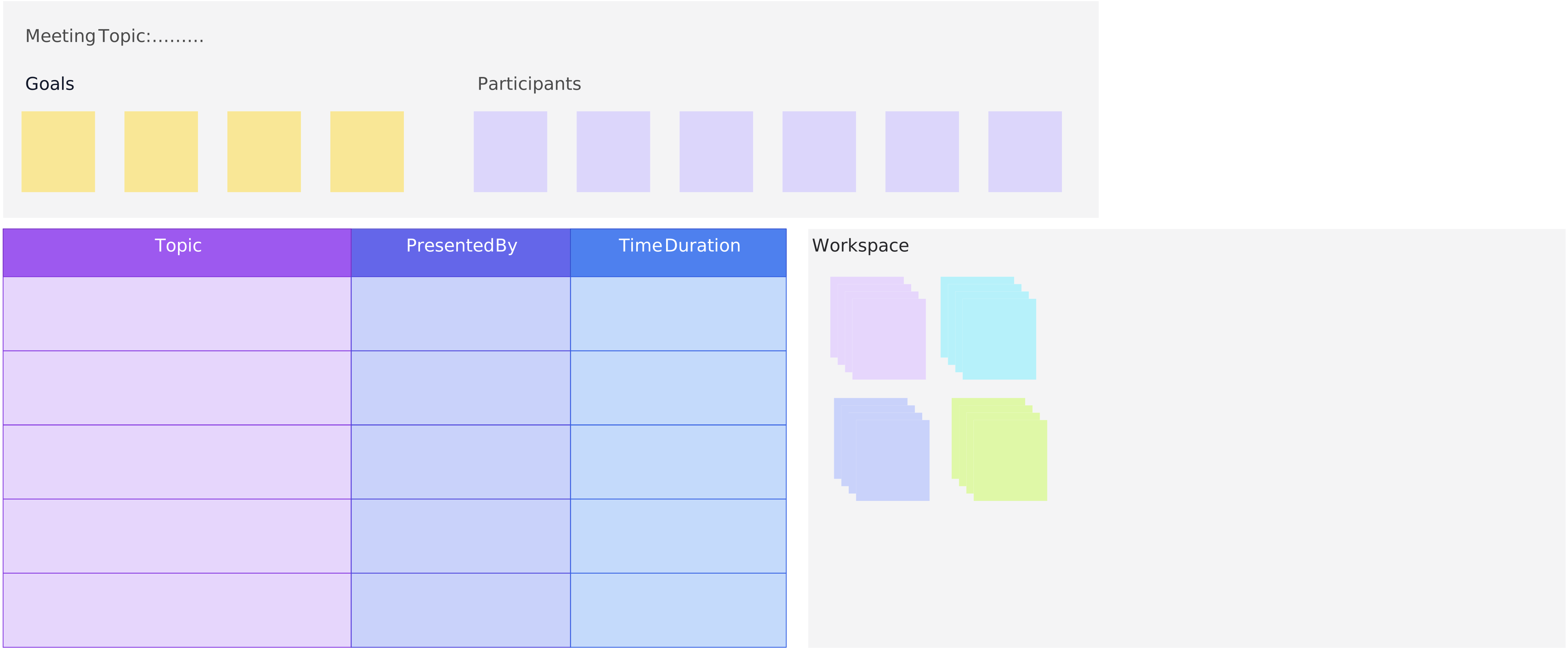
Set up these time boxes in a shared meeting agenda workspace before participants arrive. Keep the agenda visible during the session so the facilitator can park out-of-scope questions without losing them.

Opening Script
Start with a short operating agreement:
We are here to apply the same definitions to comparable evidence and decide what happens next. We will challenge assessments, not people. A change in placement is a refinement of the evidence, not a win or loss for a manager.
This framing reduces defensiveness and gives the facilitator permission to interrupt unsupported claims.
How to Facilitate the Discussion
Start with the proposed decision
Ask the presenting manager to state the proposed outcome in one sentence. For example: “I recommend confirming Jordan’s rating because the submitted evidence meets all three criteria for this review period.”
Starting with the decision helps the group evaluate relevant evidence instead of retelling the employee’s full history.
Test the evidence
Use the same questions for every contested assessment:
- What did the employee deliver during the review period?
- What scope, complexity, or ambiguity did they handle?
- Which behavior was observed more than once?
- What evidence suggests capacity for broader responsibility?
- What evidence is missing?
- What would change this assessment?
Compare like with like
Compare employees operating at similar levels or under similar expectations. A top performer in a stable role and a new employee handling a major transformation may need different context even when they share a rating.
Keep the decision fields separate
Do not collapse a rating, its supporting evidence, and the required follow-up into one judgment. Record each field separately. This makes it possible to confirm a rating while still documenting an evidence gap or assigning a follow-up action.
Close each discussion
Before moving on, state:
- The calibrated decision
- The evidence supporting it
- Any unresolved evidence gap
- The next action
- The owner and due date
- The next review point
If the group cannot decide, record what evidence is needed and who will collect it. “Discuss later” is not an actionable outcome.
Bias Checks for Talent Calibration
Bias checks work best as repeatable questions, not accusations. Pause when discussion relies on personality labels, unequal standards, or unusually recent events.
Use these prompts:
- Would we describe the same behavior differently if another employee demonstrated it?
- Are we weighting visibility more heavily than outcomes?
- Are we treating similarity to familiar employees as evidence?
- Did one recent success or setback override the full review period?
- Are employees on less visible assignments being compared fairly?
- Is the manager applying a higher evidence bar than other managers?
- Are we assuming an employee’s career preference without asking?
Review the final distribution across teams and use permitted aggregate reports for demographic comparisons. A pattern does not prove bias, but it can show where definitions or opportunities have been applied unevenly.
Talent Calibration Decision Log
The decision log is the bridge between discussion and execution. Keep it limited to information participants are authorized to access.
| Field | What to record |
|---|---|
| Employee or talent segment | The person or group discussed |
| Decision | The calibrated outcome |
| Evidence | A concise summary of the evidence used |
| Evidence gap | Missing information that could change the decision |
| Action | The agreed follow-up, escalation, or communication step |
| Owner | The person accountable for the action |
| Due date | When the action should happen |
| Success evidence | What completion or progress looks like |
| Review date | When the decision will be revisited |
Avoid recording subjective labels that cannot be explained or acted on. Access should follow the organization’s privacy, retention, and employee-data policies.
Decision Communication and Governance
The meeting record should make decisions understandable without exposing unnecessary employee information. Define who can see the working notes, who receives the approved record, and which details managers may communicate.
Prepare the approved record
Separate informal discussion notes from the final decision log. The approved record should contain the decision, concise evidence summary, action owner, due date, and review date. Remove comments that did not affect the outcome.
Route exceptions
Some decisions require review outside the meeting. Flag exceptions such as missing documentation, disagreement with policy, unavailable decision owners, or information the group is not authorized to assess. Assign an escalation owner and deadline instead of leaving the item open-ended.
Plan manager communication
Identify which outcomes require a manager conversation and what the manager is authorized to share. Calibration should improve consistency behind the scenes without turning confidential comparisons into employee-facing labels.
Control access and retention
Store the approved record according to the organization’s employee-data policy. Limit access by role, set a retention period, and avoid duplicating sensitive notes across email, chat, and personal documents.
30/60/90-Day Follow-Up Cadence
The follow-up should be lighter than the full calibration meeting but disciplined enough to keep actions current.
After 30 days
- Confirm required manager communications have occurred
- Resolve urgent evidence gaps
- Route time-sensitive actions and exceptions
- Check that every material action has an owner and date
After 60 days
- Review progress against the decision log
- Escalate blocked or overdue actions
- Update decisions affected by role or organization changes
- Check whether the same decision rules are still being applied across teams
After 90 days
- Review completion evidence
- Reopen decisions only when new evidence meets the agreed threshold
- Close completed actions and archive the approved record
- Capture process improvements for the next calibration cycle
Facilitator Checklist
Before the meeting
- Define the decisions and employee population in scope
- Publish shared definitions and evidence rules
- Assign facilitator, decision owner, and note taker
- Collect manager assessments and evidence
- Identify disagreements, gaps, and risk patterns
- Prepare a priority discussion list
During the meeting
- Reconfirm confidentiality and decision rules
- Discuss material differences rather than every employee equally
- Keep the rating, evidence, and follow-up fields separate
- Apply bias-check questions consistently
- Record the decision, evidence, action, owner, and date
- Define evidence needed for unresolved cases
After the meeting
- Share the appropriate action record with each owner
- Route approved actions and exceptions
- Protect access to sensitive employee information
- Review progress at 30, 60, and 90 days
- Improve definitions or prework based on facilitator notes
Build a Reusable Calibration Meeting Workspace
A shared visual workspace helps participants see the same agenda, definitions, evidence status, and decision state during the meeting. Create separate areas for prework, priority discussions, deferred items, approved decisions, and follow-up actions.
Keep the workspace focused on meeting control. Use consistent fields, limit sensitive information to what the audience is authorized to see, and separate working notes from the approved record. If the organization uses a talent matrix, treat it as an input and follow the 9-box talent review workflow outside this facilitation guide.