Succession bench strength answers a simple but high-stakes question: if a critical leader or expert role opens tomorrow, who can step in, how soon, and what risk remains? A strong review does not stop at naming one backup. It shows depth, readiness, concentration risk, and how the organization would absorb change across multiple roles at once.
This guide focuses on a repeatable bench-strength review model: calculate coverage metrics, find overlap and concentration risk, compare readiness by role, and assign actions every quarter.
Succession Bench Strength at a Glance
A practical bench-strength review does six things:
- Defines which roles are genuinely critical.
- Uses one readiness framework across the organization.
- Maps successor depth by role, not by anecdote.
- Tests concentration and vacancy risk.
- Converts gaps into development, mobility, hiring, or redesign actions.
- Repeats the review on a set cadence.
The goal is not to prove that every role has a perfect successor. The goal is to understand where continuity is strong, where it is thin, and what the organization must do next.
Bench-Strength Metrics to Review
Use the same measures each quarter so leaders can compare coverage over time instead of relying on anecdotal assessments.
| Metric | How to calculate it | What it reveals |
|---|---|---|
| Successor depth | Viable successors divided by critical roles | Whether important roles have enough coverage |
| Ready-now coverage | Critical roles with at least one ready-now successor divided by all critical roles | Immediate continuity strength |
| No-successor rate | Critical roles with no identified successor divided by all critical roles | The share of the portfolio with no coverage |
| Successor overlap | Successors assigned to more than one critical role divided by all named successors | Whether the same people are being counted repeatedly |
| Concentration risk | Successors from the largest contributing team or function divided by all successors | Whether coverage depends too heavily on one talent pool |
| Ready-later mix | Ready-later successors divided by all viable successors | How much coverage depends on future development |
Set definitions before calculating the metrics. Use “ready within 1 year” and “ready in 1–2 years” as distinct tiers so the ranges do not overlap.
How to Measure Succession Bench Strength
1. Keep the review position-based
Bench strength is easier to compare when roles exist as stable positions rather than being tied only to the current incumbent. That makes it possible to review readiness even as people move, leave, or take on interim scope.
2. Use a consistent readiness framework
Most teams need a simple readiness model such as:
- ready now;
- ready within 1 year;
- ready in 1 to 2 years; and
- no identified successor.
The labels matter less than consistent definitions. If one function interprets “ready soon” as six months and another interprets it as two years, the review becomes unreliable.
3. Review successor depth, not just named backups
For each critical role, ask:
- How many viable successors exist?
- Are they internal only, or is the organization assuming external hiring?
- Is there at least one near-term option?
- Are successors concentrated in one business area?
- Are the same people counted in multiple succession plans?
4. Check concentration risk
Bench strength weakens when leadership continuity depends on too few people.
| Risk pattern | What it usually means |
|---|---|
| One successor for many critical roles | Overstated coverage and unrealistic contingency planning |
| Successor depth concentrated in one team | Limited mobility and uneven development opportunity |
| No successor outside the incumbent’s direct chain | Fragile continuity if broader team changes happen |
| All viable successors are long-term only | Development is not keeping pace with business need |
| Critical roles remain vacant or interim for long periods | Structural or hiring issues are weakening the bench |
5. Compare bench strength across the organization
Reviewing roles one by one is not enough. Compare coverage by function, geography, leadership layer, or strategic capability so the organization can see patterns, not just isolated gaps.
This is especially important after reorganizations or fast growth, where one area may look strong while another is hollowed out.
How to Run a Bench-Strength Review
Step 1: Identify critical roles and continuity thresholds
List the roles that need explicit continuity coverage and define what acceptable coverage looks like. One organization may require at least one ready-now successor for every executive role. Another may allow certain technical roles to have longer readiness timelines if the external market is strong.
Step 2: Collect successor and readiness inputs
Use evidence from performance, potential, mobility, development progress, and role fit. The 9 box talent review can contribute to this step, but it should not replace role-specific successor review.
Step 3: Map successor depth visually
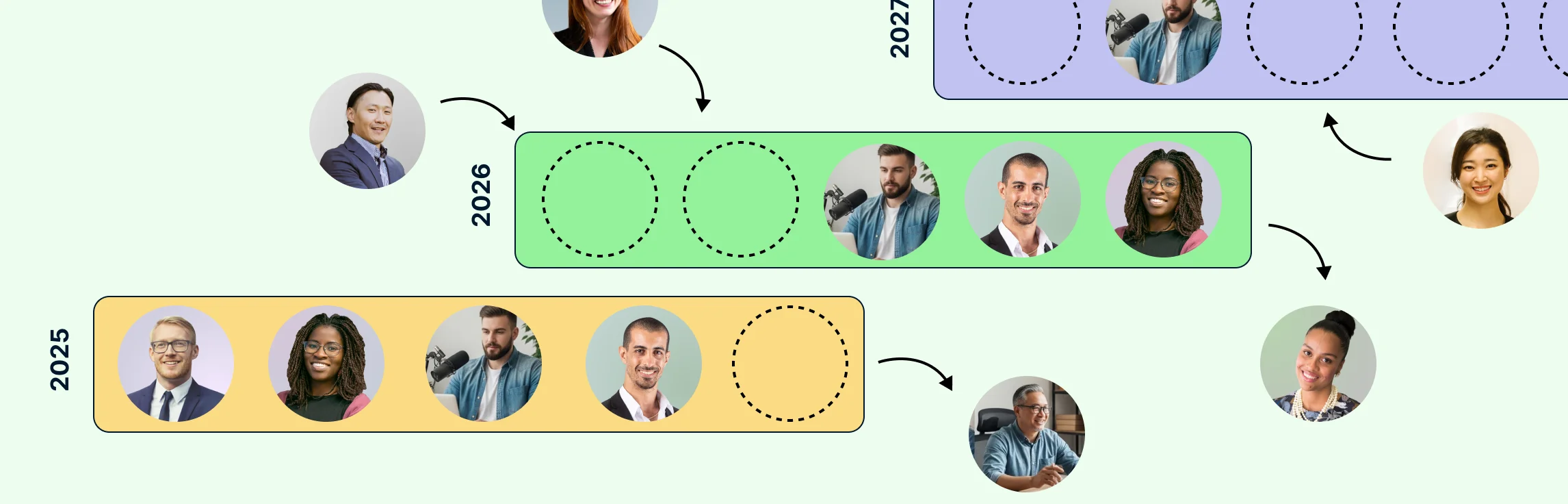
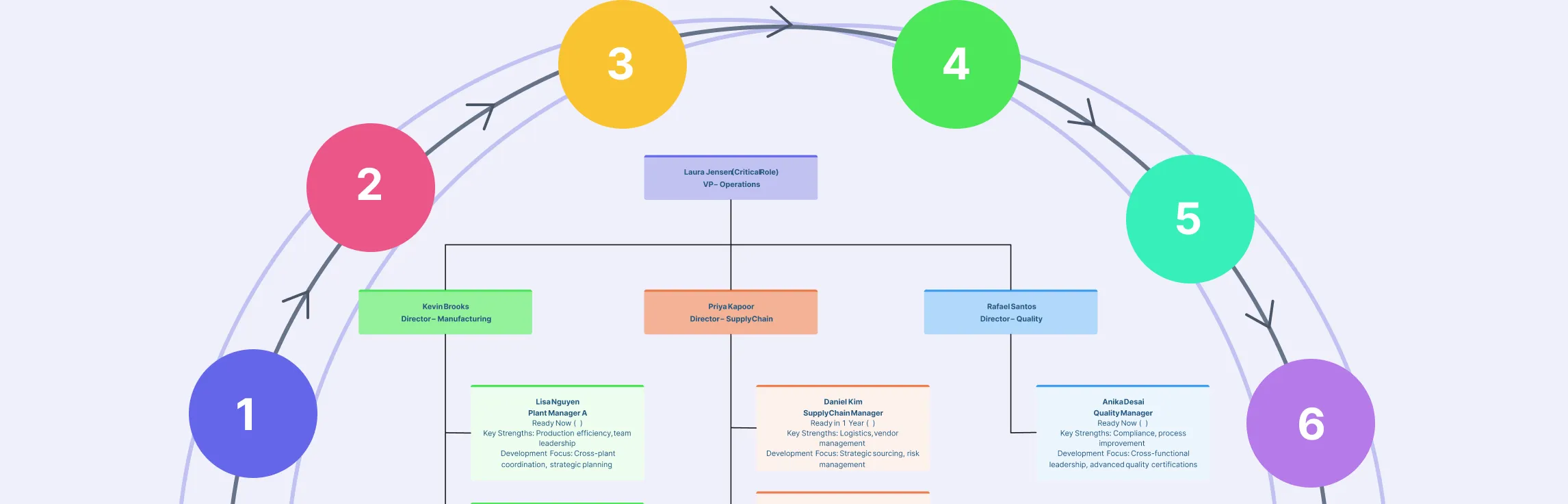
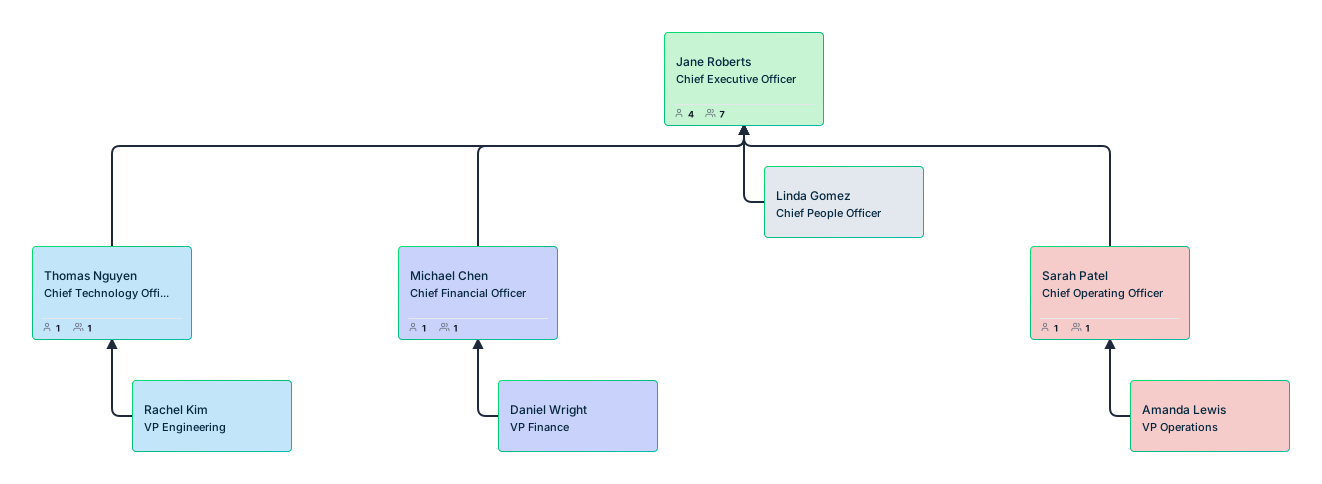
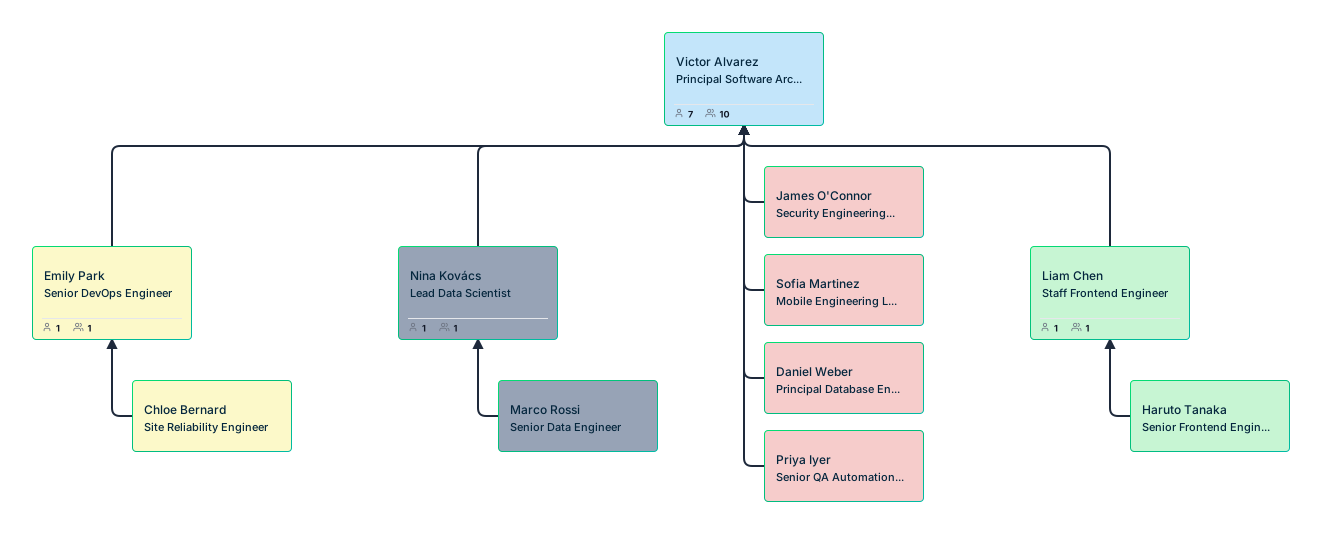
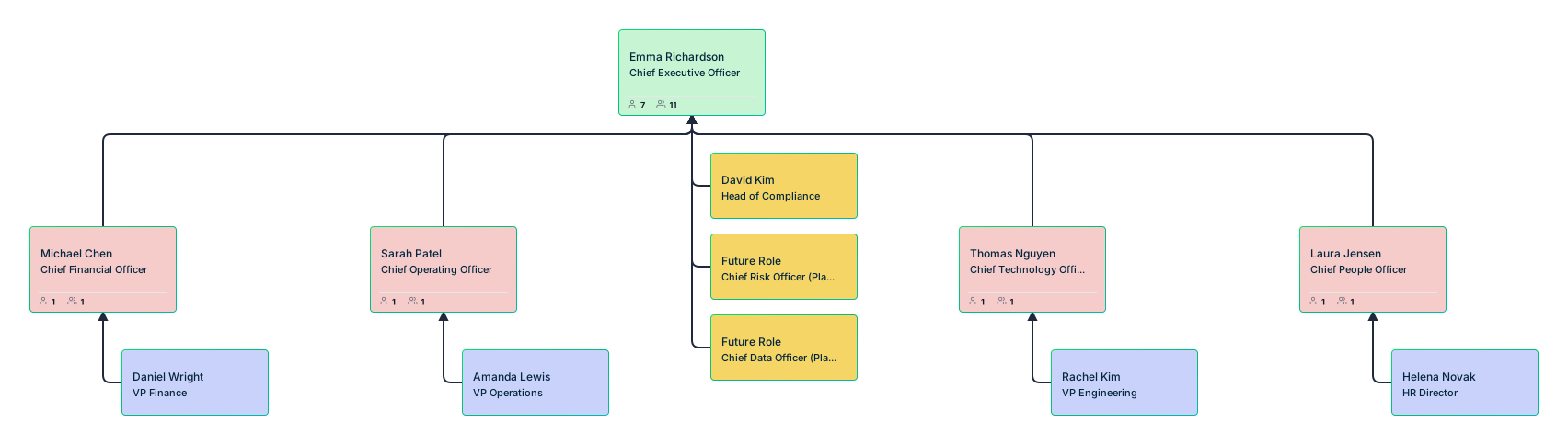
Map each critical role to its possible successors and show readiness and risk clearly. A visual org and position view helps reviewers spot where one candidate is overloaded across several succession paths or where an entire branch has no meaningful coverage.
Step 4: Test scenario pressure
Bench strength should survive more than one simple vacancy. Ask what happens if:
- two adjacent leaders exit in the same quarter;
- a reorg changes reporting relationships;
- a hiring freeze delays external support;
- a high-potential successor moves laterally; or
- a growth initiative creates new leadership roles faster than the pipeline develops.
This is where succession planning becomes more than a static chart. It becomes a continuity stress test.
Step 5: Turn the gaps into actions
A bench-strength review should produce named actions such as:
- development plans for ready-later successors;
- stretch assignments or interim rotations;
- internal mobility moves;
- targeted external hiring for roles with no realistic internal path;
- redesign of roles that are too broad for any near-term successor; and
- cadence changes for the next review.
Succession Templates for Bench-Strength Reviews
Use these templates to map critical roles, compare successor readiness, and show where coverage overlaps or remains empty.


What Strong Bench Strength Looks Like
Strong bench strength does not mean every role has many successors. It means the organization can explain and act on its coverage with confidence.
Signs of stronger bench strength include:
- clear critical-role definitions;
- at least one viable near-term path for the highest-risk roles;
- successor pools spread beyond one narrow part of the organization;
- development plans tied to actual readiness gaps;
- visibility into vacant, new, or redesigning roles; and
- regular review after leadership or structural changes.
What Weak Bench Strength Looks Like
Watch for these common warning signs:
- the same successor appears on several critical-role plans;
- leaders disagree on readiness definitions;
- succession planning exists only for executives, not for other critical roles;
- roles are person-dependent instead of position-based;
- development actions are vague or unowned; and
- the review cannot answer what happens under a reorg, freeze, or double vacancy.
Where Atlas Fits in Succession Bench Strength Reviews
Creately Atlas is designed as an always-current org-intelligence layer for HR and People leaders who need a current view of organizational structure without replacing the HRIS. In a bench-strength review, that positioning supports workflows where teams need:
- position-based views of critical roles and reporting context;
- successor and readiness overlays through structured fields or field-pack style metadata;
- scenario comparisons that show how reorganizations or vacancies change continuity coverage;
- historical views for before-and-after leadership review;
- governed collaboration so not every reviewer sees every talent field; and
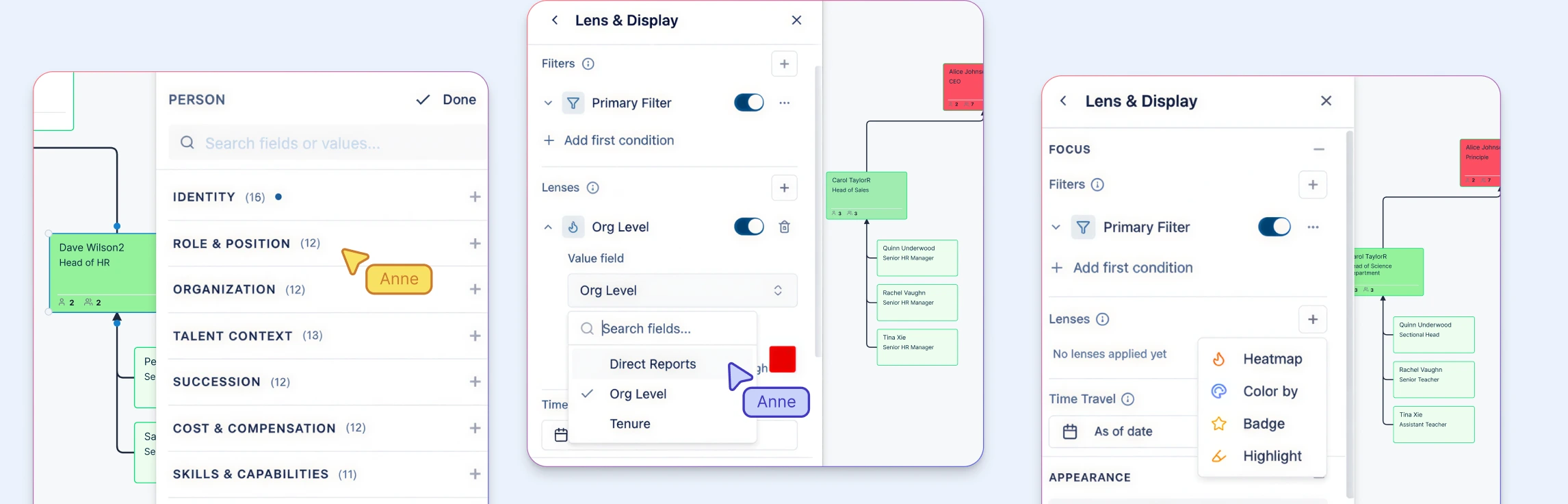
- AI-assisted org analysis to help surface bench gaps, concentration patterns, or overloaded successor pools for follow-up review.
Best Practices for Better Bench-Strength Reviews
Define readiness once
Use one readiness language across all leadership teams to avoid false comparisons.
Separate successor review from generic talent praise
A high-potential employee is not automatically a viable successor for a specific critical role.
Review multiple roles together
Bench strength is easier to judge when leadership teams can see where successor pools overlap or thin out.
Link gaps to development or hiring action
A gap with no owner is not a plan. Assign the move, development action, or hiring path needed to improve coverage.
Recheck after structural change
Any reorg, acquisition, or leadership move can change role criticality and successor readiness overnight.