Growth changes the work of running a business. Finding the first customers, delivering reliably, building a management team, and renewing a mature offering are different problems. A plan that helped at one stage may become a constraint at the next.
The stages of business growth provide a way to diagnose the current challenge and plan the next move. This guide explains five commonly used stages, the signals and metrics to watch, and how to turn the assessment into a visual growth plan.
What Are the Stages of Business Growth?
The five-stage model comes from Neil C. Churchill and Virginia L. Lewis’s Harvard Business Review article on small-business growth. Its stages are existence, survival, success, take-off, and resource maturity. Each describes a different set of questions about customers, cash, people, and systems.
Treat the model as a decision aid, not a timetable. A company can stay profitably in the success stage, move backward after a setback, or face challenges from several stages at once. Revenue or company age alone cannot tell you which stage you are in.
| Stage | Main question | Evidence to watch | Planning priority |
|---|---|---|---|
| Existence | Can we win customers and deliver the offer? | First paying customers, delivery results, cash runway | Test the business model |
| Survival | Can revenue reliably cover the cost of operating? | Repeat business, contribution margin, cash flow | Make delivery and cash management repeatable |
| Success | Do we sustain the business or prepare to expand? | Profitability, retention, owner dependency | Choose a direction and strengthen management |
| Take-off | Can we expand without losing control or cash? | Capacity, working capital, quality, manager ownership | Sequence expansion and delegation |
| Resource maturity | Can we protect performance while adapting? | Margins, customer loyalty, innovation, resilience | Renew strategy and operating practices |
These are examples of useful measures, not universal thresholds. A software company and a local services business will define healthy margins, retention, and capacity differently.
Stage 1: Existence
At existence, the business is testing whether a real customer will pay for its offer and whether it can deliver that promise. The founder often handles sales, service, and operations personally. The risk is building a polished organization around an offer that has not yet found enough demand.
Challenges: Finding customers beyond friends and early supporters; pricing the offer; delivering consistently with limited cash and time.
Metrics to watch: Qualified customer conversations, first purchases, repeat requests, delivery time or defects, and cash runway. Raw traffic and social followers can be useful context, but they do not replace evidence of paying demand.
Processes to establish: A simple record of leads and customer feedback, a reliable way to fulfill orders, and a weekly cash review. Document only the steps needed to prevent avoidable errors while the offer is still changing.
Start with a business model canvas to make assumptions visible: who the customer is, what value the offer provides, how it reaches them, and how revenue covers key costs. Revisit the canvas after real customer conversations.


For example, a meal-prep business at this stage needs to learn which customers reorder, whether deliveries arrive as promised, and whether each order covers its direct costs before planning a second kitchen.
Stage 2: Survival
A survival-stage business has proven that some customers want the offer. The question is whether enough business returns, at a workable price, to cover ongoing costs and keep operations going. Sales may be growing while the cash needed for stock, payroll, or equipment runs short.
Challenges: Turning one-off wins into repeatable demand, controlling delivery costs, and avoiding a cash gap between paying suppliers and collecting from customers.
Metrics to watch: Repeat-purchase or renewal rate, gross or contribution margin, cash collected versus cash due, on-time delivery, and complaints or rework. Choose the measures that expose the real constraint.
Processes to establish: A regular cash forecast, basic invoicing and follow-up, consistent fulfillment steps, and a way to resolve customer issues. A process map can reveal where a handoff causes delay or waste.
The meal-prep business might now have a dependable weekly order volume. Before adding more menu options, it should check whether ingredient waste, delivery costs, and late payments leave enough cash to run next week.
Stage 3: Success
The business is viable and has more choice. Its owners can build a durable, profitable operation, or invest in a larger one. Neither choice is automatically better. The important decision is to make the intended path explicit so hiring, systems, and financing support it.
Challenges: Reducing reliance on the founder, keeping quality consistent as the team grows, and deciding how much profit to reinvest.
Metrics to watch: Operating margin, customer retention, repeatable process performance, time the owner spends on routine approvals, and manager readiness. If sales rise but every exception still waits for one person, the operating model may not be ready for expansion.
Processes to establish: Clear role ownership, documented core work, a regular review of performance, and decision rights for managers. A business roadmap can show what must be in place before an expansion decision.
For the meal-prep company, success might mean a strong local business with dependable managers. Alternatively, it may decide to prepare a second location. Those paths need different staffing, cash, and operating plans.
Stage 4: Take-off
Take-off is the rapid expansion stage. Demand may be strong, but growth can consume cash and stretch managers faster than revenue becomes available. Delegation and cash planning are linked: new locations, people, and equipment all require decisions before their returns arrive.
Challenges: Funding expansion, hiring and developing managers, coordinating teams, and protecting service quality across a larger operation.
Metrics to watch: Working-capital needs, unit economics by location or product, capacity utilization, lead time, quality or defect rates, and the share of decisions handled by accountable managers.
Processes to establish: A hiring and delegation plan, consistent operating standards, a finance review tied to expansion milestones, and a way to surface problems quickly. Put dependencies on a growth roadmap: for example, train a location manager and validate delivery capacity before opening another site.

The meal-prep business might pilot one new delivery area before committing to a second kitchen. Its roadmap should include the demand test, capacity limit, manager training, cash requirement, and decision date.
Stage 5: Resource Maturity
At resource maturity, the company has people, systems, and financial resources beyond the founder. The challenge changes again: protect what works without letting established routines prevent adaptation.
Challenges: Maintaining accountability across a larger organization, responding to changing customer needs, and avoiding slow decisions or neglected innovation.
Metrics to watch: Profitability by offering or segment, customer retention, service quality, time to resolve issues, new-offer experiments, and concentration risks. Watch for good company-wide averages that hide weak products or regions.
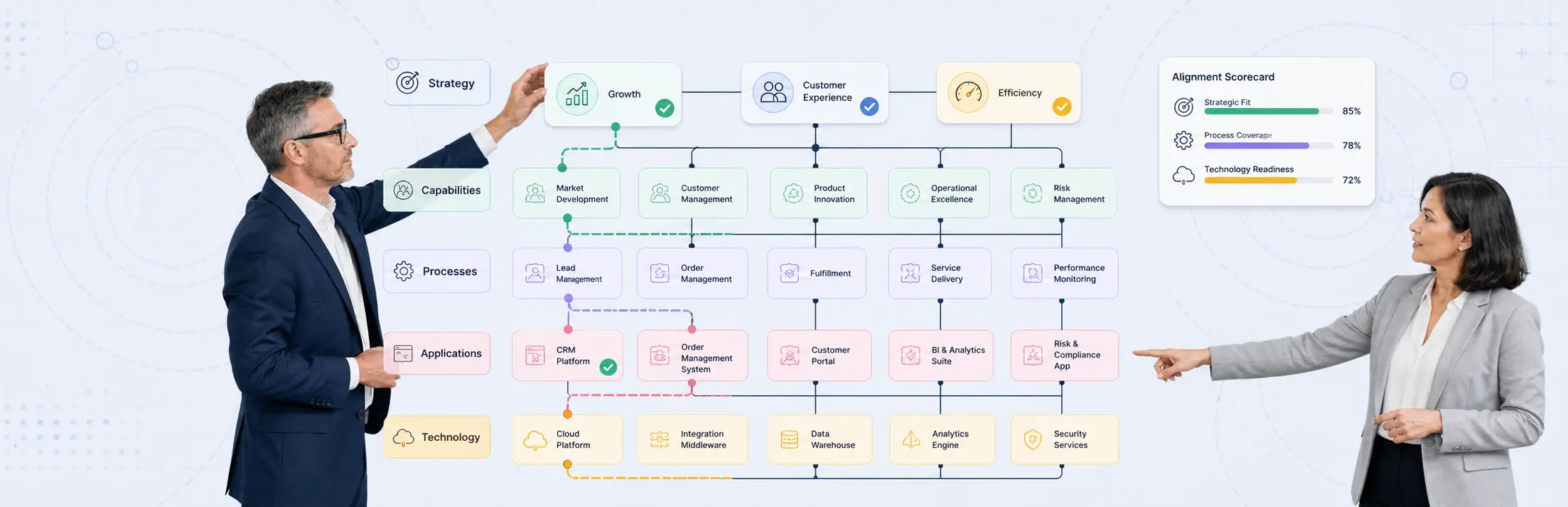
Processes to establish: Strategic reviews, clear ownership across teams, regular customer feedback, controlled experiments, and periodic updates to processes that no longer fit. A strategy map can connect financial aims, customer outcomes, internal capabilities, and learning priorities.
For the meal-prep company, maturity might bring a strong regional brand. It still needs to test changing dietary preferences and delivery habits rather than assume last year’s best-selling menu will stay relevant.
How to Assess Growth Readiness
A simple maturity check can prevent a stage label from hiding an important weakness. Review four capabilities with the people who own them. Mark each emerging, repeatable, or ready to scale, and record evidence rather than relying on a single score.
| Capability | What to examine | Example evidence |
|---|---|---|
| Customer demand | Do customers return, recommend, or renew? | Cohort retention, repeat orders, interviews |
| Cash and economics | Can the business fund normal work and planned change? | Cash forecast, margin by offering, working-capital plan |
| Delivery process | Can the team deliver reliably without heroic effort? | Lead time, errors, documented handoffs, capacity |
| Management capacity | Can decisions be made at the right level? | Named owners, manager decisions, escalation time |
Identify the weakest capability that blocks the next move. A business with strong demand but unreliable delivery should fix capacity or quality before accelerating marketing. If the evidence is missing, make gathering it the first milestone. Reassess after a meaningful change; a maturity check is a planning conversation, not a certification.
Turn the Assessment Into a Growth Plan With Creately
Use one shared Creately Workspace to keep assumptions, maps, and decisions visible to the team. Start with the business model canvas for customer and revenue assumptions. Map a troublesome workflow when delivery is the constraint. Put the next few initiatives, owners, dependencies, and review dates on a business roadmap. Use a strategy map when several functions need to align their goals.
For each planned initiative, write down the evidence that triggered it, the owner, the expected outcome, and the date to revisit it. That turns a stage assessment into a sequence of decisions rather than a permanent label.
Templates for Planning Business Growth
The body examples above use a business model canvas and a business roadmap. These additional templates support the next planning conversations without repeating those two diagrams.


Helpful Resources
Learn how to sequence initiatives and communicate a business plan over time.
Map customer segments, value, revenue, costs, and the activities behind the model.
Connect long-term goals with customer outcomes and the capabilities needed to deliver them.