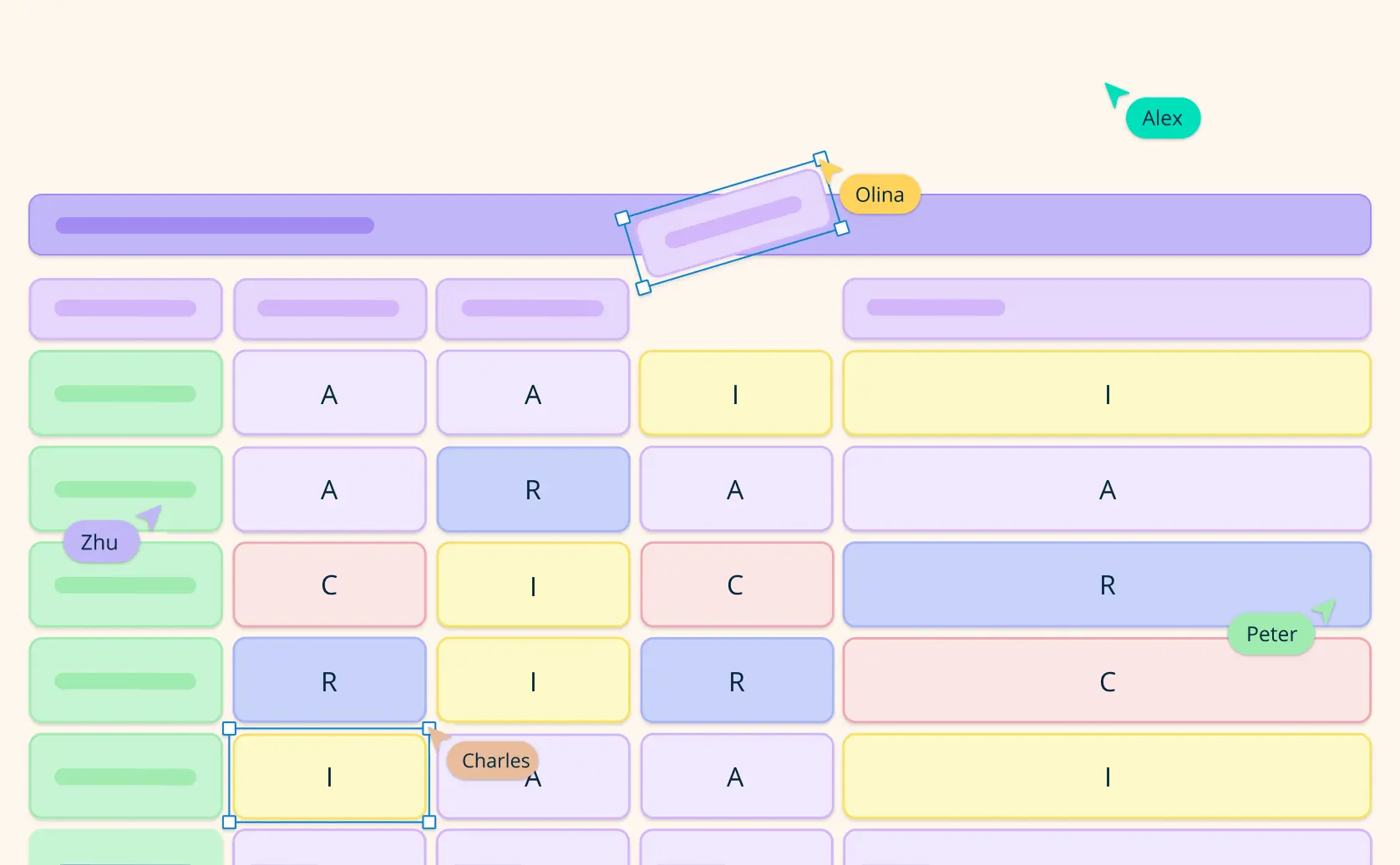
Projects often falter not from lack of talent or resources, but from unclear responsibilities and misaligned expectations. When deadlines loom and stakeholders grow anxious, the difference between success and failure often comes down to one fundamental question: Does everyone know exactly what they’re supposed to do?
The Responsibility Assignment Matrix (RAM) addresses this need for clarity in project execution. It turns vague roles and loose accountability into documented responsibility assignments. By establishing who owns the outcome, who performs the work, and who needs to be consulted or informed, a RAM helps teams coordinate project activities more confidently.
What is the Responsibility Assignment Matrix (RAM)?
The Responsibility Assignment Matrix (RAM) is an essential project management tool designed to clarify roles and responsibilities within a project. At its core, RAM serves as a blueprint for project execution by categorizing stakeholders into defined roles. These roles are Responsible, Accountable, Consulted, and Informed, commonly referred to as the RACI matrix. By employing a RAM, project managers can effectively delegate tasks, enhance team communication, and reduce ambiguity in project workflows.
RAM’s primary value lies in facilitating clearer communication and role definition among team members. By outlining who is Responsible for task execution, who holds Accountable ownership, who should be Consulted for input, and who should be Informed of progress, the matrix makes ownership visible across the workflow. This structure can reduce avoidable delays by helping people understand their duties and expectations.
In project management practices, a well-developed RAM boosts efficiency by establishing transparent pathways for delegation and consultation. It also serves as a helpful guide for integrating cross-functional team dynamics, which are vital in collaborative workspaces.
Difference Between Responsibility Assignment Matrix and RACI Matrix
In project management, both the Responsibility Assignment Matrix (RAM) and the RACI matrix serve as frameworks to define clear roles and responsibilities. However, they differ in their approach and application, necessitating a distinct understanding for effective project implementation.
| Aspect | Responsibility Assignment Matrix (RAM) | RACI Matrix |
| Structure | An overarching framework that can incorporate multiple role-designation methodologies, including RACI. | A specific type of RAM, with four defined roles: Responsible, Accountable, Consulted, and Informed. |
| Use Case | Consider when multiple role assignments and broader scope are needed. | Commonly used for clarity in simple projects; tracks responsibility allocation. |
| Flexibility | Adaptable to include additional role categories based on project requirements. | Limited to the four RACI roles, focusing on basic role clarification. |
| Ideal Scenario | Perfect for projects requiring comprehensive role assignments and accountability tracking. | Best for projects where simplicity and clear communication in role definitions are crucial. |


Roles and Responsibilities Explained

The Responsibility Assignment Matrix (RAM), an integral tool for project management, demystifies and assigns specific roles among team members, ensuring efficiency and clarity. The key components, known as the RACI model, divide responsibilities as follows:
Responsible:
This role entails the individual(s) who physically perform a task or activity. They are the action-takers who ensure the deliverables are executed. For instance, developers who are coding the features outlined in a project are tagged as responsible.
Accountable:
Crucial to the project’s success, the accountable individual is the decision-maker. They oversee the completion of work by the responsible parties, ensuring standards and timelines are met. In web development, a product manager often holds this role, signing off on a sprint before it is released.
Consulted:
These are the subject-matter experts whose opinions are sought during a task’s lifecycle. They offer guidance and feedback, ensuring insightful integration into the project. A legal consultant might review compliance documentation, providing essential advice to the project leads.
Informed:
Individuals in this category need to be kept in the loop about major project updates and decisions, though they do not directly contribute to task completion. Stakeholders, such as business owners, often fall into this group, ensuring higher-ups are aware of project progress and outcomes.
Assigning clear roles is important for reducing project delays and confusion. A well-implemented RAM supports timely communication by helping everyone understand their responsibilities in the broader project. Task mismatches or overlaps can hinder productivity, while roles and responsibilities guidance can help teams address these issues. Creately’s RACI Chart Maker provides a shared visual starting point for reviewing responsibility, accountability, consultation, and approval needs.
By effectively utilizing a RAM, teams can synchronize efforts, maintain accountability at every project stage, and achieve a harmonious workflow. This structured approach not only defines expectations clearly but also empowers team members to contribute to the project’s success confidently.
Types of Responsibility Assignment Matrices
The versatility of a Responsibility Assignment Matrix (RAM) allows it to be customized to fit the specific needs of various projects. Below, we explore a few prominent types of Responsibility Assignment Matrices that can be utilized in diverse scenarios:
Functional RAM (F-RAM):
This type is ideal for projects where tasks align closely with specific departmental functions. It leverages the expertise of functional leaders, ensuring tasks are executed within the domain knowledge, enhancing precision and efficiency.
Projectized RAM (P-RAM):
Employed in projects where focus shifts to specialized skills required for a specific project. Roles are tightly aligned with project goals rather than functional departments, allowing teams to tackle unique challenges effectively.
These variations in RAM frameworks demonstrate the flexibility in aligning matrices to the unique demands of projects, making them invaluable tools for project managers striving for clarity and efficiency in responsibility assignments.
How to Create a Responsibility Assignment Matrix
Creating a Responsibility Assignment Matrix (RAM) is an essential aspect of effective project management. It provides clarity and direction by mapping out roles and responsibilities across team members, thereby optimizing collaboration and accountability. Here’s a step-by-step guide to creating a RAM:
1. List Project Activities
The foundation of an effective RAM begins with a thorough breakdown of project activities. This step requires careful analysis of the project scope to identify all significant components, deliverables, and ongoing tasks. Work with project stakeholders to ensure no critical activities are overlooked. Break down larger activities into manageable components while keeping them substantial enough to avoid micromanagement.
Define project phases with clear start and end points
Identify major deliverables that represent significant project outcomes
List critical milestones that mark important project transitions
Include key operational tasks required for project execution
Document ongoing support activities and maintenance requirements
Specify quality control and validation activities
Add project management and coordination tasks

2. Identify Team Members
A comprehensive understanding of your project team is crucial for accurate responsibility assignment. This step involves mapping out all individuals and their roles within the project context. Consider both direct team members and those who may have periodic involvement. Document their positions, departments, and general areas of expertise to facilitate appropriate responsibility assignments.
List project managers and their specific areas of oversight
Include team leaders responsible for different project components
Document technical staff members and their specializations
Identify support personnel who provide auxiliary services
Add department representatives who need involvement
Note external resources and contractors
Specify backup personnel for critical roles
Include subject matter experts who may provide specialized input

3. Define Responsibility Types
A clear definition of responsibility types ensures consistent assignment and understanding across the project team. Unlike more complex matrices, RAM focuses on straightforward responsibility levels that clearly indicate who does what. Each type should be clearly defined and understood by all team members to prevent confusion or overlap.
Primary Responsibility
Full ownership of task completion
Authority to make decisions
Accountability for outcomes
Direct reporting obligations
Secondary Responsibility
Backup support for primary owner
Shared task execution
Collaborative decision-making
Regular involvement
Support Role
Assists primary and secondary owners
Provides specific expertise
Limited decision-making authority
Task-specific involvement
Optional Involvement
As-needed participation
Advisory capacity
No direct responsibility
Periodic consultation

4. Create the Matrix Structure
The matrix’s visual organization is crucial for usability and clarity. Create a clear, easy-to-read format that allows quick identification of responsibilities and relationships. The structure should facilitate both detailed review and quick reference, with clear headers and consistent formatting throughout.
Select appropriate software tools for matrix creation and maintenance
Design vertical activity listing grouped by project phase
Create horizontal team member listing organized by department
Include clear column and row headers
Add department and role information
Implement consistent formatting for easy reading
Consider color coding for visual clarity
Include space for notes and clarifications

5. Assign Responsibilities
This critical step involves matching team members with activities based on their skills, availability, and authority levels. Each assignment should reflect both the needs of the task and the capabilities of the team member. Ensure balanced distribution of responsibilities while maintaining clear lines of accountability.
Designate primary responsibilities with clear markers
Assign secondary responsibilities to ensure backup coverage
Indicate support roles where additional assistance is needed
Mark optional involvement for consultative roles
Verify every activity has appropriate coverage
Balance workload across team members
Consider dependencies between activities
Account for team member capacity and availability
6. Review and Validate
Thorough review helps confirm that the matrix reflects project needs and team capabilities. Conduct structured reviews with stakeholders to verify assignments, identify gaps, and resolve potential conflicts. This step is important for gaining team buy-in and making the matrix useful in practice.
Schedule review sessions with key stakeholders
Verify all activities have appropriate coverage
Check for balanced workload distribution
Confirm team member availability and capacity
Address any gaps or overlaps in responsibility
Document team agreement and acceptance
Incorporate feedback from review sessions
Finalize responsibility assignments
7. Distribute and Maintain
Using the RAM requires clear communication and ongoing maintenance. Establish processes for distribution, updates, and regular reviews so the matrix remains current throughout the project lifecycle. In a shared Creately workspace, teams can discuss assignments with contextual comments, keep notes and files connected to the matrix, and use version history to understand previous changes.
Share final matrix with all team members
Establish regular review intervals
Create update procedures
Track changes and modifications
Maintain version control system
Document change history
Set up accessibility protocols
Schedule periodic reviews
Create backup and archive procedures
Establish change approval process
Following these steps helps the Responsibility Assignment Matrix reflect agreed roles and support collaboration while reducing the risk of miscommunication.
For further visual assistance, consider exploring the Matrix Org Chart Template that can help visualize the responsibility distribution effectively, keeping alignment with project goals and organizational structure.
Helpful Resources
A hierarchical decomposition method that breaks down project deliverables into smaller, more manageable components.
A responsibility assignment framework that defines four key roles in task completion and decision-making processes.
Kanban boards provide real-time visualization of work progress through distinct stages of completion.
When Should a Responsibility Assignment Matrix be Created?
A Responsibility Assignment Matrix (RAM) is usually created during project initiation or planning and maintained throughout the project lifecycle. It is most useful once the team understands the main activities, stakeholders, and decision rights well enough to assign roles accurately.
The ideal time to create a RAM is during the project initiation and planning phases, for the following reasons:
Establish Clarity from the Start:
Creating a RAM early on helps set clear expectations and responsibilities from the very beginning of the project. This prevents confusion, overlapping work, and gaps in accountability as the project progresses.
Support Project Planning:
The RAM serves as a crucial input to other project planning artifacts, such as the work breakdown structure, project schedule, and resource planning. Defining roles and responsibilities upfront makes these downstream planning activities much more effective.
Facilitate Team Formation:
When a new project team is assembled, the RAM helps onboard members by clearly delineating their roles and expectations. This promotes faster team cohesion and productivity.
Manage Changing Scope:
As project scope evolves over time, the RAM can be updated to reflect new responsibilities and assignments. Maintaining a current RAM ensures the project stays on track despite changes.
Enable Monitoring and Control:
The RAM shows who owns and contributes to each activity, but it does not replace a project schedule or task tracker. Project managers can use it alongside those tools to identify the right person for status updates, decisions, and escalations.
Support Handoffs and Knowledge Transfer:
When team members join or leave the project, the RAM serves as a reference to quickly understand who is accountable for what, facilitating a smooth transition.
While the RAM is most critical during project initiation, it should be reviewed and updated regularly throughout the project lifecycle. This ensures the matrix remains an accurate and useful tool for managing responsibilities and facilitating project success.
Why a Responsibility Assignment Matrix is Essential for Project Success
Clarity and Accountability
A Responsibility Assignment Matrix provides a shared reference for project roles. By identifying who is Responsible, Accountable, Consulted, and Informed for relevant tasks and deliverables, it can reduce ambiguity and clarify decision paths. When challenges arise, team members can use the matrix to identify the appropriate owner or stakeholder, provided the assignments are kept current.
Enhanced Cross-Functional Collaboration
The implementation of RAM can improve how cross-functional teams coordinate their efforts. By providing a clear structure for interdepartmental collaboration, a Responsibility Assignment Matrix helps teams identify dependencies and communication paths across organizational boundaries. Team members from different departments gain a better understanding of how their work affects others, supporting clearer communication and coordination.
Risk Management and Mitigation
A Responsibility Assignment Matrix can support risk management by identifying owners for risk-related activities and mitigation work. Explicit assignments can reveal gaps in coverage and show who should be involved in an escalation. The RAM does not assess or monitor risk by itself, so teams should use it alongside a risk register and the project’s agreed escalation procedure.
Operational Efficiency
The implementation of RAM dramatically streamlines project operations by optimizing decision-making processes and resource utilization. Clear responsibility assignments reduce the need for excessive meetings and expedite issue resolution by eliminating confusion about who should address specific challenges. The matrix provides a framework for efficient workflow management, enabling better capacity planning and resource allocation. This improved operational efficiency translates directly into enhanced productivity and more effective use of project resources.
Team Empowerment
A Responsibility Assignment Matrix creates an environment of empowerment by providing team members with clear understanding of their authority and responsibilities. This clarity enables confident decision-making within defined parameters and increases job satisfaction through reduced role ambiguity. Team members can better plan their career development as they understand the full scope of their responsibilities and can identify areas for growth. The resulting increase in engagement and morale leads to higher productivity and better project outcomes.
Project Control and Monitoring
A Responsibility Assignment Matrix clarifies who should provide updates, make decisions, or address issues, which supports project oversight. Because the matrix does not record milestone completion, resource use, budgets, or deadlines by itself, teams should use it alongside their project tracking and reporting tools.
Stakeholder Management
Effective stakeholder management is greatly enhanced through RAM implementation. The matrix clearly defines communication channels and information flow patterns, ensuring that all stakeholders receive appropriate updates and are engaged at the right level. This structured approach to stakeholder management leads to better expectation management, improved client satisfaction, and more effective vendor relationships. Clear responsibility assignments for stakeholder communication reduce the risk of mixed messages and ensure consistent engagement throughout the project lifecycle.
Maintaining a Responsibility Assignment Matrix in a collaborative workspace can make ownership and handoffs easier to review as a project changes. Retrospective meetings are also useful for identifying unclear assignments and agreeing on updates to the matrix.
Common Pitfalls to Avoid
Implementing a Responsibility Assignment Matrix (RAM) can transform project management by creating clarity and structure. However, some common mistakes can hinder its effectiveness. Here’s how to avoid them:
Lack of Clarity:
Ambiguities in role definitions can lead to confusion. Ensure all team members understand their roles and responsibilities clearly within the RAM framework.
Overcomplication:
A RAM should be straightforward. Avoid including unnecessary details that complicate its purpose. Keep it streamlined for efficient communication.
Static Assignments:
Projects evolve, and so should your RAM. Regularly update role assignments to adapt to changes in project scope or personnel.
Missed Stakeholder Alignment:
Failing to engage stakeholders throughout the RAM process can result in oversight. Ensure ongoing collaboration and buy-in from all parties involved.
Tool Over-Reliance:
While templates and software tools can aid RAM creation, relying solely on them without input from your team may lead to gaps. Encourage regular discussions to complement these tools.
Avoiding these pitfalls helps keep the RAM useful as responsibilities and project conditions change.
How Creately Enhances Visual Project Management for Seamless Collaboration and Execution
Creately provides a shared visual workspace for building and maintaining responsibility assignment matrices. Here’s how teams can use its supported diagramming and collaboration capabilities:
1. Visual Task Tracking for Clear Progress Monitoring
Teams can place a RAM beside supporting project views such as Kanban boards, timelines, and process diagrams. This makes it easier to understand how responsibility assignments relate to project activities while keeping progress tracking in the appropriate project view.
2. Simplified Role and Responsibility Assignment
Editable RAM and RACI templates give project managers a structured starting point for defining Responsible, Accountable, Consulted, and Informed roles. The team should still validate each assignment and keep one clearly identified Accountable owner where the chosen framework requires it.
3. Common Workspace to Share and Manage Progress
Teams can keep notes, links, files, and relevant project context connected to the matrix in a shared workspace. This helps stakeholders find supporting information alongside the responsibility assignments and makes the RAM easier to maintain as living project documentation.
4. Real-Time Collaboration for Faster Decision-Making
Multiple users can edit the matrix together using real-time cursors and contextual comments. Stakeholders can question an assignment, provide input, and agree on changes, while the Accountable owner incorporates accepted updates. Version history provides additional context when teams need to review how the matrix changed.
5. Customizable Visual Templates for Diverse Project Needs
Customizable templates for RAM, RACI, work breakdown structures, flowcharts, and other project views help teams begin with a relevant structure. They can then adapt the content, roles, and visual conventions to their project and governance needs.
6. Integration with Other Tools for a Unified Workflow
Teams can add links and supporting references to matrix elements so relevant external context remains accessible from the visual. This keeps the RAM connected to the information used during reviews without presenting the matrix itself as a task-execution system.
By keeping role assignments, supporting context, stakeholder feedback, and change history together, Creately helps teams treat the RAM as an owned, current project reference. Clear review routines remain essential: stakeholders provide feedback, the designated owner updates the matrix, and the team confirms that assignments still reflect the work.
Sources:
AcqNotes. “Responsibility Assignment Matrix (RAM) - AcqNotes.” AcqNotes, 20 July 2017, www.acqnotes.com/acqnote/careerfields/responsibility-assignment-matrix.
Malsam, William. “How to Make a Responsibility Assignment Matrix for a Project (Template Included).” ProjectManager.com, 10 June 2021, www.projectmanager.com/blog/responsibility-assignment-matrix.
Six, Ten. “What Is a Responsibility Assignment Matrix (RAM) in Project Management?” Ten Six Consulting, 11 Apr. 2024, www.tensix.com/what-is-a-responsibility-assignment-matrix-ram-in-project-management/.
FAQ about RAM
What is a responsibility assignment matrix (RAM) in project management?
What can a responsibility assignment matrix (RAM) eliminate?
A RAM can help reduce several common project management challenges:
- Role ambiguity and confusion about task ownership
- Duplicate efforts and redundant work
- Communication gaps and information silos
- Decision-making bottlenecks
- Unclear escalation paths
- Resource allocation conflicts
- Accountability issues
It does not eliminate these problems on its own; teams must review and maintain the assignments as the project changes.
How does a RAM differ from other project management tools?
Unlike other project management tools:
- RAM focuses specifically on responsibility assignment rather than scheduling or task management
- It provides a clear framework for decision-making authority
- It explicitly defines different levels of involvement for each task
- It helps balance workload and authority across the team