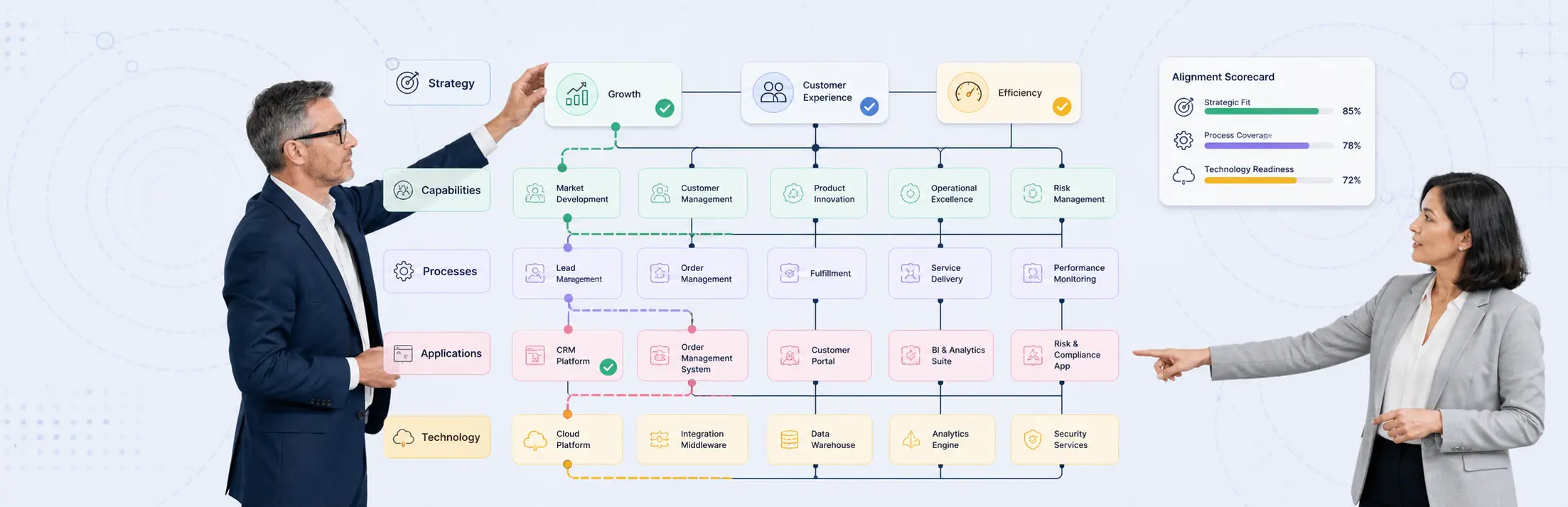
If your team has already completed a SWOT, VRIO, or value-chain analysis, the next mistake is often turning too many findings into goals. That usually creates bloated OKRs, confused ownership, and reporting noise. The better move is to decide which findings deserve focused execution and which should stay as evidence, operational work, risks, or backlog. This guide shows how to make that prioritization before you write a single OKR.
When to Use This Playbook
Use this guide when:
- You already have strategy inputs such as SWOT findings, VRIO insights, value-chain observations, or a strategy-map draft.
- Leaders agree the analysis is directionally useful, but execution is still vague.
- Teams need a shared way to decide which findings deserve measurable work.
Do not use this page as your primary explainer for strategy maps, balanced scorecards, or OKR basics. This guide starts after the analysis is done and focuses on selection, not full execution design.
This guide is not a replacement for the underlying frameworks. If you need the definitions or templates first, start with VRIO analysis, value chain analysis, or the OKR guide.
What Good Prioritization Looks Like
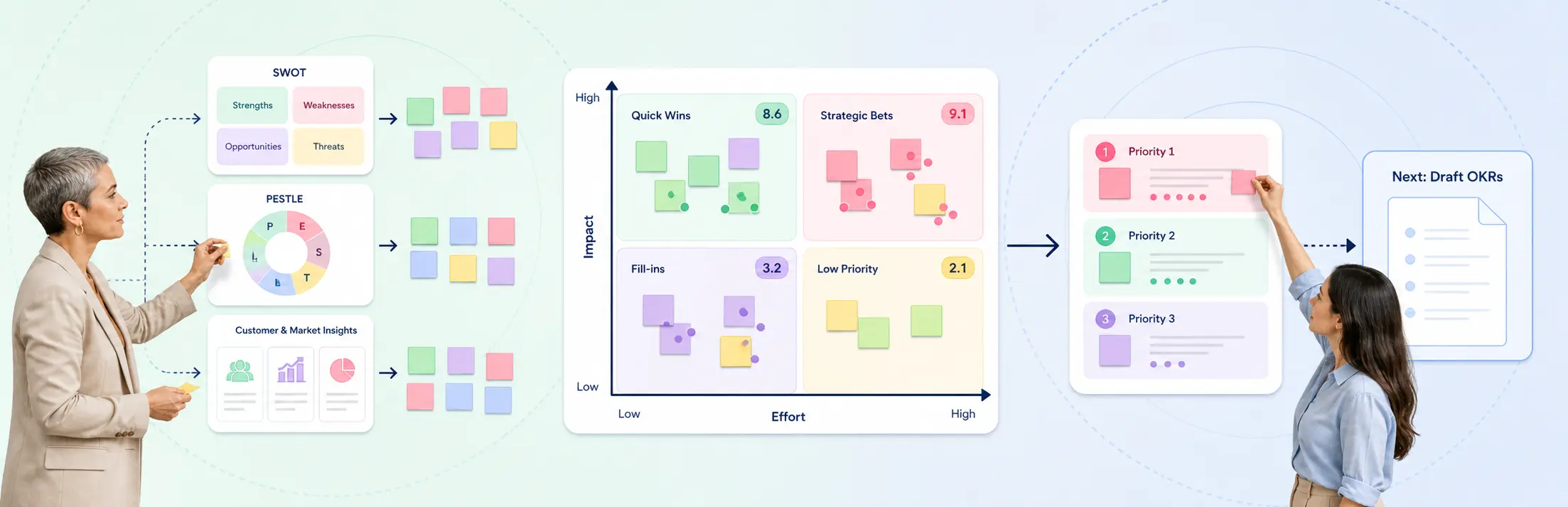
The goal is not to carry every note forward. The goal is to separate signal from noise so only the few findings that change direction become OKR candidates.
| Finding type | Likely next home | Why |
|---|---|---|
| Strategic finding | OKR candidate | It changes direction and deserves focused execution |
| Repeating delivery problem | Operational improvement | It needs fixing, but not necessarily a top-level OKR |
| Emerging uncertainty | Research or discovery backlog | The team still needs evidence before setting a goal |
| Ongoing exposure | Risk register or monitoring metric | It should be watched, not turned into a quarterly objective |
| Supporting observation | Evidence under a bigger choice | It informs the decision but should not become its own goal |
Where Teams Usually Get Stuck
Teams rarely struggle because they lack frameworks. They struggle because the workshop output is still a list of observations, not a decision package someone can run with.
That handoff usually breaks in one of three places:
- The team keeps every finding instead of prioritizing the few that change direction.
- The strategic choice stays implicit, so every function champions a different finding.
- Teams write OKRs too early, before deciding what belongs in an OKR at all.
This guide focuses on fixing that decision filter. It is not a general explainer on strategy maps, balanced scorecards, or OKR basics.
The Prioritization Filter in 5 Moves
1. Consolidate Findings Into a Short Decision List
Most analysis outputs are observations. Before you write OKRs, reduce them into a short list of findings that may justify action.
For example:
- SWOT finding: onboarding is a strength, enterprise trust is a weakness.
- VRIO finding: your workflow library is valuable and difficult to copy.
- Value-chain finding: handoffs between sales, implementation, and support delay time-to-value.
Those findings suggest a strategic direction, but they are not all equal. The question is not “How do we write three OKRs from this?” The question is “Which of these findings actually deserves focused execution?”
2. Test Each Finding Against Four Prioritization Questions
For every shortlisted finding, ask:
- Does it change strategic direction, or is it just informative?
- Does solving it require coordinated focus across a cycle?
- Can progress be measured meaningfully?
- Is the impact large enough to displace other priorities?
If the answer to most of these is “no”, the finding probably should not become an OKR.
3. Sort Findings Into Buckets Before Drafting Goals
Use a simple sorting rule:
- Promote to OKR candidate when the finding clearly points to a strategic choice with measurable impact.
- Keep as operational improvement when the work matters but belongs in normal delivery management.
- Keep as risk or monitoring item when the team should watch it rather than mobilize around it.
- Keep as research/backlog when evidence is still incomplete.
In practice, one workshop often produces ten to twenty findings but only one to three real OKR candidates.
4. Turn Only the Top Findings Into One Strategic Choice
Once the findings are sorted, combine the top candidates into one clear strategic choice.
Using the earlier example, the findings may support this choice:
Win regulated mid-market accounts by improving implementation speed and governance readiness.
That is the point where the team is ready to write an OKR. Before that, you are still prioritizing.
5. Draft the First OKR Only After the Choice Is Clear
Now write the first OKR draft:
- Objective: Improve implementation confidence for regulated mid-market accounts
- Key Result 1: Reduce implementation cycle time from 21 days to 10 days
- Key Result 2: Increase activation rate from 58% to 75%
- Key Result 3: Raise buyer satisfaction with onboarding and governance readiness from 3.8 to 4.4 out of 5
The important point is sequencing: findings first, prioritization second, OKR drafting third.
Worked Example: From Analysis to Execution
Here is a simple example of how prioritization changes the output.
Framework Outputs
- SWOT: strong product adoption after onboarding, weak enterprise security perception
- VRIO: proprietary workflow templates are valuable, rare, and not easy to copy
- Value chain: implementation delays occur during handoffs between sales, onboarding, and support
Sorting the Findings
- Promote to OKR candidate: implementation delays across handoffs
- Promote to OKR candidate: governance readiness is blocking buyer confidence
- Use as supporting evidence: workflow templates are hard to copy
- Do not promote directly: general product adoption strength after onboarding
Strategic Choice
Win regulated mid-market accounts by reducing time-to-value and strengthening governance readiness.
First OKR Draft
- Objective: Improve implementation confidence for regulated mid-market accounts
- Key Result 1: Reduce implementation cycle time from 21 days to 10 days
- Key Result 2: Increase activation rate from 58% to 75%
- Key Result 3: Raise buyer satisfaction with onboarding and governance readiness from 3.8 to 4.4 out of 5
What Did Not Become an OKR
- The strong workflow library remains supporting evidence for the choice.
- The general adoption strength is useful context, but it is not the priority problem to mobilize around this cycle.
This is the heart of the angle: not every valid finding deserves a goal.
Common Mistakes to Avoid
- Promoting every finding to a goal: most analysis outputs are evidence, not objectives.
- Skipping the sorting step: if you move straight from workshop notes to OKRs, weak findings become fake priorities.
- Choosing findings that are already business-as-usual: not every delivery issue needs executive goal status.
- Writing OKRs before making a strategic choice: metrics do not create focus on their own.
- Confusing supporting evidence with the main priority: strong evidence should inform the goal, not multiply the number of goals.
Helpful Resources
Use this guide when you need to evaluate which resources and capabilities can support a defensible strategic choice.
Use this guide to identify where value is created, where friction appears, and which process gaps should feed into the cascade.
Use this guide after prioritization is complete and you are ready to write objectives and measurable key results.
FAQs on Prioritizing Framework Findings Before Writing OKRs
Should every SWOT, VRIO, or value-chain finding become an OKR?
What makes a framework finding strong enough to become an OKR?
What should happen to findings that do not become OKRs?
Do you need a strategy map before prioritizing findings?
When are you ready to start writing OKRs?
Sources
- Kaplan, Robert S., and David P. Norton. Having Trouble with Your Strategy? Then Map It. Harvard Business Review, September-October 2000.
- Google re:Work. Set goals with OKRs.