Trauma Counseling Case View
Frames the family structure around the main counseling or therapy focus.
Frames the family structure around the main counseling or therapy focus.
Shows partners, parents, children, and siblings involved in the case.
Leaves room to note conflict, closeness, distance, or support.
Keeps discussion points visible for assessment and follow-up.
Connects current concerns with relevant family history.
Clarifies caregiving, custody, parenting, or support responsibilities.
Supports shared review before deeper clinical notes are added.
Can be extended as the conversation reveals more family context.
Explore trauma history, family and chosen relationships, mental-health context, and sources of support in one editable counseling genogram.
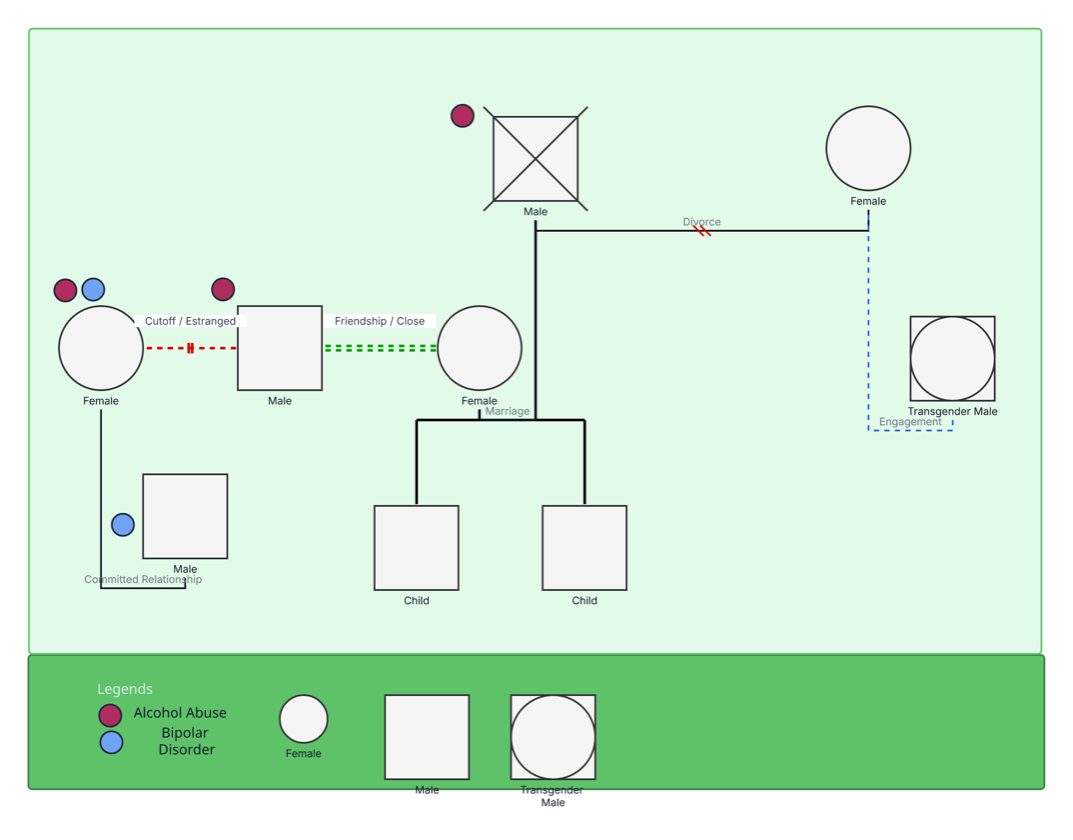
This trauma counseling genogram combines a compact family structure with mental-health, substance-use, and emotional relationship information that can guide collaborative therapeutic exploration.
The example contains nine people across three generations. It includes a divorced couple in the oldest generation, a married couple and an engaged transgender male in the middle generation, a committed relationship in another family branch, and two children. One person is marked deceased.
The legend identifies alcohol abuse and bipolar disorder. Colored markers show where those categories occur in the family. Two relationship lines add emotional context: one connection is labeled Cutoff / Estranged, while another is labeled Friendship / Close. Together, these elements help users explore difficult patterns alongside trusted and supportive connections.
This trauma counseling genogram helps counselors, care teams, learners, and clients organize difficult experiences alongside identity, coping, and trusted relationships.
Explore trauma-related patterns, boundaries, recovery goals, and sources of support.
Coordinate family, chosen-family, treatment, and community context around a shared case view.
Practice inclusive, trauma-informed notation and review case formulation.
Map meaningful relationships using preferred identities, pronouns, and relationship terms.
Standard and inclusive family symbols establish the structure, while colored markers and relationship lines add counseling context.
Male family member
Female family member
Transgender male in this example
Deceased family member
Marriage or partner relationship
Divorce
Engagement
Committed relationship
Cutoff or estranged relationship
Friendship or close relationship
Alcohol abuse or bipolar disorder, as defined in the legend
Use this example when counseling work needs a shared view of trauma-related family patterns and current support.
Add the focus person, relatives, partners, former partners, children, chosen family, important dates, living status, and current relationship status.
Mark friendship, closeness, supportive people, safe relationships, coping resources, treatment, and community connections that can support recovery.
Add reported experiences, estrangement, mental-health or substance-use information, losses, triggers, treatment history, and current impact using neutral and specific language.
Identify boundaries, safety needs, coping strategies, relationships to strengthen, referrals, support people, and practical next steps agreed in counseling.
Creately Clinical provides inclusive person shapes, structured notes, and relationship markers for counseling-focused genograms. It supports collaborative review while keeping identity, sensitive context, strengths, and therapeutic goals attached to the appropriate people and connections.
Include family and chosen relationships, significant experiences, losses, mental-health or substance-use context, coping, treatment, close supports, protective factors, and information relevant to the counseling goal.
Yes. Add chosen-family relationships, gender identity, pronouns, and relationship terms using the language each person prefers. Adapt symbols and labels so the map represents the family accurately and respectfully.
Use neutral and specific language, distinguish reported from observed or confirmed information, follow consent and safety procedures, and limit access according to professional and organizational requirements.
Custom fields, notes, inclusive symbols, relationship markers, and visual categories can keep counseling context organized. Shared editing, comments, version history, and exports support reflection, supervision, and coordinated care.
Edit the genogram to map the family and chosen support network, add strengths and trauma-related context, and create a respectful shared visual for safety, recovery, and therapeutic change.