for Analyzing Intergenerational Trauma Case View
Frames the family structure around the main counseling or therapy focus.
Frames the family structure around the main counseling or therapy focus.
Shows partners, parents, children, and siblings involved in the case.
Leaves room to note conflict, closeness, distance, or support.
Keeps discussion points visible for assessment and follow-up.
Connects current concerns with relevant family history.
Clarifies caregiving, custody, parenting, or support responsibilities.
Supports shared review before deeper clinical notes are added.
Can be extended as the conversation reveals more family context.
Explore family relationships, alcohol-use history, mental health information, and sources of connection across generations using this trauma-informed genogram on Creately Clinical.
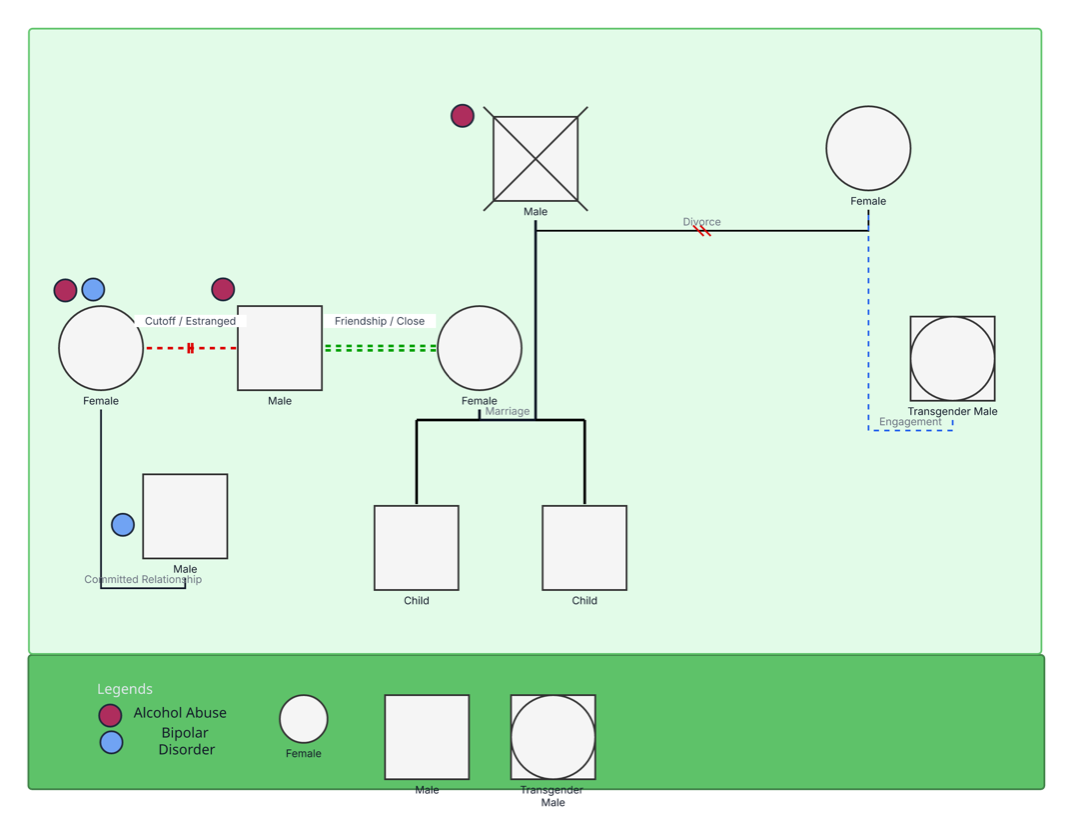
This intergenerational trauma genogram helps clients and professionals organize family history, relational patterns, mental health information, and supportive connections across generations—creating a shared visual foundation for careful exploration and recovery-focused conversations.
The example maps nine people across three generations. Its legend identifies three alcohol-use tags and two bipolar-disorder tags. A deceased family member appears in the oldest generation, while the broader family structure includes divorce, marriage, engagement, a committed relationship, and two children.
The emotional relationship lines include cutoff or estrangement and friendship or closeness. These contrasting bonds help keep both difficult experiences and potential sources of connection visible. The diagram does not establish that trauma, alcohol use, or bipolar disorder caused another person’s experience; it organizes documented context that a qualified professional can explore collaboratively.
This intergenerational trauma genogram can help behavioral-health professionals, learners, and clients organize family history, relationship patterns, and sources of support in one clear view.
Explore multigenerational context, treatment history, relationships, coping, and protective factors at a client-led pace.
Create a shared view for case conceptualization, supervision, and multidisciplinary review.
Practice trauma-informed genogram methods with fictional or de-identified information.
Collaboratively map relevant history and strengths with appropriate consent and professional guidance.
Use the legend and relationship labels consistently, and distinguish diagnoses from observations or family reports.
Male family member
Female family member
Transgender male family member
Deceased family member
Alcohol abuse, using the terminology shown in the example legend
Bipolar disorder, as defined by the example legend
Cutoff or estranged relationship
Friendship or close relationship
Use this example when a family-systems conversation benefits from seeing multigenerational context and supportive relationships together.
Add the identified person, partners, children, parents, and grandparents. Confirm relationships and life events before adding sensitive clinical information.
Separate confirmed diagnoses, treatment history, self-reports, family reports, and professional observations. Use respectful language and note dates or sources when they help interpretation.
Map closeness, estrangement, conflict, caregiving, community support, coping resources, and other relevant dynamics. Let the client guide which details are useful to include.
Explore possible patterns as questions rather than conclusions. Check the client’s comfort, preserve choice, and revise the genogram as understanding develops. Limit access to sensitive information appropriately.
Creately Clinical supports trauma-informed family mapping with therapy and medical fields, relationship-focused views, controlled collaboration, and report-ready outputs.
No. A genogram can reveal topics worth exploring, but it does not establish cause or prove that one person’s experience produced another’s. Interpretation should consider each person’s history, culture, environment, relationships, and strengths.
Record it as a diagnosis only when documented or reliably reported, and keep suspected symptoms or observations separate. Bipolar disorder requires assessment by a qualified health professional; family history can inform evaluation but does not diagnose another relative.
Prioritize physical and emotional safety, transparency, collaboration, and the person’s voice and choice. Explain why information is being requested, allow the person to pause or omit details, and include strengths, supports, and paths toward recovery.
The Family Therapy field pack supports emotional bonds, coping strategies, trauma history, treatment, goals, and intergenerational patterns. Medical & Genetic fields can record mental health and substance-use information, while Relationship Dynamics view, comments, permission-based sharing, and PDF or DOCX reports support collaborative professional review.
Edit the genogram to map family context, recognize sources of connection, and create a shared visual that supports careful, collaborative exploration.