Clinical Case Case View
Frames the family structure around the main counseling or therapy focus.
Frames the family structure around the main counseling or therapy focus.
Shows partners, parents, children, and siblings involved in the case.
Leaves room to note conflict, closeness, distance, or support.
Keeps discussion points visible for assessment and follow-up.
Connects current concerns with relevant family history.
Clarifies caregiving, custody, parenting, or support responsibilities.
Supports shared review before deeper clinical notes are added.
Can be extended as the conversation reveals more family context.
Map family structure, relationship history, emotional dynamics, and inclusive identities in one editable clinical genogram.
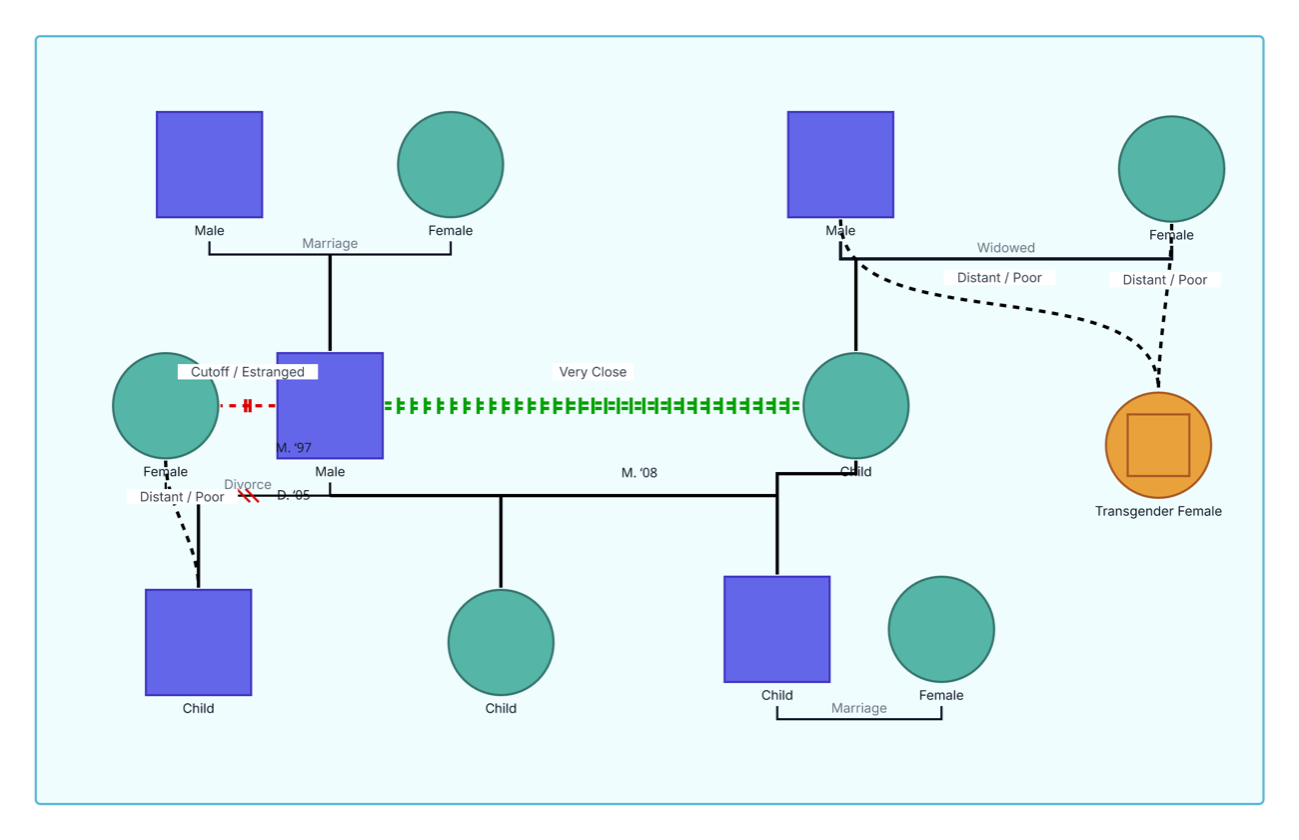
This clinical case genogram brings family structure and emotional relationships into one view, helping practitioners understand who is connected, how relationships have changed, and where important bonds shape the case.
The example maps 11 people across three generations using anonymous role labels. Marriage and divorce dates add a timeline to the family structure, while a widowed relationship records bereavement within another branch of the family.
Emotional-relationship lines add clinical depth by showing very close, distant or poor, and cutoff or estranged connections. The combined transgender female symbol demonstrates how identity information can be represented respectfully alongside the wider family system.
This clinical case genogram example helps practitioners and care teams organize family structure, relationship history, emotional dynamics, and significant life events in one clear view.
Build a systems view for intake, assessment, formulation, and treatment planning
Document family members, changing unions, support, loss, and relevant relationship dynamics
Review clinical context and relationship patterns using a shared visual reference
Practice combining standard family notation with emotional and inclusive identity markers
Each line adds a specific layer of meaning. Family connections establish the structure, while emotional-relationship lines show the quality of important relationships within the case.
Male family member
Female family member
Represents a transgender woman using the selected inclusive notation
Connects married partners; dates can record when the marriage began
Shows a dissolved marriage; dates can record when the divorce occurred
Records that a spouse or partner has died
Shows a strong emotional bond
Shows limited contact or a low-quality emotional connection
Shows an emotional cutoff or estranged relationship
Connects a child to the relevant parent or parental union
Use this example when a practitioner needs a concise systems view for intake, assessment, treatment planning, supervision, or a collaborative family conversation.
Add the person receiving support and the immediate family members who are most relevant to the case. Use the names, pronouns, and identity terms each person prefers.
Add parents, siblings, children, grandparents, partners, and other significant people. Connect them using the relationship type that best reflects the family structure.
Record important marriage, divorce, death, separation, or household-transition dates. Then add very close, distant, cutoff, conflict, or other relationship dynamics that are useful to the clinical purpose.
Invite the client or family to clarify relationships, identify sources of support, and add relevant context. Use the finished genogram to guide goals, questions, and next steps while keeping access and sharing appropriate to the case.
Creately Clinical supports case formulation with clinical relationship notation, structured therapy fields, inclusive person shapes, collaborative review, and case-ready reports.
For this example, the Base and Family Therapy field packs are the most relevant capability set. Family Therapy fields can record attachment style, emotional bonds, family roles, trauma history, coping strategies, treatment, and goals, while auto-derived person shapes keep identity and life-status notation consistent with the underlying data.
A family tree primarily shows lineage. This clinical genogram also records union history, emotional bonds, losses, identity information, and relationship patterns that help explain how the family system functions.
Generic labels make the example easy to adapt for teaching or a new case. Replace them with the level of identifying information appropriate to your workflow and privacy requirements.
Yes. You can add attachment style, emotional bonds, family roles, trauma history, coping strategies, mental health treatment, treatment goals, and therapy notes through Creately's Family Therapy fields.
Creately provides relationship subtypes for closeness, distance, cutoff, conflict, and other dynamics. The Relationship Dynamics viewpoint, collaborative editing, comments, auto-save, and PDF or DOCX case reports help teams move from intake to review and documentation in one workspace.
Edit the genogram, replace the anonymous roles with the people relevant to the case, and map the relationships that matter most. Add dates and emotional dynamics, invite collaborative review, and use the completed visual to support clearer case formulation and next steps.