Intergenerational Spiritual Spiritual Map
Shows spiritual identity, practices, and family relationships together.
Shows spiritual identity, practices, and family relationships together.
Captures affiliation, tradition, belief shifts, or spiritual influences.
Connects spiritual patterns across relatives and generations.
Leaves room for worship, rituals, coping practices, and values.
Keeps households, couples, children, and relatives clear.
Helps identify sources of support, tension, belonging, or change.
Supports counseling, chaplaincy, or care conversations.
Can be updated as beliefs, roles, or practices change.
Map family history, faith influences, formative relationships, losses, and historical context using this intergenerational spiritual genogram on Creately Clinical.
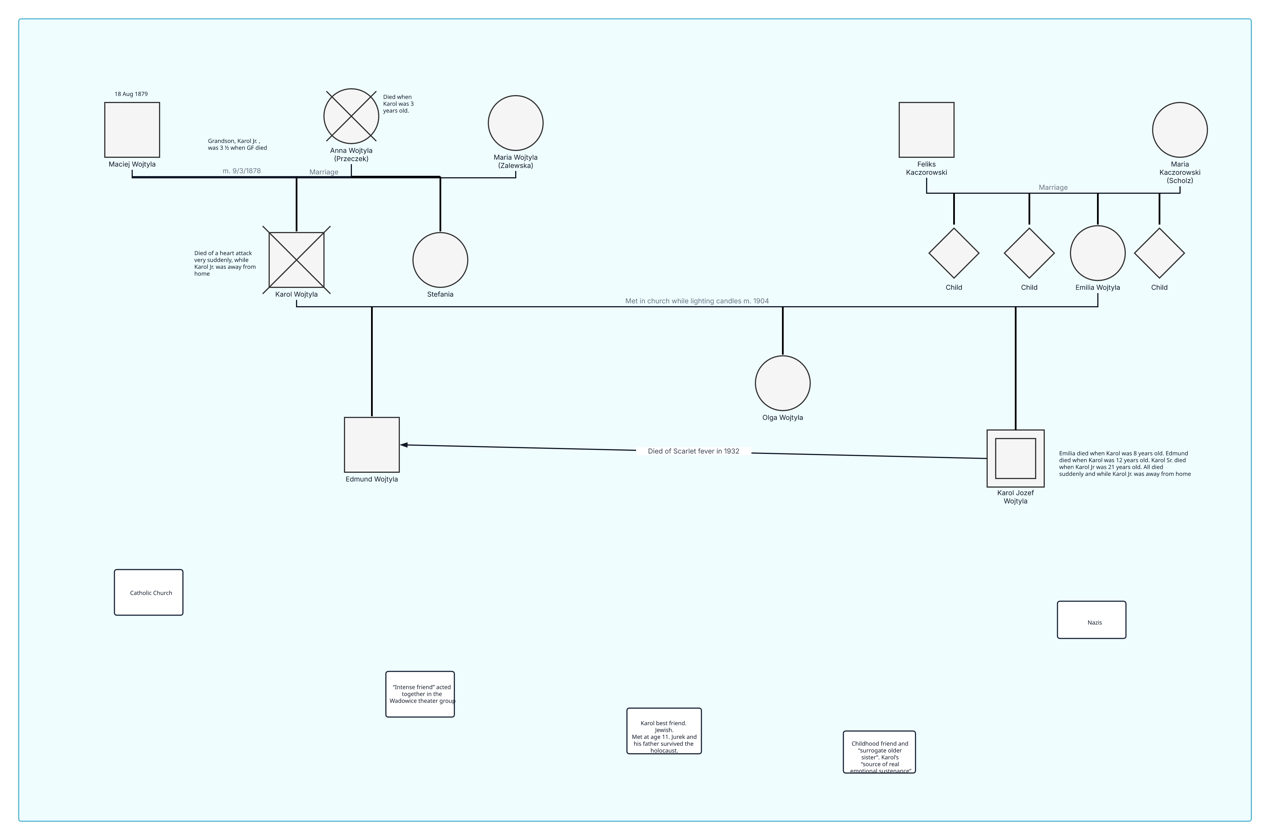
This intergenerational spiritual genogram combines family history with faith, loss, friendship, and historical context, helping users explore how beliefs and formative experiences can be carried through a life story.
The example maps 14 people across three generations of the Wojtyła and Kaczorowski families. It traces Karol Józef Wojtyła through his parents, Karol Wojtyła and Emilia Kaczorowska, and both grandparent branches. His siblings Edmund and Olga are also included, along with three unnamed children in Emilia’s family branch.
The surrounding notes add spiritual and social context: the Catholic Church, the Nazi occupation, a friendship connected to the Wadowice theatre group, a Jewish childhood friend who survived the Holocaust, and a close childhood relationship described as a source of emotional sustenance. Family notes record that Emilia died in 1929, Edmund died in 1932, and Karol’s father died in 1941. Official biographical records indicate that Karol Józef was 20 when his father died, so the editable version should update the note that currently says 21.
For consistent notation, add deceased markers to Emilia, Edmund, and Olga if their deaths remain part of the final diagram. They are described as deceased in the notes but are not currently marked with an X.
This intergenerational spiritual genogram can help pastoral, counseling, research, and family-history users organize faith and formative context in one clear view.
Explore beliefs, practices, grief, meaning, identity, resilience, and community support.
Connect family relationships, loss, coping, spiritual influences, and significant life events.
Place family history alongside documented institutions, friendships, and historical events.
Reflect on beliefs, rituals, values, transitions, and sources of meaning across generations.
Use person symbols for family structure and separate notes for spiritual, relational, and historical context. Cite sources when the map represents a real person or family.
Male family member
Female family member
Person whose sex or gender is unspecified in the example
Deceased person
Karol Józef Wojtyła as the identified or focal person
Marriage or partner relationship
Parent–child relationship
Institution, historical force, or contextual note
Connects a dated event or contextual statement to the relevant person
Use this example when family, faith, relationships, and major life events need to be considered together rather than as separate timelines.
Add the focal person, parents, siblings, grandparents, partners, and other relevant relatives. Include dates and deceased markers where they are known.
Record religious traditions, communities, rituals, mentors, belief transitions, and practices that are important to the person or family.
Add losses, migrations, historical events, friendships, and sources of meaning or support. Connect each note to the relevant person and include its date and source.
Check names, dates, quotations, and interpretations against reliable records or the family’s account. Use respectful language and appropriate permissions for personal spiritual information.
Creately Clinical supports spiritual genograms with base and therapy fields, cultural and timeline views, collaborative reflection, and report-ready outputs.
A spiritual genogram retains the family structure but adds beliefs, religious communities, rituals, values, transitions, significant relationships, and events that shape spiritual identity or meaning-making.
No. Record only what is known and relevant. A person may be affiliated, unaffiliated, uncertain, private about belief, or connected to spirituality through values and practices rather than a formal institution.
Attach a source and date to each claim, distinguish documented facts from interpretation, and update conflicting information before publication. For this example, official Vatican records confirm that Karol’s mother died in 1929, his brother in 1932, and his father in 1941.
Base fields support religion, dates, cultural heritage, and notes, while Family Therapy fields can capture loss, coping, treatment goals, and intergenerational patterns. Timeline Events and Cultural viewpoints, sticky notes, comments, permissions, and PDF or DOCX reports support reflective and professional use.
Edit the genogram to map family relationships, add spiritual and community influences, and connect important losses, friendships, and historical events to the life story they helped shape.