Denominational Transition Spiritual Map
Shows spiritual identity, practices, and family relationships together.
Shows spiritual identity, practices, and family relationships together.
Captures affiliation, tradition, belief shifts, or spiritual influences.
Connects spiritual patterns across relatives and generations.
Leaves room for worship, rituals, coping practices, and values.
Keeps households, couples, children, and relatives clear.
Helps identify sources of support, tension, belonging, or change.
Supports counseling, chaplaincy, or care conversations.
Can be updated as beliefs, roles, or practices change.
Trace religious affiliation, belief changes, and spiritual influences across four generations with an editable denominational transition genogram.
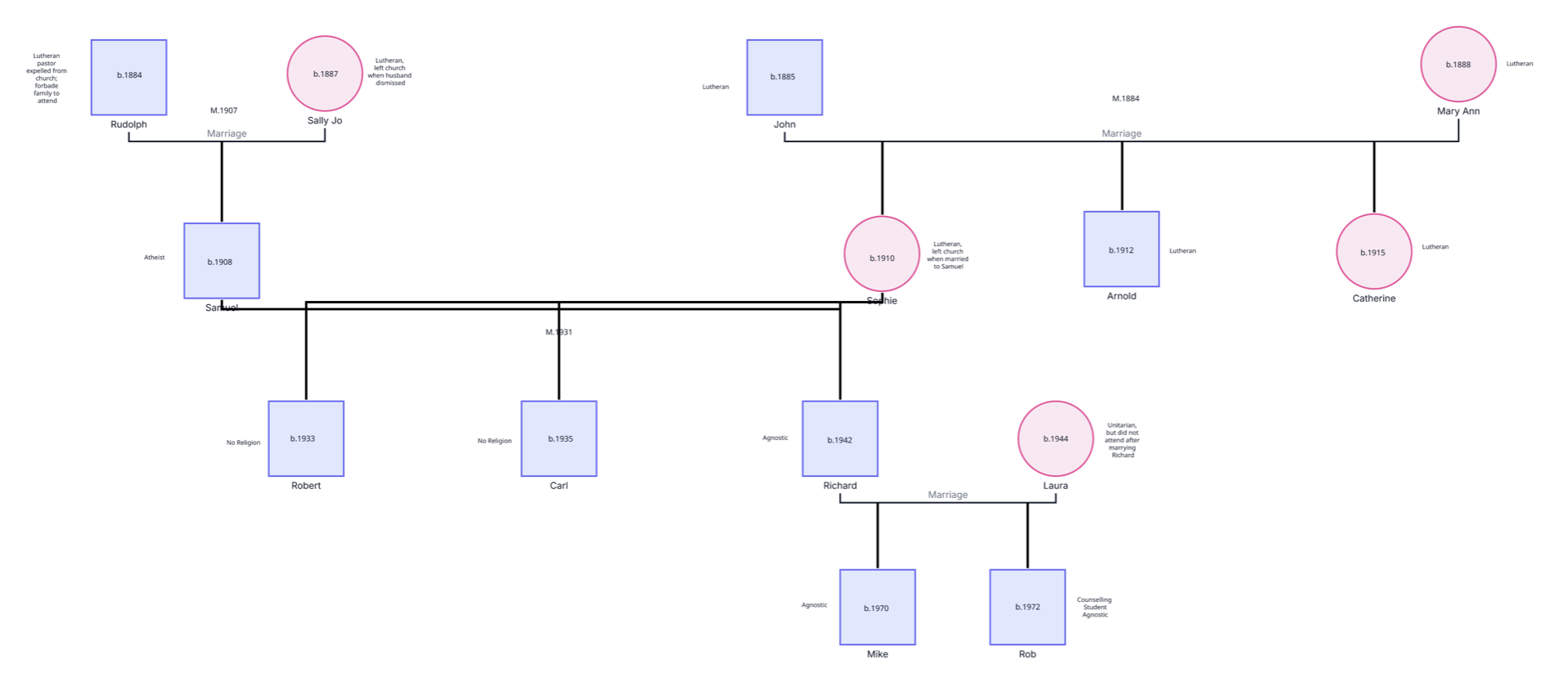
This denominational transition genogram places religious affiliation and changes in belief alongside family history, helping users explore how spiritual identities, practices, and influences evolve across generations.
The example maps 14 people across four generations and records a birth year for each person. Marriage dates help establish the family timeline, while short notes identify affiliations or viewpoints such as Lutheran, atheist, no religion, agnostic, and Unitarian.
Several annotations add context to personal transitions, including leaving a church after marriage, joining a new congregation, and describing the influence of a partner. Together, the structure and notes create a useful starting point for discussing how belief, practice, relationships, and family experiences interact over time.
This denominational transition genogram helps professionals, researchers, and families organize religious affiliation, nonreligious identities, and changes in belief across generations in one clear view.
Explore affiliation, participation, spiritual influence, and sources of meaning across family history
Include relevant spiritual and nonreligious identities in a broader person-centered assessment
Study or teach intergenerational change in belief, participation, marriage, and family influence
Build a respectful shared history of traditions, transitions, and changing worldviews
Standard family symbols organize the relationships, while dates and concise belief notes create a timeline of religious and denominational change.
Male family member
Female family member
Connects married partners
Connects a child to the relevant parental union
Records a person’s birth year
Records a marriage year
Records the religious, spiritual, or nonreligious identity reported for a person
Describes a change in affiliation, participation, belief, or influence and its relevant context
Use this example when a person, family, counselor, pastoral-care professional, educator, or researcher wants to understand how religious and nonreligious identities change through family history.
Add the focus person and the relatives needed to understand their spiritual family history. Connect partners, parents, children, and siblings, then add birth and marriage years where known.
Add the denomination, religion, spiritual identity, or nonreligious viewpoint the person uses for themselves. Keep the terms specific and allow identities to change over time.
Note changes such as joining or leaving a denomination, changes in participation, conversion, interfaith marriage, renewed practice, or a shift toward an agnostic or nonreligious identity. Include dates and context when they help explain the change.
Review the map for continuity, change, partner influence, family traditions, community connections, and sources of meaning or support. Invite the person or family to refine the story in language that feels accurate to them.
Creately Clinical supports spiritual-history mapping with structured religion and notes fields, relationship notation, dates, AI-assisted drafting, collaborative editing, and reusable reports.
For this example, the Base field pack is the most relevant capability set because it includes religion, dates, location, cultural heritage, and notes. These fields keep affiliations, worldviews, transition details, and family context attached to each person while the genogram preserves the multigenerational timeline.
It is a change in how a person identifies with or participates in a religious denomination or faith community. It can include joining, leaving, changing congregations, converting, returning to practice, or adopting a spiritual or nonreligious identity.
Yes. The example includes atheist, agnostic, and no-religion labels alongside denominational affiliations. Record the words each person uses and give every worldview the same respectful treatment.
Add the reason when the person considers it relevant and is comfortable sharing it. A brief note can connect the change to marriage, family influence, community, personal reflection, or another meaningful experience.
Creately’s Base fields include religion and notes, while dates and relationship connections place spiritual changes in family context. AI-assisted drafting can turn a written family history into a starter genogram, and collaborative editing lets participants or authorized team members refine the details together.
Edit the genogram, replace the example family with the people relevant to your project, and record affiliations, dates, and transitions in their own terms. Use the completed genogram to explore spiritual continuity, personal change, family influence, and sources of meaning across generations.