Basic Spiritual Spiritual Map
Shows spiritual identity, practices, and family relationships together.
Shows spiritual identity, practices, and family relationships together.
Captures affiliation, tradition, belief shifts, or spiritual influences.
Connects spiritual patterns across relatives and generations.
Leaves room for worship, rituals, coping practices, and values.
Keeps households, couples, children, and relatives clear.
Helps identify sources of support, tension, belonging, or change.
Supports counseling, chaplaincy, or care conversations.
Can be updated as beliefs, roles, or practices change.
Map family relationships, religious identities, and changes in belief with an editable, color-coded spiritual genogram.
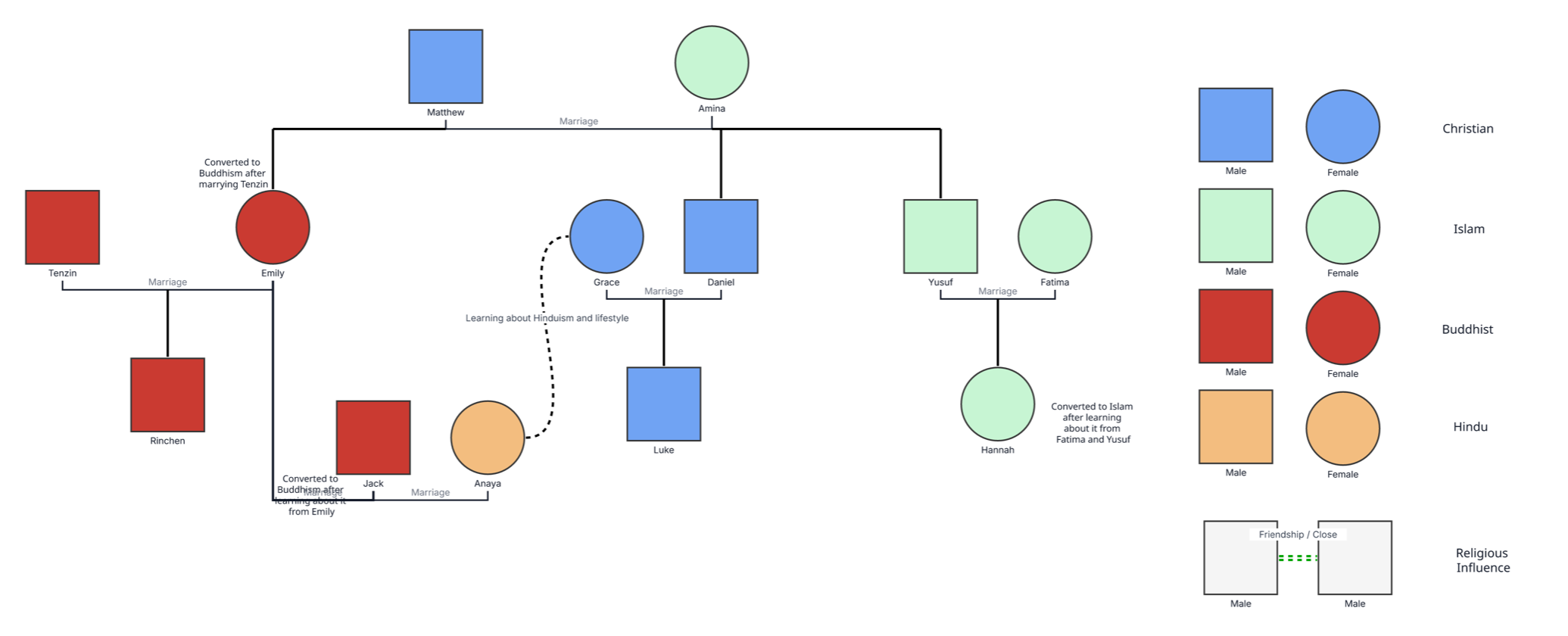
This spiritual genogram combines family and partner relationships with a example-specific color key for religious identity. Short notes show how some people’s beliefs or interests changed through close relationships.
The example uses blue for Christian, green for Islam, red for Buddhist, and orange for Hindu. Squares and circles distinguish the male and female people shown, while marriage lines connect partners. The diagram includes several family groups rather than one fully connected family tree.
Four notes add context that color alone cannot provide. Emily and Jack are described as converting to Buddhism, Grace is learning about Hinduism and its associated lifestyle, and Hannah is described as converting to Islam. These notes demonstrate spiritual influence or change, but they should be treated as individual experiences rather than conclusions about how belief develops generally.
This basic spiritual genogram example helps professionals, learners, and families organize religious identities, spiritual experiences, and family relationships in one clear view.
Explore faith background, spiritual change, and sources of meaning within relationships
Include relevant spiritual identity and influence in a broader person-centered assessment
Practice combining family structure with a clearly labeled spiritual color key
Discuss traditions, conversions, learning, and differences in belief respectfully
The faith colors belong to this example; they are not universal genogram symbols. Keep the written religion labels in the legend, and add text to each person's record so meaning does not depend on color alone.
Male person
Female person
Christian identity
Islamic identity
Buddhist identity
Hindu identity
Connects married partners
Indicates a close relationship that may carry religious influence when supported by the person's account
Describes a conversion, learning experience, or other relevant spiritual context
Use this example when a conversation needs a simple visual of religious identities and spiritual influence across family or close relationships. Ask permission before recording sensitive beliefs, and use each person's own language.
Add the person or family groups needed for the conversation. Use squares and circles as appropriate, then connect partners and family members with the correct relationship lines.
Ask how each person describes their religion, spirituality, worldview, uncertainty, or nonreligious identity. Do not infer identity from relatives, names, culture, or appearance.
Use a consistent color for each tradition and keep the written legend visible. Add the religion to the person's Creately fields or notes so the diagram remains understandable without color.
Record conversion, learning, or influence only when it is relevant and supported by the person's account. Use neutral wording, identify the relationship involved, and review the completed map for accuracy and consent.
Creately Clinical supports spiritually informed family mapping with structured identity fields, relationship notation, notes, collaboration controls, and flexible exports.
For this example, the Base field pack is the most relevant capability set because it includes religion, cultural heritage, and notes alongside core person details. The standard genogram view keeps family structure clear, while example-specific colors and written labels can make multiple traditions easier to discuss without relying on color alone.
It records the people and relationships shown, assigns one of four faith colors in the example, and adds notes about conversion, learning, or religious influence. It does not provide a complete spiritual assessment by itself.
No. They are a visual key created for this example. Keep the labeled legend and include written identity information so readers do not have to rely on color or memorize a custom code.
Yes. Adapt the legend and labels to reflect how each person identifies, including multiple traditions, uncertainty, spirituality without religious affiliation, or no religious affiliation. Avoid forcing a person into one category.
The current Genogram product guide includes religion and notes in the Base field pack. Use those fields with standard relationship types and, when relevant, cultural heritage tags. Religion and culture may overlap, but they should not be treated as the same thing.
Edit the genogram, replace the example people with the relevant family or relationship groups, and customize the faith legend. Confirm identities and spiritual-change notes with the people involved before using the diagram for care, counseling, research, or reflection.