Mental Health Pattern View
Highlights emotional or behavioral patterns connected to family context.
Highlights emotional or behavioral patterns connected to family context.
Shows relatives and relationship lines before deeper notes are added.
Connects current concerns with patterns across parents, children, and relatives.
Leaves room to mark closeness, stress, conflict, or support.
Supports brief clinical notes for review and discussion.
Helps identify protective factors and areas needing follow-up.
Gives clinicians a clear starting map for sessions or case reviews.
Can be expanded as new symptoms, relationships, or histories emerge.
Map family relationships, emotional dynamics, mental health information, and sources of support across generations using this genogram on Creately Clinical.
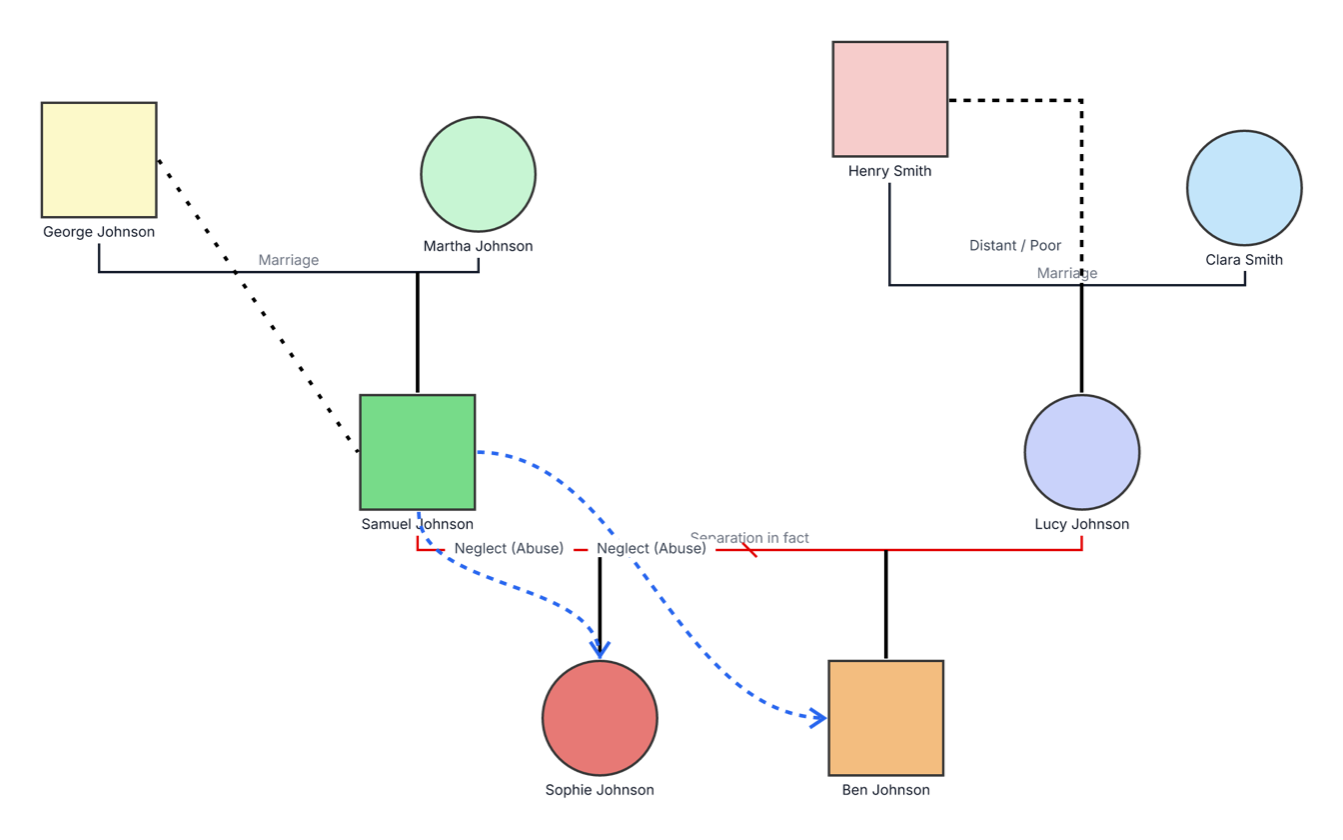
This mental health genogram brings family structure and emotional relationships into one clear view, helping users explore how experiences, connections, and sources of support relate across generations.
The example maps eight people across three generational rows. George and Martha Johnson form one grandparent couple, while Henry and Clara Smith form the other. Samuel and Lucy Johnson appear in the parental row, with Sophie and Ben Johnson in the next generation.
Relationship notation adds context to the family map. Henry and Clara’s relationship is labeled distant or poor, Samuel and Lucy are shown as separated in fact, and two directional lines document neglect from Samuel toward Sophie and Ben. The editable example can be enriched with confirmed mental health history, significant events, treatment or support information, dates, and notes.
This mental health genogram can help behavioral-health professionals, learners, and clients organize family relationships and care context in one clear view.
Explore family structure, emotional dynamics, confirmed history, treatment, strengths, and goals.
Create a shared view of stressors, caregivers, formal services, and informal support.
Practice case formulation and clearly labeled relationship notation.
Collaboratively map relevant experiences and sources of support with appropriate consent.
Use standard family symbols for structure and labeled lines for emotional relationships.
Male family member
Female family member
Marriage or partner relationship
Parent–child relationship
Separation in fact
Distant or poor relationship, as labeled
Directional neglect relationship, as labeled
Visual grouping that can be customized for the case legend
Use this example when family relationships and mental health context need to be explored together in a structured visual.
Start with the people central to the conversation, then add the relatives and generations that provide useful context.
Add partners, parents, children, siblings, and grandparents using consistent relationship and descent lines.
Add clearly labeled lines for closeness, distance, conflict, caregiving, neglect, or other dynamics relevant to the purpose of the genogram.
Record confirmed history, significant events, treatment, strengths, coping resources, and support systems with appropriate dates and sources, then review the diagram collaboratively.
Creately Clinical supports behavioral-health genograms with therapy and medical fields, relationship-focused views, controlled collaboration, and report-ready outputs.
You can include family structure, emotional relationships, confirmed mental health history, significant events, treatment, coping resources, strengths, and formal or informal support systems.
Three generations offer a practical starting point for many counseling and behavioral-health conversations. The editable canvas can be extended when additional family context would be useful.
Yes. You can adapt the line styles, labels, colors, and notes to match the notation used by your team while keeping the legend clear for everyone reviewing the diagram.
Behavioral-health and relationship fields can keep relevant information connected to each person. Shared editing, comments, view modes, version history, and export options support collaborative review and ongoing updates.
Edit the genogram to map the family, add meaningful relationship context, and create a clear mental health genogram for collaborative exploration and care planning.