Older Adult Nursing Focus
Highlights older adult nursing details alongside family health history.
Highlights older adult nursing details alongside family health history.
Connects diagnoses, risks, and relevant medical notes across relatives.
Shows how health conditions or risks appear across family lines.
Leaves space for symptoms, screenings, and care notes.
Keeps parents, children, partners, and siblings easy to trace.
Supports quick review of conditions that may need follow-up.
Gives clinicians a clear visual for discussion and documentation.
Can be expanded as new relatives or health details are added.
Map an older adult’s family health history, significant relationships, and potential support network using this nursing genogram on Creately Clinical.
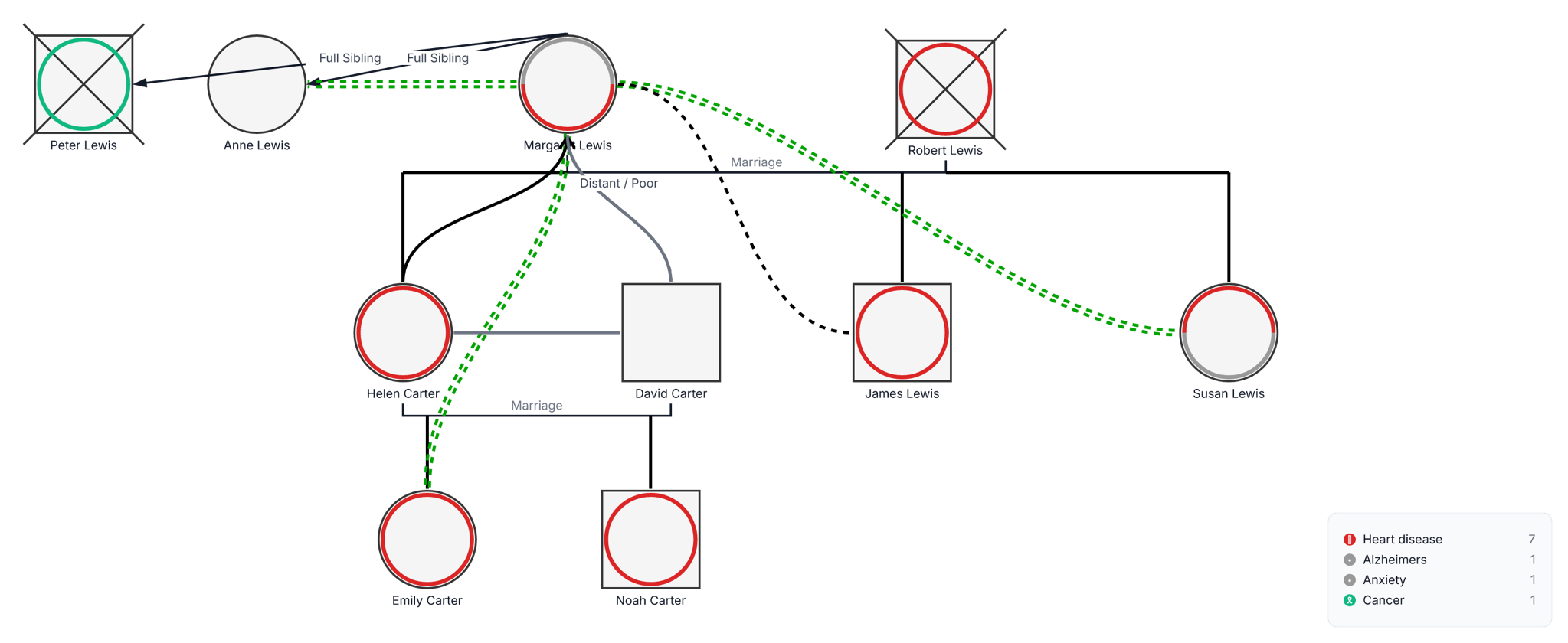
This older-adult nursing genogram combines family structure, health patterns, and relationship dynamics to support a more complete view of an older person’s care context.
The example maps 10 people from the Lewis and Carter families across three family levels. It includes Peter, Anne, Margaret, and Robert Lewis; Helen and David Carter; James and Susan Lewis; and Emily and Noah Carter. Peter and Robert are marked deceased.
Colored health overlays correspond with the legend for heart disease, Alzheimer’s, anxiety, and cancer. Relationship lines add another layer of nursing context by showing full-sibling connections and distant or poor relationships. Together, these details provide a practical starting point for discussing health history, family involvement, communication, and available support.
This older-adult nursing genogram can help care professionals and families organize health history, relationships, and practical support in one clear view.
Review conditions, medications, treatment, function, living status, and family history.
Identify caregivers, communication routes, services, residence, and availability.
Create a shared view for assessment, discharge planning, and care conferences.
Discuss family involvement, health context, and support with the care team.
Standard person symbols establish the family structure, while overlays and labeled relationship lines add health and social context.
Male family member
Female family member
Deceased family member
Marriage or partner relationship
Relationship between relatives
Close or supportive relationship
Distant or poor relationship
Condition recorded in the health legend
Heart disease, Alzheimer’s, anxiety, and cancer categories
Use this example when nursing care would benefit from seeing an older adult’s health history and family relationships together.
Enter names, ages, living status, partner relationships, siblings, children, and other family members important to the assessment.
Add confirmed conditions, age at diagnosis, treatment history, medications, functional changes, and other clinically relevant details.
Show close, distant, or significant relationships and note caregiving roles, communication patterns, residence, and availability.
Review health patterns and family resources with the care team, then add priorities, responsibilities, referrals, and follow-up actions.
Creately Clinical supports geriatric nursing workflows with medical and social-work fields, health and service views, collaborative review, and report-ready outputs.
It is a visual map that combines an older person’s family structure with relevant health history, relationship dynamics, and sources of support. Nurses can use it to organize information for assessment and coordinated care planning.
You can add diagnoses, age of onset, treatment history, medication notes, allergies, cognitive or functional changes, hospitalizations, causes of death, and other details relevant to the person’s care.
Yes. Add relatives, friends, home-care providers, primary-care teams, specialists, pharmacies, senior services, and community organizations to create a broader support view.
Health fields, notes, relationship markers, and visual categories can keep family and care information organized. Shared editing, comments, version history, and exports support team review, care coordination, and clear documentation.
Edit the genogram to add the older adult’s family, personalize the health legend, and build a useful visual for nursing assessment, family discussion, and coordinated care planning.