Genetic Risk Focus
Highlights genetic risk details alongside family health history.
Highlights genetic risk details alongside family health history.
Connects diagnoses, risks, and relevant medical notes across relatives.
Shows how health conditions or risks appear across family lines.
Leaves space for symptoms, screenings, and care notes.
Keeps parents, children, partners, and siblings easy to trace.
Supports quick review of conditions that may need follow-up.
Gives clinicians a clear visual for discussion and documentation.
Can be expanded as new relatives or health details are added.
Map Hemophilia A carrier and affected status across four generations using this genetic-risk genogram on Creately Clinical.
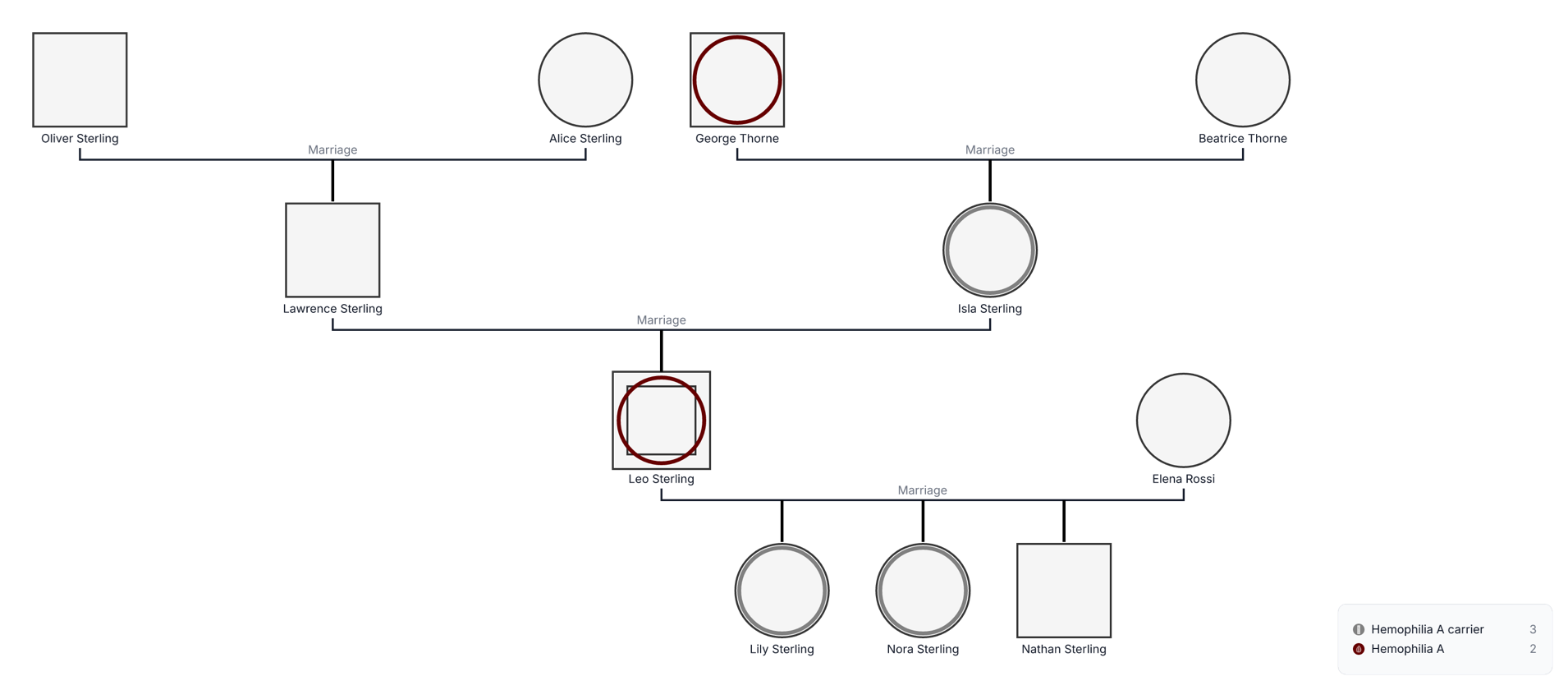
This genetic risk genogram brings family relationships, affected status, and carrier status into one four-generation view, giving genetic counselors, healthcare professionals, and families a clear starting point for informed conversations.
The example maps 11 members of the Sterling and Thorne families. George Thorne and his grandson Leo Sterling are marked as having Hemophilia A. Isla Sterling and Leo’s daughters, Lily and Nora, are marked as Hemophilia A carriers. Other relatives remain unmarked, making the documented pattern easy to scan without assigning an unsupported status.
The arrangement illustrates the X-linked inheritance pattern commonly associated with Hemophilia A: the affected grandfather’s daughter is shown as a carrier, her son is affected, and the affected son’s daughters are carriers while his son is unmarked. The example visualizes recorded information; individual status and family-specific risk calculations should be confirmed by qualified healthcare or genetics professionals.
This genetic risk genogram can help genetics professionals, healthcare teams, learners, and families organize carrier and affected status in one clear view.
Review documented inheritance patterns, tested status, evidence gaps, and questions for family communication.
Connect bleeding history, factor levels, diagnoses, and genetic results with the family structure.
Explore a four-generation example of X-linked inheritance and careful status notation.
Prepare confirmed family information for discussion with qualified healthcare or genetics professionals.
Use the legend consistently and record how each carrier or affected status was established.
Male family member
Female family member
Marriage or partner relationship
Parent–child connection
Hemophilia A, as defined by the legend
Hemophilia A carrier, as defined by the legend
No Hemophilia A or carrier status is displayed; it should not automatically be read as a confirmed negative result
Separate the family into four generations
Use this example to organize a documented family pattern before or during a professional genetics conversation.
Add the identified person, siblings, parents, grandparents, partners, and children. Keep each generation aligned and make biological connections unambiguous.
Apply separate markers for confirmed Hemophilia A and confirmed carrier status. Add the source and date of the diagnosis or genetic test whenever available.
Include relevant bleeding history, factor levels, genetic test results, and other clinical information appropriate to the purpose of the genogram. Mark unknown or untested status explicitly instead of assuming a negative result.
Share the family history with a genetic counselor or qualified healthcare professional for individualized interpretation, testing guidance, and risk discussion. Protect sensitive genetic information with appropriate access controls.
Creately Clinical supports genetic-risk genograms with structured carrier and affected-status fields, health-focused views, controlled collaboration, and report-ready outputs. The Medical & Genetic field pack keeps genetic markers, test evidence, and clinical context connected to each person in the family.
It illustrates an X-linked pattern. Hemophilia A is caused by variants in the F8 gene on the X chromosome. Fathers do not pass an X-linked variant to sons, while daughters inherit their father’s X chromosome. A genetic counselor can interpret the pattern for a particular family.
Yes. Some girls and women with one Hemophilia A-associated variant experience bleeding symptoms. Carrier status should not be treated as synonymous with having no health effects; clinical assessment and factor testing may be appropriate.
Not necessarily. It only means the example does not display an affected or carrier marker for that person. Record tested-negative, untested, unknown, and unavailable information as distinct statuses.
The Medical & Genetic field pack supports genetic markers and carrier, affected, possibly affected, or suspected status. Health view, AI-assisted pattern detection, evidence-gap review, real-time collaboration, permission-based sharing, and PDF or DOCX reports help teams organize and review the information.
Edit the genogram to map your family structure, distinguish carrier and affected status, and prepare a clear visual for healthcare or genetic counseling conversations.