Legal for Guardianship for an Incapacitated Adult Legal View
Shows the relatives and relationships involved in the legal matter.
Shows the relatives and relationships involved in the legal matter.
Clarifies parents, children, partners, guardians, heirs, or caregivers.
Highlights relationship lines that matter for review or documentation.
Leaves room for roles, responsibilities, and relevant legal notes.
Connects family branches so the case context is easier to follow.
Supports notes for deceased, separated, contested, or dependent relatives.
Gives teams a shared visual before deeper case details are added.
Can be updated as new parties, facts, or documents are confirmed.
Organize family relationships, powers of attorney, care decisions, financial responsibilities, and contested claims using this adult guardianship genogram on Creately Clinical.
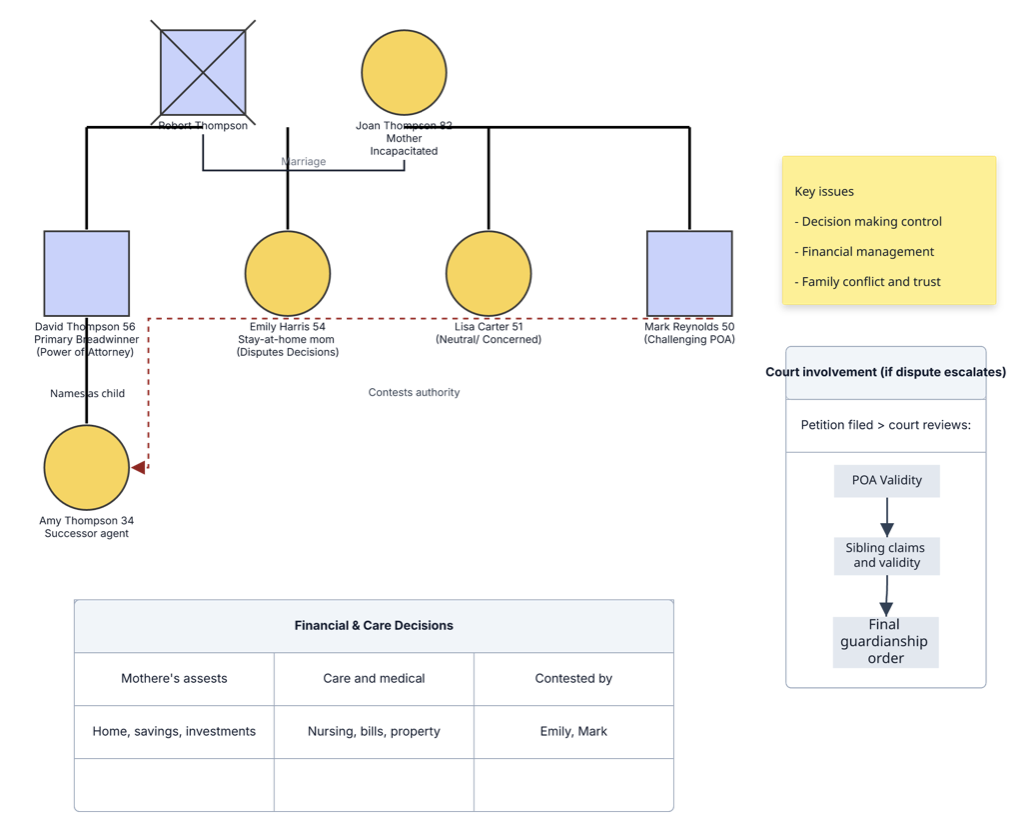
This adult guardianship genogram places the person at the center of the matter alongside relatives, powers of attorney, financial and care responsibilities, contested claims, and possible court involvement, helping authorized teams review the situation as one connected case map.
The hypothetical example centers on Joan Thompson, age 82, who is labeled incapacitated. Her spouse, Robert Thompson, is deceased. Their adult children are David Thompson, Emily Harris, Lisa Carter, and Mark Reynolds. David is identified as the primary breadwinner and as holding a power of attorney, Emily is described as disputing decisions, Lisa as neutral or concerned, and Mark as challenging the power of attorney.
Amy Thompson, age 34, appears in the third generation as a successor agent and is connected to a contested-authority line. The diagram also organizes Joan’s home, savings, and investments alongside nursing, bills, property, and the claims raised by Emily and Mark. A separate panel illustrates a possible sequence from petition and POA review to consideration of sibling claims and a final order.
Before professional use, change “Names as child” to “Named as child” and identify whose child Amy is. Also attach the document, date, scope, activation conditions, and current legal status for every POA claim.
This adult guardianship genogram can help authorized legal, care, and financial professionals organize decision-making roles and family context in one clear view.
Review capacity evidence, powers of attorney, alternatives, interested people, and disputed authority.
Connect family relationships with care needs, supports, known wishes, and service responsibilities.
Organize assets, income, debts, expenses, trusts, and decision-making authority.
Create a factual shared view for case conferences, facilitated discussion, or court preparation.
Label family connections, legal documents, allegations, and court outcomes separately so the map does not present a disputed role as an established fact.
Male family member
Female family member
Deceased person; used for Robert Thompson
Marriage between Robert and Joan
Parent–child relationship
Contested or challenged authority involving Amy in the example
POA, successor-agent, incapacity, or dispute information attributed to a person
Assets, care needs, expenses, and the people contesting decisions
Illustrative review path rather than a universal legal procedure
Use this example when family structure, decision-making authority, care needs, finances, and disputed positions need to be reviewed together.
Add the adult at the center of the matter, spouse or partner, children, grandchildren, caregivers, and other interested people. Confirm each relationship and mark deceased relatives.
Add each POA, advance directive, trust, supported decision-making arrangement, representative payee, or existing court order. Record the document date, scope, activation status, source, and any challenge.
List the person’s known wishes, abilities, supports, care needs, assets, income, debts, expenses, and the position of each participant. Distinguish agreed facts from allegations or unresolved questions.
Work with qualified local professionals to assess capacity evidence, less restrictive options, notice, POA validity, fiduciary duties, and possible court action. Update the map when an agreement or order changes a person’s role.
Creately Clinical supports guardianship case mapping with legal and estate fields, focused views, controlled collaboration, and report-ready outputs.
Not always. A valid and adequate POA may be a less restrictive way to meet the person’s needs, but its effect depends on its terms, status, the person’s circumstances, applicable law, and any dispute. A qualified local professional should review the document and available alternatives.
In a guardianship proceeding, the court applies the jurisdiction’s legal standard using the required evidence. A medical diagnosis may inform the evidence, but incapacity for guardianship is a legal determination rather than a label the example can establish.
No. It is a planning aid. Filing requirements, notice, capacity evidence, appointment standards, terminology, rights, review of POAs, and final orders vary by jurisdiction and case. Replace the panel with the actual local process.
The Legal & Estate field pack supports legal status, guardianship, powers of attorney, advance directives, wills and trusts, fiduciaries, beneficiaries, assets, debts, and legal notes. Legal & Estate view, comments, read-only permissions, and PDF or DOCX reports support controlled professional review.
Edit the genogram to organize the family, document decision-making roles, connect care and financial responsibilities, and prepare a clear factual overview for professional review.