for Probate Dispute with Contested Heir Legal View
Shows the relatives and relationships involved in the legal matter.
Shows the relatives and relationships involved in the legal matter.
Clarifies parents, children, partners, guardians, heirs, or caregivers.
Highlights relationship lines that matter for review or documentation.
Leaves room for roles, responsibilities, and relevant legal notes.
Connects family branches so the case context is easier to follow.
Supports notes for deceased, separated, contested, or dependent relatives.
Gives teams a shared visual before deeper case details are added.
Can be updated as new parties, facts, or documents are confirmed.
Organize family relationships, estate facts, recognized heirs, and a disputed parentage claim using this probate genogram on Creately Clinical.
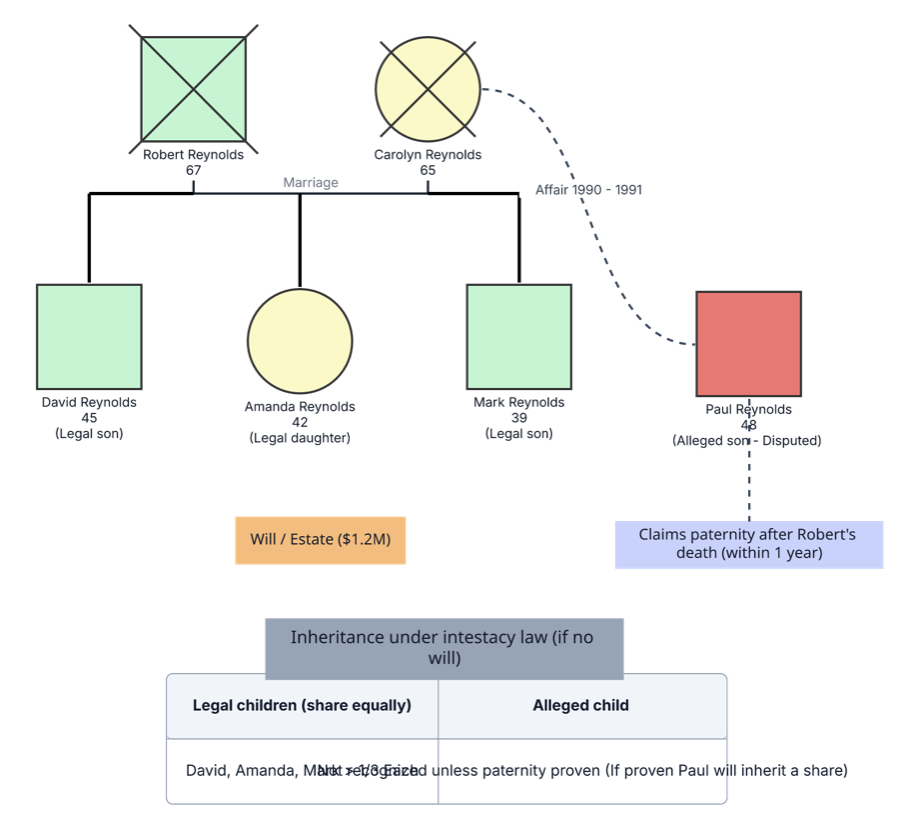
This contested-heir probate genogram places the decedents, recorded children, alleged relationship, estate value, and open legal question in one view, helping legal teams organize the facts before applying the governing law.
The hypothetical example shows Robert Reynolds, age 67, and Carolyn Reynolds, age 65, as deceased spouses. David, Amanda, and Mark Reynolds are identified as their legal children. Paul Reynolds, age 43, is shown separately as an alleged son whose status is disputed.
A dotted line beside Carolyn and the disputed branch is labeled “Affair 1990–1991,” and a note says Paul asserted parentage after Robert’s death and within one year. Because the line’s participants are not fully clear from the image, they should be verified and labeled before the diagram is used. The example also records a $1.2 million estate and presents a hypothetical intestacy question. Its proposed shares are not a universal rule: parentage, heirship, deadlines, will validity, asset ownership, debts, and distribution depend on the relevant jurisdiction and evidence.
This contested-heir probate genogram can help legal professionals and authorized case participants organize established facts, disputed claims, and estate context in one clear view.
Map decedents, successors, claimants, evidence, deadlines, and unresolved heirship questions.
Organize family structure alongside wills, trusts, assets, debts, and beneficiary information.
Create a neutral visual for focused discussion of disputed relationships and timelines.
Connect records, declarations, court events, and verification status to the family map.
Label each relationship and legal status explicitly so the diagram distinguishes established facts, allegations, and unresolved questions.
Male person
Female person
Deceased person
Marriage between Robert and Carolyn
Recorded legal child relationship in the example
Relationship labeled “Affair 1990–1991”; the participants should be verified in the editable diagram
Disputed or alleged parentage connection requiring legal determination
Records estate value, claim timing, and a hypothetical distribution question
Use this example to turn a contested probate narrative into a structured case map that attorneys and other authorized participants can review efficiently.
Add the decedent, spouse or partner, children, descendants, and other potential successors. Record full legal names and relevant dates where verified.
Identify relationships supported by records and show disputed parentage or heirship with a distinct labeled line. Avoid presenting a claim as an established relationship before it is admitted or determined.
Record the will or trust status, approximate estate value, major assets and debts, beneficiary designations, claim dates, court filings, and sources such as certificates, declarations, or orders.
Review jurisdiction, standing, notice, parentage, filing deadlines, and possible distributions with a qualified probate professional. Update the diagram when the court admits evidence or resolves an issue, and restrict access to confidential materials.
Creately Clinical supports probate case mapping with legal and estate fields, timeline-focused views, controlled collaboration, and report-ready outputs.
The example cannot determine that outcome. Whether a claimant qualifies as an heir depends on the governing jurisdiction, legally recognized parentage, admissible evidence, procedural requirements, and the complete estate facts. A probate attorney should assess the claim.
Not necessarily. The result may change based on a valid will or trust, a surviving spouse’s rights, established parentage, beneficiary designations, jointly owned or non-probate assets, debts, and local succession law. Treat the table as a scenario to evaluate, not a final distribution.
Useful records may include birth, death, and marriage certificates; wills and trusts; beneficiary designations; court orders; parentage records; declarations; correspondence; and an asset-and-debt inventory. Record each item’s source, date, and verification status.
The Legal & Estate field pack supports legal status, will status, trustees, executors, beneficiaries, assets, debts, and legal notes. Legal & Estate and Timeline Events viewpoints can surface case-relevant details, while comments, viewer permissions, and PDF or DOCX reports support controlled professional review.
Edit the genogram to map the family, distinguish established relationships from disputed claims, and organize the estate questions for focused legal review.