High-Conflict Financial Financial View
Shows family relationships tied to financial roles or conflict.
Shows family relationships tied to financial roles or conflict.
Keeps couples, children, and relatives visible in the same map.
Leaves room for support, dependency, inheritance, or conflict details.
Connects financial patterns across branches of the family.
Identifies decision makers, dependents, caregivers, or responsible parties.
Supports notes about strain, disputes, or high-conflict relationships.
Gives advisors or care teams a shared starting point.
Can be expanded as roles, assets, or obligations become clearer.
Map family structure, inheritance concerns, shared debt, financial control, and decision-making roles using this financial genogram on Creately Clinical.
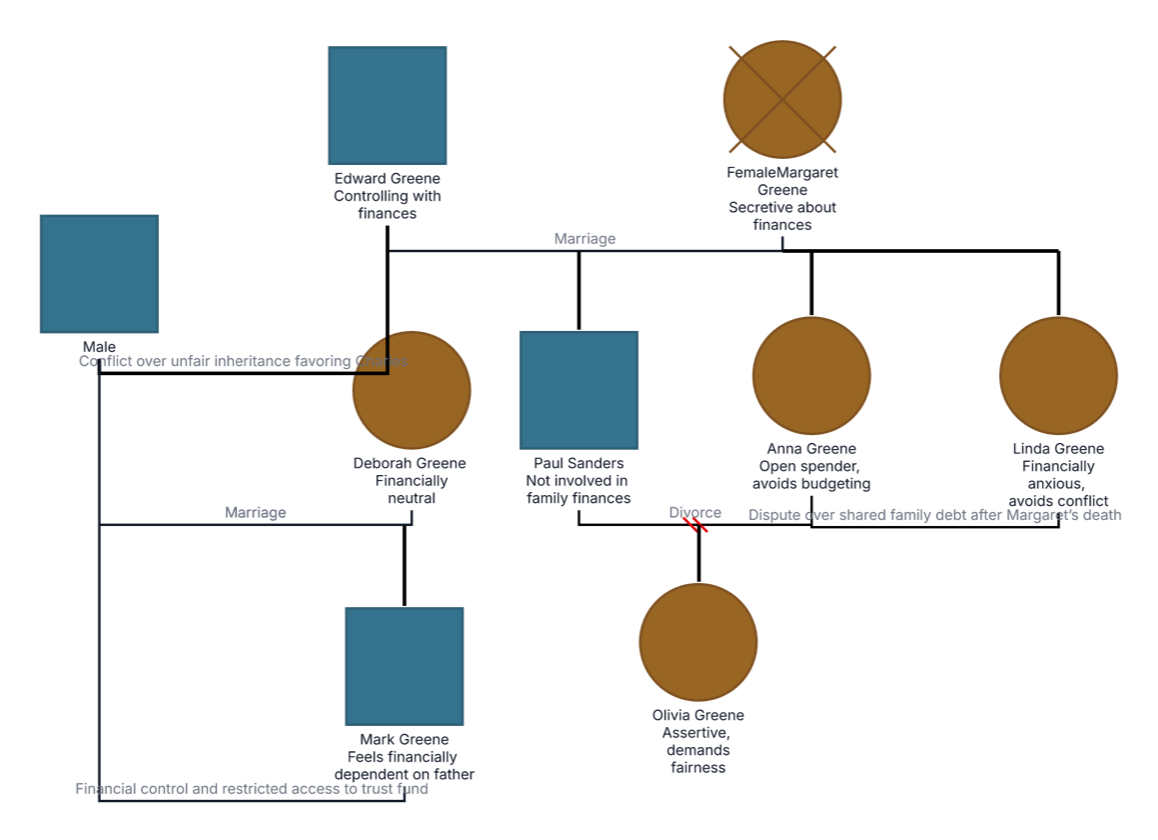
This high-conflict financial genogram combines family structure with financial roles, concerns, and points for discussion, helping professionals organize a complex narrative before planning the next conversation or review.
The example centers on the Greene family across three generations. Edward Greene is described as controlling the finances, while his deceased spouse, Margaret Greene, is described as secretive about finances. Other family members are given short behavioral or participation notes: Deborah is financially neutral, Paul Sanders is not involved in family finances, Anna is described as an open spender who avoids budgeting, Linda is financially anxious and avoids conflict, Mark feels financially dependent on his father, and Olivia is described as assertive and focused on fairness.
The diagram highlights three discussion areas: a conflict concerning an inheritance said to favor Charles, a dispute over shared family debt after Margaret’s death, and financial control involving restricted access to a trust fund. These labels are useful prompts for structured review and should be updated with sources, dates, amounts, and verification status when the example is used for a real matter.
This high-conflict financial genogram can help counseling, mediation, and legal professionals organize family relationships and financial issues in one clear view.
Explore money roles, dependence, secrecy, communication, and decision-making patterns.
Structure discussions about shared debt, inheritance expectations, and access to family funds.
Connect family context with assets, debts, trusts, beneficiaries, and authority.
Organize several perspectives, documents, and open questions around one family map.
Use clear labels to distinguish family relationships, legal statuses, financial arrangements, and statements that still require verification.
Male family member
Female family member
Deceased person; used for Margaret Greene
Marriage or partner relationship
Divorce
Parent–child relationship
Describes a financial role, attitude, or degree of involvement in the example
Identifies an inheritance, debt, financial-control, or trust-fund topic for review
Use this example when financial decisions and family relationships need to be understood together in a clear, discussion-ready format.
Add family members, marriages, divorces, parent–child connections, and deceased markers. Record relevant dates where they are known.
Note who manages finances, contributes income, depends on support, holds decision-making authority, or is connected to an asset, debt, trust, or estate.
Label inheritance concerns, shared debts, access restrictions, and areas of disagreement. Add amounts, dates, source documents, and whether each statement is reported, agreed, or still being reviewed.
Use the completed map to identify questions, required records, decision-makers, and areas for facilitated discussion. Apply suitable permissions when sharing financial or legal information.
Creately Clinical supports financial family-system mapping with legal, estate, and relationship fields, focused views, controlled collaboration, and report-ready outputs.
No. It can support financial therapy, family counseling, mediation, estate planning, or multidisciplinary review. Customize the fields and terminology for the professional purpose of the discussion.
Use specific, neutral language and attribute the source. For example, record a statement as self-reported, reported by another family member, supported by an account record, or still to be confirmed rather than presenting an interpretation as an established fact.
You can add relevant dates, amounts, assets, debts, account or trust details, decision-making authority, source documents, and next actions. Include only information appropriate to the purpose and the viewer’s access level.
The Legal & Estate field pack supports legal status, financial power of attorney, wills, trusts, trustees, executors, beneficiaries, assets, debts, and legal notes. Legal & Estate and Relationship Dynamics viewpoints, comments, role-based permissions, and PDF or DOCX reports support structured professional review.
Edit the genogram to organize the family structure, clarify financial roles, and bring inheritance, debt, and trust-fund questions into one focused view for productive discussion.