Multi-Generational Reconstituted Family Structure
Shows the main family members and relationships in this example.
Shows the main family members and relationships in this example.
Connects couples, parents, children, and siblings in a readable layout.
Places relatives across generations so patterns are easier to see.
Leaves room for names, roles, dates, and family notes.
Supports markers for marriage, separation, loss, conflict, or support.
Keeps the visual focused on the family story shown in the hero image.
Helps teams discuss the same structure before adding deeper notes.
Can be extended as new relatives or relationship details are added.
Map blended households, former and current partners, custody arrangements, scheduled contact, and extended-family support using this genogram on Creately Clinical.
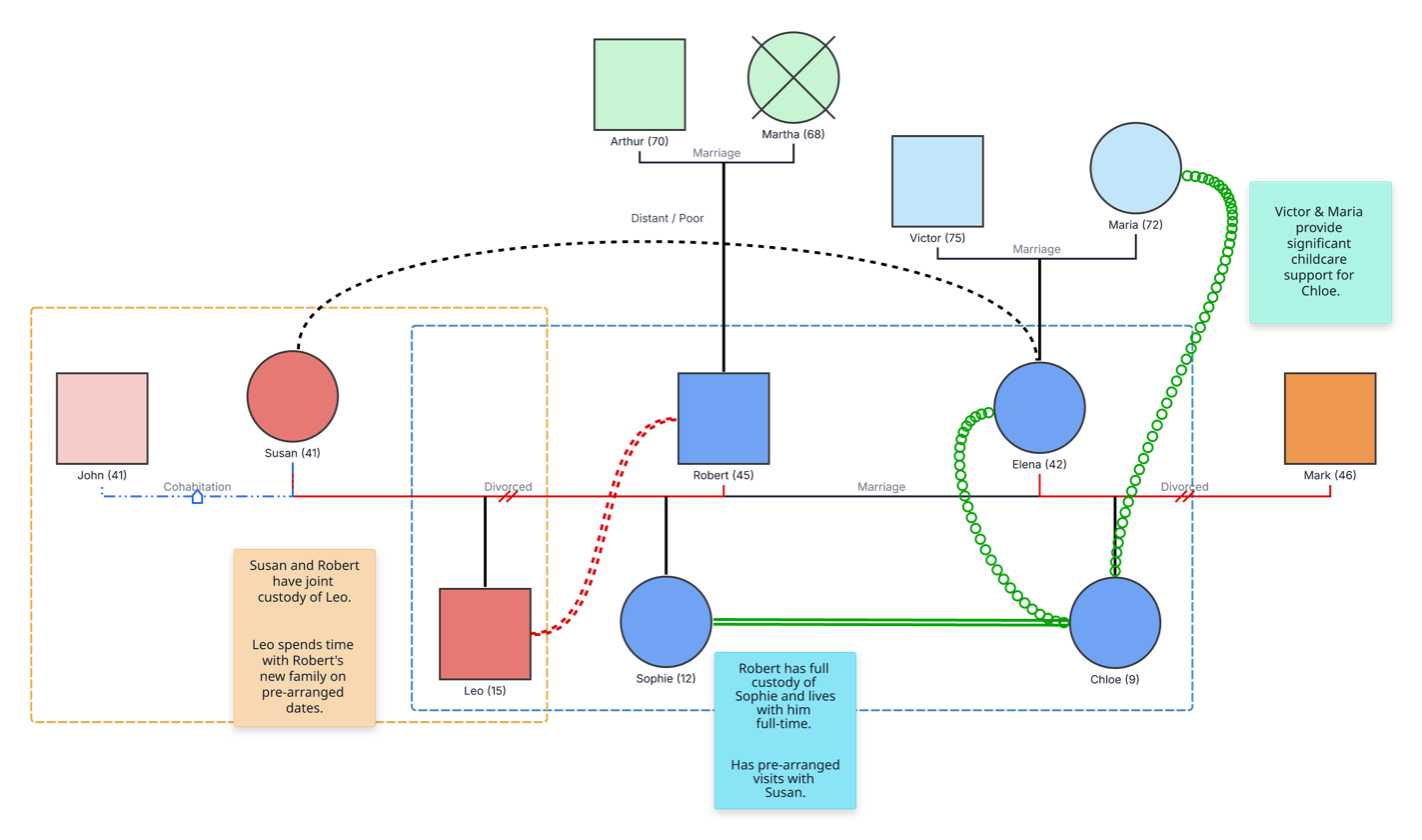
This multi-generational reconstituted-family genogram connects former and current partners, children, household membership, custody arrangements, and supportive relationships in one coordinated family view.
The example maps 12 people across three generations. The grandparent row includes Arthur and Martha, and Victor and Maria. The adult row shows John, Susan, Robert, Elena, and Mark, while Leo, Sophie, and Chloe appear in the children’s row. Ages are included throughout the map, and Martha is marked deceased.
Two shaded boundaries help distinguish the family’s household groups. Notes record that Susan and Robert share custody of Leo, Robert has full custody of Sophie with scheduled contact involving Susan, and Victor and Maria provide significant childcare support for Chloe. Relationship lines also show close connections involving Chloe and Sophie, together with other dynamics relevant to the family map.
This reconstituted-family genogram can help families and professionals organize multiple households, caregiving arrangements, and sources of support in one clear view.
Explore current and former partnerships, children’s connections, household roles, and family strengths.
Document residence, custody, contact, caregiving, and extended-family support.
Create a shared visual for co-parenting and coordinated family planning.
Map the wider blended-family system and update practical arrangements together.
Use family symbols for structure, boundary boxes for households, and labeled lines or notes for care and relationship context.
Male family member
Female family member
Deceased family member
Marriage, cohabitation, or another partner relationship
Divorced relationship
Parent–child relationship
Household or family group
Close or supportive connection
Custody, contact, residence, or childcare information
Use this example when a blended or reconstituted family includes several households, caregiving arrangements, or generations of support.
Add the adults, children, grandparents, partners, and former partners relevant to the family’s current structure.
Use distinct boundaries or colors to show where family members live and where children spend regular or scheduled time.
Record joint or primary custody, residence, scheduled contact, childcare roles, and other practical arrangements in concise notes.
Add close relationships, sibling bonds, grandparent involvement, communication routes, and other strengths that help the family coordinate care.
Creately Clinical supports reconstituted-family mapping with structured relationships, family-therapy and social-work fields, collaborative editing, and report-ready outputs.
A reconstituted or blended family brings together adults and children through new partnerships following previous relationships. The genogram can include current and former partners, biological and step-relatives, households, and extended-family support.
Each dashed boundary groups the people connected with a household. Overlapping boundaries can help represent children who have meaningful roles, routines, or scheduled time across more than one home.
Yes. Add short notes for custody, primary residence, scheduled contact, childcare, and decision-making arrangements, then update them as the family’s plans evolve.
Family and relationship fields, household boundaries, notes, and visual connectors keep care arrangements tied to the people involved. Shared editing, comments, version history, and exports support collaborative review and coordinated updates.
Edit the genogram to map the households, personalize custody and care notes, and create a shared view of the family’s relationships and support network.