Close & Supportive Family Structure
Shows the main family members and relationships in this example.
Shows the main family members and relationships in this example.
Connects couples, parents, children, and siblings in a readable layout.
Places relatives across generations so patterns are easier to see.
Leaves room for names, roles, dates, and family notes.
Supports markers for marriage, separation, loss, conflict, or support.
Keeps the visual focused on the family story shown in the hero image.
Helps teams discuss the same structure before adding deeper notes.
Can be extended as new relatives or relationship details are added.
Map close family bonds and extended support across four generations with an editable, strength-based family genogram.
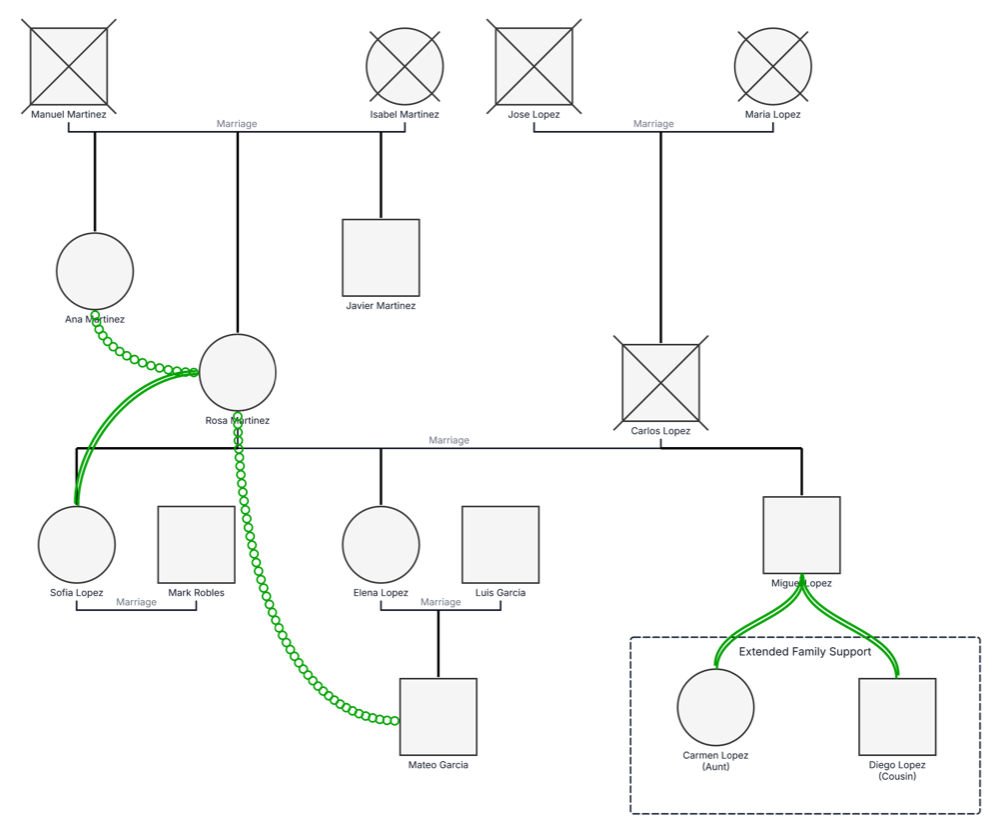
This strength-based genogram combines family structure with close and supportive relationships, helping practitioners and families see where connection, encouragement, and practical support are available.
The example maps 16 people across four generations. Five marriage lines organize the Martinez, Lopez, Robles, and Garcia family branches, while deceased markers preserve important multigenerational context.
Green relationship lines bring the support system into focus. Rosa Martinez is connected with Ana Martinez, Sofia Lopez, and Mateo Garcia, while Miguel Lopez is linked to Carmen Lopez and Diego Lopez inside a clearly labeled Extended Family Support group.
This close and supportive family genogram example helps professionals and families organize strengths, dependable relationships, and extended-family support in one clear view.
Identify close bonds, resilience, practical help, and supportive relationships during assessment or planning
Document informal support, caregiving connections, and extended-family resources
Practice strength-based genogram mapping alongside standard family notation
Recognize the people and connections that provide encouragement, belonging, and practical support
Standard family symbols map the structure, while green relationship lines and the extended-family group make supportive connections easy to identify.
Male family member
Female family member
Deceased family member
Connects married partners
Connects a child to the relevant parental union
Highlights a close, positive, or supportive relationship defined by the family
Brings relatives who form a support network into one labeled area
Describe the emotional, practical, social, or caregiving support available through a connection
Use this example when a family, therapist, counselor, or social worker wants to make existing strengths and dependable relationships more visible.
Add the focus person, household members, and relatives across the generations that matter to the conversation. Connect marriages, parents, children, siblings, and extended family using the appropriate relationship types.
Ask who provides emotional encouragement, practical help, caregiving, advice, companionship, advocacy, or a reliable sense of belonging. Include family members identified as meaningful by the person or family.
Connect each supportive pair with a consistent positive relationship style. Add short notes when they help explain the kind, direction, frequency, or availability of support.
Review the support network together and explore how existing relationships can contribute to treatment goals, care plans, coping strategies, family communication, and follow-up support.
Creately Clinical supports strength-based family work with positive relationship notation, structured family-therapy and social-work fields, collaborative editing, and reusable reports.
For this example, the Base, Family Therapy, and Social Work field packs are especially relevant. They can record emotional bonds, coping strategies, treatment goals, support networks, services, caregiving context, and other strengths while the underlying family structure remains visible.
Support may be emotional, practical, financial, social, spiritual, informational, or caregiving-related. Let the person or family describe what support means and which relationships feel dependable to them.
Yes. The example places an aunt and cousin inside an Extended Family Support group. You can add grandparents, cousins, chosen family, or other significant people who contribute to the support network.
Yes. Rosa's connections demonstrate how one person can be part of several supportive relationships. Mapping these links together helps show both individual bonds and the wider family network.
Creately's relationship library includes close and very close connections, while Family Therapy fields can capture emotional bonds, coping strategies, and treatment goals. Social Work fields can add support networks, and the Relationship Dynamics or Risk & Services viewpoints help teams focus the same family data for different conversations.
Edit the genogram, replace the example family with the people relevant to your situation, and highlight the relationships that provide meaningful support. Add short notes, invite collaborative input, and use the completed map to build on the family's existing strengths.