Career Structure
Shows the main family members and relationships in this example.
Shows the main family members and relationships in this example.
Connects couples, parents, children, and siblings in a readable layout.
Places relatives across generations so patterns are easier to see.
Leaves room for names, roles, dates, and family notes.
Supports markers for marriage, separation, loss, conflict, or support.
Keeps the visual focused on the family story shown in the hero image.
Helps teams discuss the same structure before adding deeper notes.
Can be extended as new relatives or relationship details are added.
Explore occupations and career influences across three family generations with an editable career genogram.
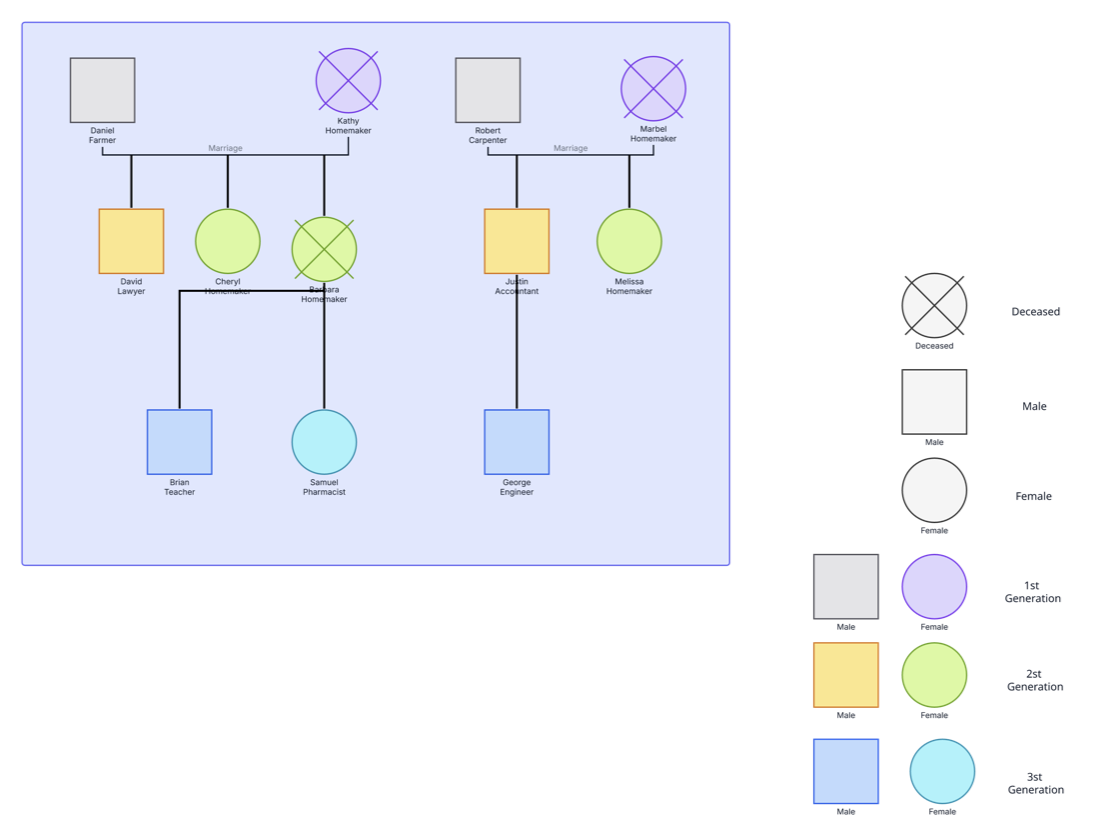
This career genogram connects family relationships with occupations across three generations, helping people explore career traditions, changing opportunities, and the influences that shape work-related choices.
The example includes two grandparent couples, their children, and three members of the youngest generation. Occupation labels place roles such as farmer, carpenter, lawyer, accountant, teacher, pharmacist, engineer, and homemaker directly beneath each person’s name.
The generational color key makes each level of the family easy to scan, while deceased markers preserve important family context. Users can build on this foundation by adding education, training, career changes, work values, turning points, migration, economic circumstances, and influential relationships.
This career genogram example helps counselors, educators, coaches, and families organize occupations and career influences across generations in one clear view.
Explore occupational patterns, role models, expectations, and turning points across generations
Connect family work histories with education, training, and future career possibilities
Add work identity, employment context, and family expectations to a broader person-centered view
Reflect on career traditions, changing opportunities, support, and new directions together
The family symbols establish the relationships, while occupation labels and generational colors add the career-focused layer.
Male family member
Female family member
Deceased family member
Connects married partners
Connects children to the relevant parental union
Records the person's role or main area of work
Distinguishes first-, second-, and third-generation family members
Adds education, training, transitions, achievements, barriers, or career influences
Use this example when someone wants to understand how family experiences and expectations may connect with their own career story and future choices.
Add the person exploring their career story, followed by parents, siblings, grandparents, and other relatives who have meaningfully influenced their work or education.
Record each person's occupation, industry, business, trade, caregiving role, homemaking work, education status, retirement, or other meaningful work identity using the terms they prefer.
Add education, training, promotions, career changes, migration, unemployment, entrepreneurship, financial pressures, work values, and important role models where they help explain the career story.
Review repeated professions, new career directions, family expectations, sources of support, and opportunities that emerge across generations. Use the insights to guide goals and next-step conversations.
Creately Clinical supports career-focused family mapping with structured occupation and education fields, relationship notation, notes, collaborative editing, and reusable exports.
For this example, the Base and Social Work field packs are the most relevant capability set. Base fields can record occupation, education, dates, location, cultural heritage, and notes, while Social Work fields can add employment status, income sources, and education level when those details support the conversation.
It can highlight recurring occupations, changes in educational access, family businesses, influential role models, career expectations, work values, and new directions across generations.
Include the role the person considers meaningful. Career exploration benefits from recognizing paid employment, unpaid care, homemaking, study, community work, retirement, and periods between jobs.
Yes. Add multiple roles or use notes and dates to show how a person's career changed over time. This can reveal turning points and make non-linear career journeys easier to discuss.
Creately's Base fields include occupation, education, dates, location, cultural heritage, and notes. The Social Work field pack can add employment status, income sources, and education level, while the Timeline Events viewpoint helps organize important transitions.
Edit the genogram, replace the example family members and occupations with your own, and add the career details that matter most. Invite a counselor, coach, educator, or family member to collaborate and turn the visual patterns into practical next steps.