Bat Family Structure
Shows the main family members and relationships in this example.
Shows the main family members and relationships in this example.
Connects couples, parents, children, and siblings in a readable layout.
Places relatives across generations so patterns are easier to see.
Leaves room for names, roles, dates, and family notes.
Supports markers for marriage, separation, loss, conflict, or support.
Keeps the visual focused on the family story shown in the hero image.
Helps teams discuss the same structure before adding deeper notes.
Can be extended as new relatives or relationship details are added.
Learn genogram symbols and relationship lines with an editable fictional example featuring nine Bat Family characters.
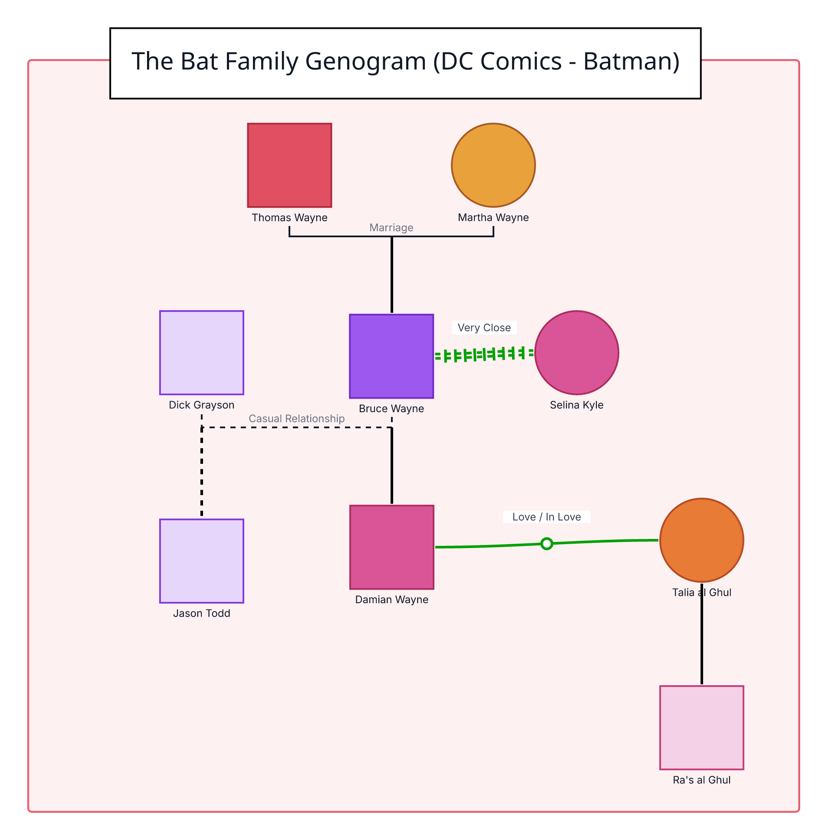
This fictional Bat Family example offers a familiar, low-stakes way to practice reading person symbols, generational placement, family connections, and emotional-relationship lines before working with real family information.
The diagram includes nine characters from Batman stories. Thomas and Martha Wayne are shown as Bruce Wayne’s parents. Bruce is connected to Selina Kyle, Dick Grayson, Jason Todd, Damian Wayne, and Talia al Ghul, while Ra’s al Ghul belongs on Talia’s parental side of the family.
Because Bat Family relationships vary across comics, films, television, and games, the example works best when users choose a specific continuity and label biological, adoptive, guardian, partner, and surrogate-family roles consistently.
This Bat Family genogram example helps learners and fans explore family structure and emotional relationships through a familiar fictional example.
Practice person symbols, generational placement, and relationship notation with recognizable characters
Introduce structural and emotional genogram lines without using private family information
Demonstrate how biological, adoptive, guardian, and surrogate-family roles can be distinguished
Organize character relationships within a selected Batman continuity
Standard genogram symbols identify people and family structure. Emotional-relationship lines add a second layer, but they should never replace biological, adoptive, or guardianship connections.
Male character
Female character
Connects characters depicted as married in the selected continuity
Shows biological, adoptive, or other defined descent; label the relationship type when needed
Shows a strong emotional bond between two characters
Shows a noncommitted partner relationship when supported by the selected storyline
Shows romantic affection between partners; it must not be used for a parent and child
A decorative grouping device in this example, not a standard genogram meaning unless a legend is supplied
Use this example for teaching, workshops, or self-guided practice when learners need to understand genogram structure without discussing a real person's private family history.
Decide which comic, film, television, or game continuity the example represents. Batman relationships change across adaptations, so document the source and avoid combining incompatible versions without explanation.
Arrange Thomas and Martha above Bruce, connect the relevant parents and children, and place each character on the generational row used by the selected continuity.
Represent Dick and Jason as Bruce's adopted, ward, or surrogate-family connections according to the chosen continuity. Use a legend or note when the relationship cannot be expressed clearly with one line.
Once the family structure is correct, add supported labels such as Very close or Casual relationship. Review every line to ensure it connects the intended two characters and cannot be mistaken for a different relationship.
Creately Clinical supports fictional relationship mapping with standard person notation, distinct relationship encodings, fast relative creation, collaborative editing, and flexible exports.
For this example, the Base field pack and standard genogram view provide the best fit. Users can add notes for the selected continuity, apply clearly labeled family and emotional relationships, and keep character information organized as the map develops.
No. It is a fan-oriented educational example for practising genogram notation. Character relationships vary across DC continuities, and the diagram should identify the storyline or adaptation it follows. DC character names belong to their respective rights holders.
Choose one comic, film, television, or game continuity and map the relationships used in that version. Add a source or note when a biological, adoptive, guardian, or surrogate-family role differs across adaptations.
That depends on the selected continuity. Dick is commonly presented as Bruce's ward and adopted son. Jason is commonly presented as a ward or surrogate son, with formal adoption varying by continuity. State the relationship type rather than relying on an ambiguous descent line.
Yes. Move the characters into the correct generational rows, replace incorrect lines, add relationship labels, and include a legend. Creately's relationship subtypes and person fields can provide more detail than decorative colors alone.
Edit the genogram, select a continuity, organize the character relationships, and add supported family and emotional connections. Use the finished diagram as an engaging fictional learning exercise or character-reference map.