Attachment Style Pattern View
Highlights emotional or behavioral patterns connected to family context.
Highlights emotional or behavioral patterns connected to family context.
Shows relatives and relationship lines before deeper notes are added.
Connects current concerns with patterns across parents, children, and relatives.
Leaves room to mark closeness, stress, conflict, or support.
Supports brief clinical notes for review and discussion.
Helps identify protective factors and areas needing follow-up.
Gives clinicians a clear starting map for sessions or case reviews.
Can be expanded as new symptoms, relationships, or histories emerge.
Explore attachment-relevant family dynamics across three generations, including emotional distance, separation, abuse, and neglect.
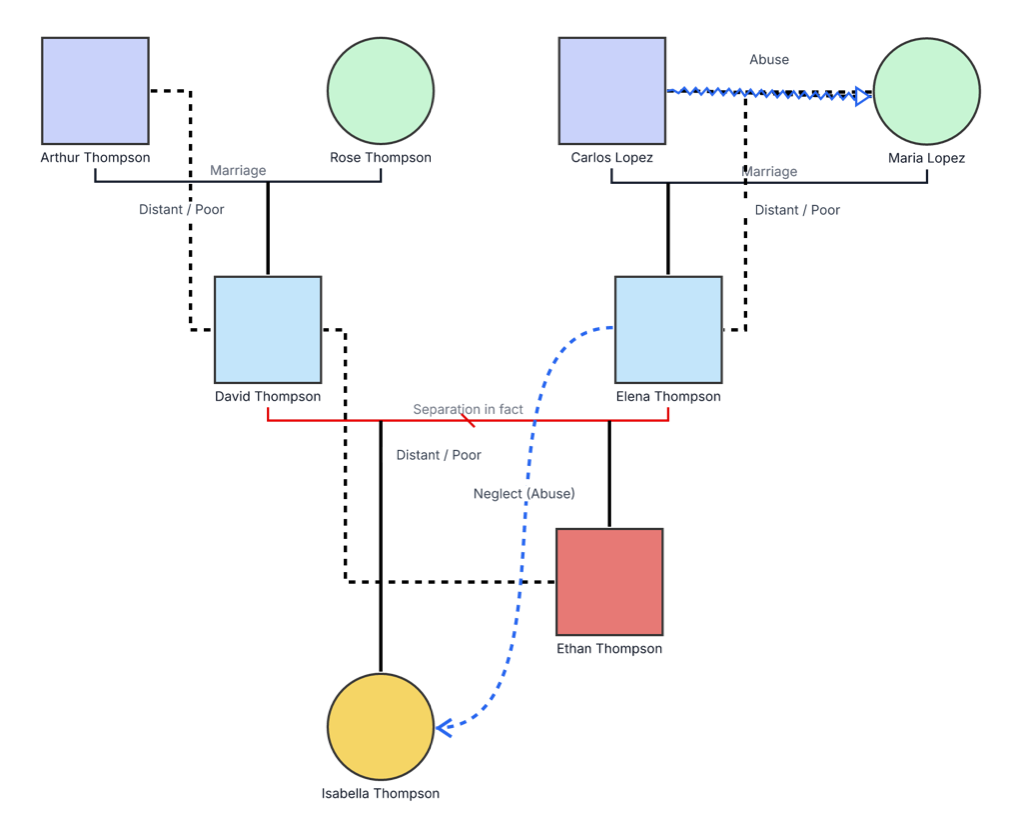
This attachment-focused genogram maps relational distance, separation, abuse, and neglect across three generations, providing context for exploring how experiences within the family system may shape attachment.
The first generation includes Arthur and Rose Thompson, and Carlos and Maria Lopez. Both couples are married and their relationships are marked distant or poor. The Lopez relationship also includes an abuse marker directed from Carlos toward Maria.
In the second generation, David Thompson and Elena Thompson are marked as separated in fact, with a distant or poor relationship. The third generation includes Ethan Thompson and Isabella Thompson. A directional neglect or abuse marker runs from Elena toward Isabella.
The diagram shows attachment-relevant experiences and relationship dynamics, but it does not assign secure, anxious, avoidant, or disorganized attachment styles to any person. Practitioners should add those classifications only when supported by an appropriate assessment and should not treat the genogram as a diagnosis.
This attachment style genogram example helps professionals and learners organize attachment-relevant family relationships and caregiving experiences in one clear view.
Explore attachment-relevant patterns, relationship quality, and caregiving experiences across generations
Document family structure, separation, safety concerns, and support relationships for shared case discussions
Practice distinguishing structural relationships from emotional and attachment-related information
Review relational patterns and supported observations during case formulation
The example combines structural genogram notation with emotional and abuse-related relationship markers. Because abuse and neglect are directional, the arrow should clearly identify the reported direction of harm.
Represents a male family member
Represents a female family member
Connects Arthur and Rose Thompson, and Carlos and Maria Lopez
Marks David and Elena Thompson as separated without implying a legal divorce
Identifies limited emotional connection or poor relationship quality between partners
Shows the reported direction of abuse from Carlos to Maria and neglect or abuse from Elena to Isabella
Use this example when attachment-focused work needs to consider emotional distance, disrupted partnerships, and harmful family experiences across generations. Review immediate safety and safeguarding needs before using the diagram for broader pattern exploration.
Replace the fictional Thompson-Lopez details with the relevant family members. Confirm parent-child connections, partnerships, and the three-generation structure before adding clinical information.
Use the appropriate structural relationship type for marriage, separation, or divorce. Add a separate emotional relationship marker for distance, closeness, conflict, fusion, cutoff, or another supported dynamic.
Add abuse or neglect markers only when supported by the information available. Confirm the direction, use neutral and precise labels, follow applicable safeguarding procedures, and limit access to sensitive details.
Use the Family Therapy field pack to record secure, anxious, avoidant, or disorganized attachment information where it is supported by assessment. Explore possible patterns collaboratively without presenting them as fixed diagnoses.
Creately Clinical supports professional attachment-focused workflows with clinical relationship notation, structured family-therapy fields, collaboration controls, and case-ready reporting.
For this example, the most relevant capability set is the Base and Family Therapy field packs, paired with the standard genogram view. The Family Therapy pack can store attachment style, family roles, trauma history, and coping strategies, while distinct relationship encodings keep structural status, emotional quality, and reported harm visually separate.
No. It shows relationship quality, separation, abuse, and neglect, all of which may be relevant to attachment-focused assessment. Secure, anxious, avoidant, or disorganized attachment classifications must be added separately when supported by appropriate assessment.
No. It describes the quality of a relationship between two people. An attachment style is recorded for an individual, while an emotional relationship marker describes a specific interpersonal dynamic.
Use the appropriate directional relationship marker so the diagram identifies who reportedly directed the harmful behavior toward whom. Verify the information, distinguish reports from confirmed findings, and follow applicable safeguarding and documentation requirements.
Yes, when appropriate privacy, consent, organizational, and safeguarding requirements are followed. Use role-based permissions, restrict sensitive information to authorized collaborators, and avoid including unnecessary identifying details.
Open the example, map the structure quickly, and use Creately Clinical for AI-assisted drafting, collaborative editing, and report-ready outputs. This keeps the first draft simple while making it easy to turn the same diagram into a stronger working artifact later.