Cultural Background Identity View
Shows cultural identity and family structure in one visual map.
Shows cultural identity and family structure in one visual map.
Connects cultural background, migration, language, and identity across relatives.
Keeps family members and relationship lines easy to follow.
Leaves space for traditions, values, affiliations, and lived context.
Helps compare experiences across branches of the family.
Supports notes about belonging, distance, conflict, or adaptation.
Gives teams a shared view for cultural assessment or discussion.
Can be updated as family stories and cultural details become clearer.
Map cultural heritage, identity, traditions, and migration experiences across three generations with an editable cultural background genogram.
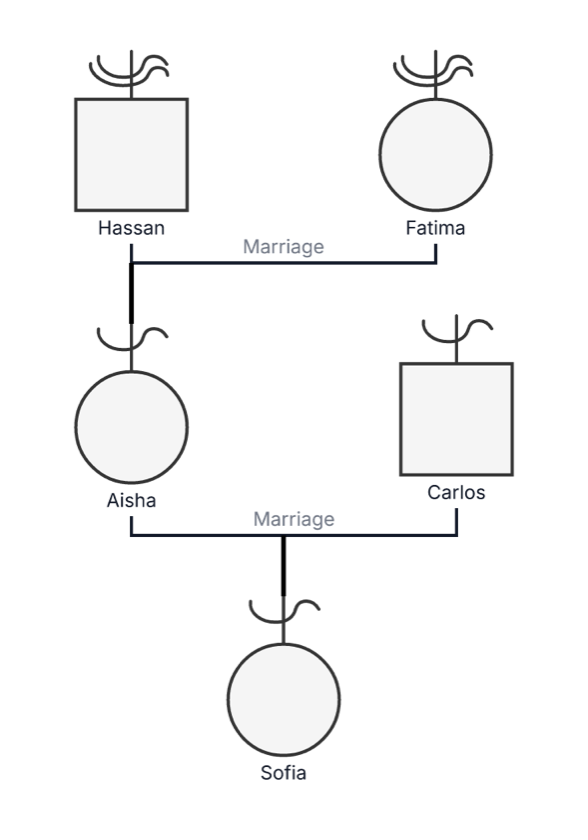
This cultural background genogram combines a clear family structure with cultural heritage markers, helping families and professionals explore identity, traditions, migration, language, and belonging across generations.
The example maps five people across three generations. Hassan and Fatima form the first-generation couple. Their daughter Aisha and her partner Carlos form the second-generation couple, and Sofia appears in the third generation.
Each person has a culture flag marker that can be customized with one or more self-identified cultural backgrounds. The simple structure leaves room for details such as language, religion, birthplace, location, migration experiences, traditions, and changes in identity over time.
This cultural background genogram example helps professionals, learners, and families organize heritage, identity, traditions, and migration experiences in one clear view.
Explore identity, belonging, traditions, and cultural influences across generations
Document heritage, language, migration, location, and community connections
Practice culturally responsive family mapping using self-identified information
Discuss cultural continuity, intercultural relationships, traditions, and changing identities together
Standard genogram symbols map the family structure, while culture flags, heritage tags, and contextual notes add each person’s cultural story.
Male family member
Female family member
Connects married partners
Connects a child to the relevant parental union
Indicates that cultural background is recorded for a person and can represent multiple heritages
Stores a person’s self-identified cultural background
Color-codes heritage tags so cultural patterns can be viewed across generations
Capture language, religion, location, migration history, traditions, and identity context
Use this example when a family, therapist, counselor, social worker, educator, or researcher wants to understand how cultural experiences connect with family structure.
Add the focus person and relatives across the generations that matter to the conversation. Connect partners, parents, children, and siblings with the appropriate family lines.
Record heritage in the person’s own words. Add multiple cultural backgrounds when relevant, and avoid assigning identity based on names, appearance, nationality, or family position.
Include languages, religion or spirituality, birthplace, current location, migration experiences, traditions, community ties, and significant cultural events when these details support the purpose of the genogram.
Switch to the Cultural viewpoint to see heritage patterns across the family. Review continuity, change, shared traditions, intercultural connections, and sources of belonging, then invite collaborators to add context where appropriate.
Creately Clinical supports culturally responsive family mapping with structured heritage fields, a dedicated Culture view, relationship notation, collaborative editing, and reusable reports.
For this example, the Base field pack is the most relevant capability set because it includes cultural heritage, religion, location, and notes alongside core person details. The Culture view can apply consistent colors to recorded heritage tags while preserving the same family structure.
Include the cultural details that are meaningful to the family and relevant to the conversation. These may include self-identified heritage, languages, religion or spirituality, migration experiences, traditions, community connections, and important cultural events.
Yes. Creately supports multiple cultural heritage tags, allowing bicultural and multicultural identities to be represented. Let each person choose the terms that best describe their experience.
It indicates that cultural background information is associated with that person. You can customize the related tags and notes rather than using the marker to imply one predetermined culture.
The Base field pack includes cultural heritage, religion, location, and notes. The Cultural viewpoint can assign distinct colors to heritage tags, while AI-assisted text import can identify cultural details from a family description for users to review and refine.
Edit the genogram, replace the example family with the people relevant to your conversation, and invite them to describe their cultural backgrounds in their own words. Add heritage tags and contextual notes, then use the Cultural viewpoint to explore family traditions, intercultural connections, and identity across generations.