Family Counseling Case View
Frames the family structure around the main counseling or therapy focus.
Frames the family structure around the main counseling or therapy focus.
Shows partners, parents, children, and siblings involved in the case.
Leaves room to note conflict, closeness, distance, or support.
Keeps discussion points visible for assessment and follow-up.
Connects current concerns with relevant family history.
Clarifies caregiving, custody, parenting, or support responsibilities.
Supports shared review before deeper clinical notes are added.
Can be extended as the conversation reveals more family context.
Map marriages, divorce, children, and family relationships as a clear visual starting point for counseling sessions on Creately Clinical.
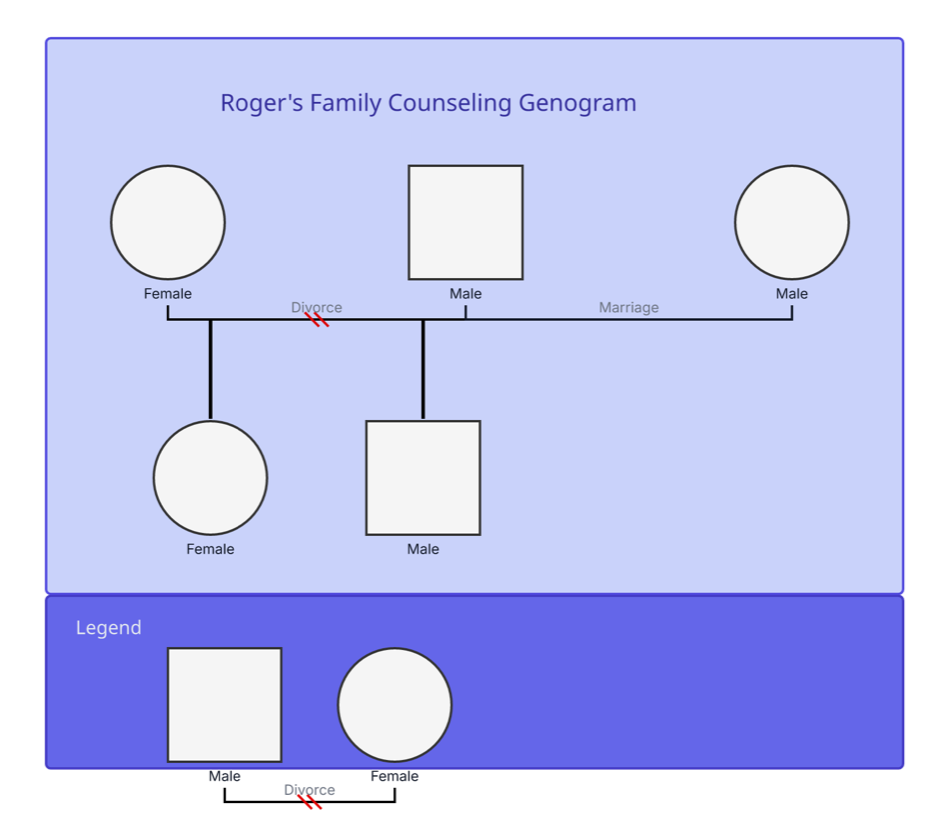
This family counseling genogram offers a simple visual foundation for discussing family structure, relationship changes, and the experiences each person brings into counseling.
The example, titled “Roger’s Family Counseling Genogram,” maps five people across two generations. A central male family member is connected to a previous female partner through a divorce relationship and to a current female partner through a marriage relationship.
Two children appear in the second generation, preserving their place within the family system as partner relationships change. The open layout is ready for names, ages, emotional bonds, family roles, communication patterns, coping strategies, strengths, and shared counseling goals.
This family counseling genogram can help counseling professionals, learners, and families organize family structure and relationship context in one clear view.
Establish family structure and explore relationships, roles, communication, strengths, and goals during sessions.
Document changing partnerships, children, caregiving context, and support needs for shared case discussion.
Practice foundational notation and use the map for teaching, training, and case supervision.
Build a shared visual of the family system and update it as understanding and goals develop.
The example uses a compact set of standard symbols so counselors and families can establish the structure first and add relationship dynamics during the conversation.
Male family member
Female family member
Connects currently married partners
Records a dissolved marriage while preserving family history
Connects a child to the relevant parent or parental union
Can be added to represent closeness, harmony, distance, conflict, or another emotional dynamic
Add names, ages, roles, and other information relevant to counseling
Capture observations, strengths, coping strategies, and treatment goals alongside the map
Use this example when a counselor, therapist, supervisor, student, or family wants a clear starting point for exploring relationships and changes within a compact family system.
Replace the generic labels with names and add ages or other basic details that help everyone orient themselves. Confirm how each person would like to be represented.
Add previous and current partnerships, then connect each child to the appropriate parent or parental union. Use the correct relationship type for marriage, divorce, separation, cohabitation, or another partnership.
Invite family members to describe closeness, support, communication, caregiving, boundaries, and other meaningful dynamics. Add only the lines and notes that help the counseling conversation.
Add strengths, coping strategies, family roles, and treatment goals using the Family Therapy fields. Revisit the map during later sessions to reflect new understanding and progress.
Creately Clinical supports counseling workflows with structured family notation, therapy-focused fields, live collaboration, and report-ready outputs. For this example, the Base and Family Therapy field packs help counselors move from a clear family structure to deeper relationship and treatment context.
Previous relationships remain part of the family’s history and may connect parents, children, and extended relatives. Keeping them visible helps everyone understand the complete family system while focusing on the present conversation.
Yes. Building it together can help family members clarify relationships, share perspectives, and identify strengths. Creately’s real-time editing and comments make the map easy to review collaboratively.
Yes. Begin with the family structure, then add close, distant, conflictual, cutoff, harmonious, or other relationship types as the family describes them. The Relationship Dynamics viewpoint can help focus the visual on these connections.
Creately’s Family Therapy fields include emotional bonds, attachment style, communication style, coping strategies, family roles, treatment history, and goals. AI-assisted drafting, shared editing, session notes, and PDF or DOCX reports support the workflow from intake through review.
Edit the genogram, replace the generic symbols with the people relevant to your counseling conversation, and confirm the family structure together. Add relationship dynamics, strengths, and shared goals as the discussion develops, then return to the same map to reflect progress over time.