Counseling Case View
Frames the family structure around the main counseling or therapy focus.
Frames the family structure around the main counseling or therapy focus.
Shows partners, parents, children, and siblings involved in the case.
Leaves room to note conflict, closeness, distance, or support.
Keeps discussion points visible for assessment and follow-up.
Connects current concerns with relevant family history.
Clarifies caregiving, custody, parenting, or support responsibilities.
Supports shared review before deeper clinical notes are added.
Can be extended as the conversation reveals more family context.
Explore family history, marriages, emotional dynamics, and supportive relationships with an editable counseling genogram.
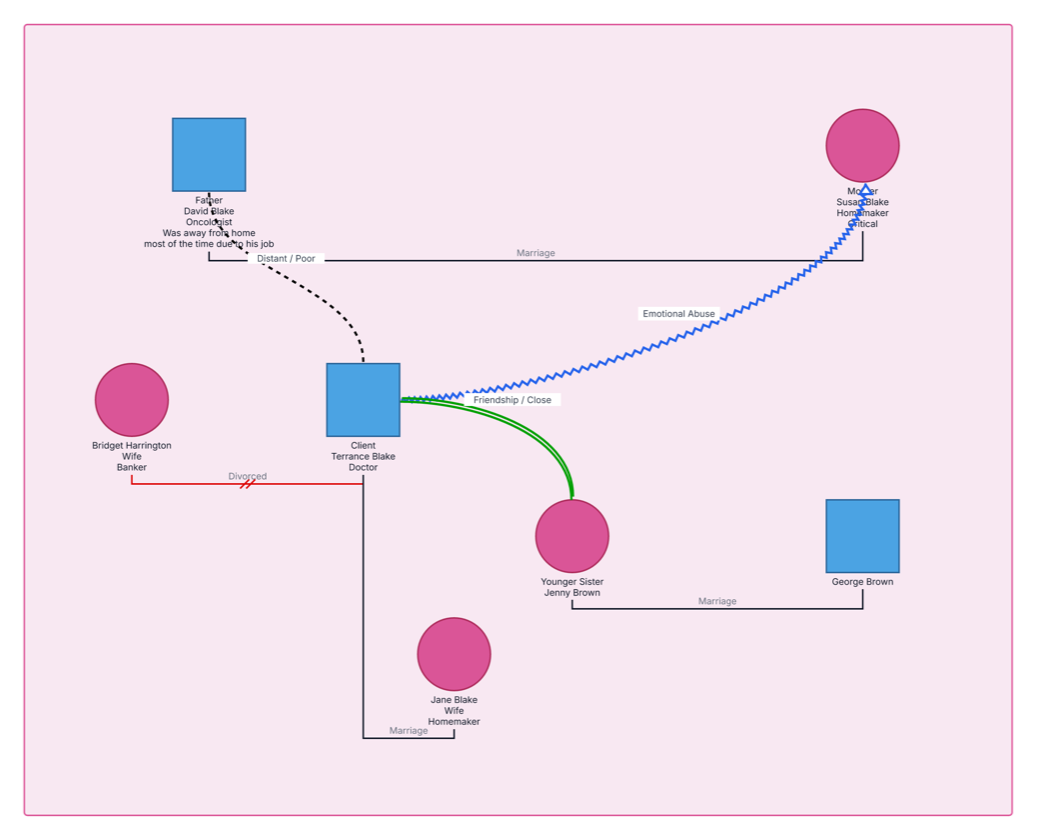
This counseling genogram places the client at the center of a two-generation family map, combining family structure, relationship history, challenging dynamics, and an important source of support.
Terrance Blake is identified as the client. The first generation includes his father, David Blake, and mother, Susan Blake. The diagram also records Terrance’s divorce from Bridget Harrington, his current marriage to Jane Blake, and his younger sister Jenny Brown’s marriage to George Brown.
Emotional-relationship lines add context to the family structure. Terrance’s relationship with his father is marked distant or poor, his relationship with his mother carries an emotional-abuse marker, and his friendship or close bond with Jenny highlights a supportive connection that can contribute to counseling goals.
This counseling genogram example helps counselors, clients, and care teams organize family history, relationship dynamics, life transitions, and supportive connections in one clear view.
Build a focused systems view for intake, formulation, treatment planning, and collaborative review
Document family members, relationship history, stressors, strengths, and support around the client
Practice distinguishing family structure from reported emotional relationship dynamics
Use a shared visual to discuss connections, boundaries, resilience, and desired change
Family lines establish who belongs in the system, while emotional-relationship lines help counselors and clients explore how those connections are experienced.
Male family member
Female family member
Connects married partners
Shows a dissolved marriage using slash marks
Connects Terrance and Jenny to their parents
Represents limited contact or a relationship experienced as emotionally distant
Records a reported pattern of emotional harm between family members
Shows a warm, supportive, or trusted connection
Add roles, occupations, context, and information relevant to counseling
Use this example when a counselor or therapist wants a focused view of the client's family relationships, life transitions, and available support.
Add the client and the relatives, partners, or other significant people most relevant to the reason for counseling. Include the identity terms and relationship labels the client uses.
Connect parents, siblings, current partners, and former partners. Add marriage, divorce, separation, or other relationship details that help establish the timeline.
Use specific relationship lines for closeness, distance, cutoff, conflict, abuse, or another reported dynamic. Include supportive connections so the map reflects resources and resilience as well as difficult experiences.
Review the genogram collaboratively and explore boundaries, coping responses, communication, support, and desired change. Add therapy notes and goals that help guide the next stage of the work.
Creately Clinical supports counseling workflows with clinical relationship notation, structured family-therapy fields, collaborative editing, privacy-aware sharing, and case-ready reports.
For this example, the Base and Family Therapy field packs are the most relevant capability set. Family Therapy fields can record attachment style, emotional bonds, family roles, trauma history, coping strategies, treatment information, and goals while the diagram keeps structure and reported dynamics visually distinct.
It brings the client's parents, siblings, partners, relationship history, emotional dynamics, and supportive bonds into one view. This gives counseling conversations a shared visual reference.
Yes. The example combines distant, emotionally harmful, and close connections. Seeing these dynamics together can help identify boundaries, stressors, resilience, and people who may support the client's goals.
Use the client's language, add only information relevant to the counseling purpose, and review the meaning of each relationship line together. Appropriate privacy and sharing settings help keep the genogram within the intended care context.
Creately's Family Therapy fields can record attachment style, emotional bonds, family roles, trauma history, coping strategies, treatment, and goals. The Relationship Dynamics viewpoint, comments, real-time collaboration, auto-save, and PDF or DOCX reports support work from intake through review.
Edit the genogram, replace the Blake family with the people relevant to your counseling context, and map the relationships that shape the client's experience. Add strengths and goals, review the visual together, and use it to guide meaningful next steps.