Religious Community Network
Shows the people, groups, and organizations connected to the case.
Shows the people, groups, and organizations connected to the case.
Clarifies who provides support, services, influence, or coordination.
Keeps family members visible within the wider community system.
Maps how help, referrals, and relationships move through the network.
Identifies schools, healthcare, faith, nonprofit, or social-service links.
Leaves room to mark strong, weak, or strained connections.
Helps teams discuss the same community picture during planning.
Can be updated as services, roles, or contacts change.
Map family relationships, faith-community roles, spiritual connections, and sources of support using this religious community genogram on Creately Clinical.
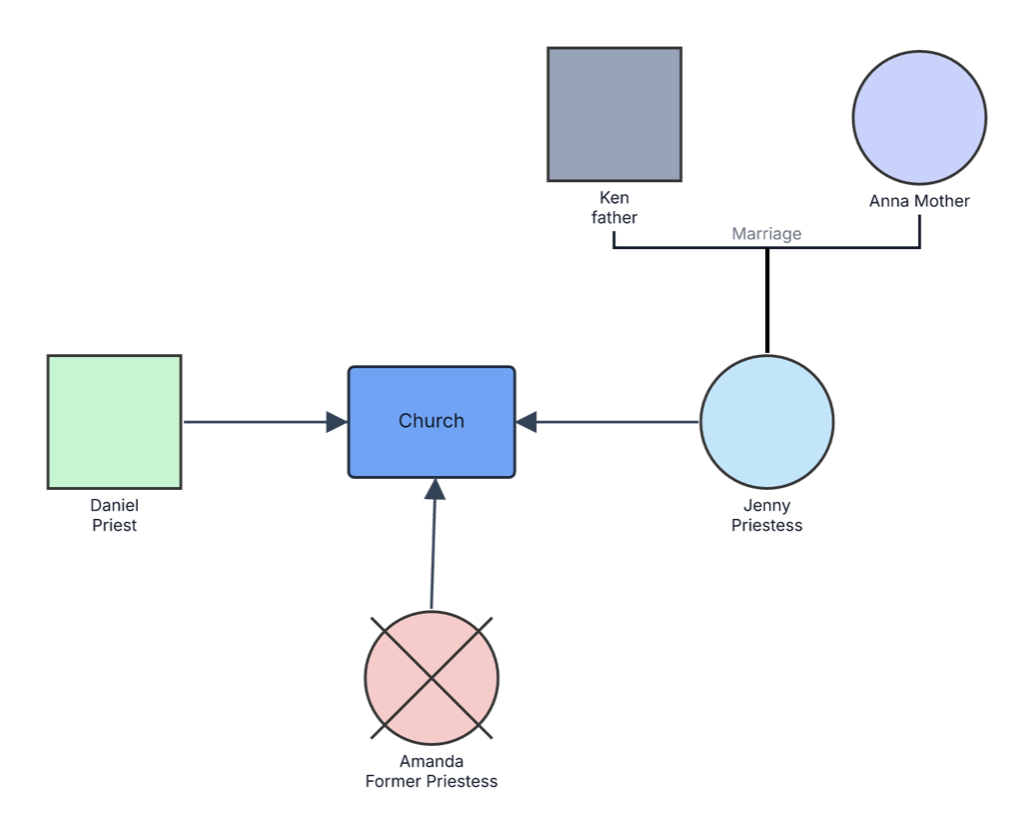
This religious community genogram brings personal relationships and faith-community involvement into one visual, helping users understand roles, participation, and sources of spiritual or practical support.
The example contains five people and one central church. Ken and Anna are shown as a married couple. Daniel is identified as a priest, Jenny as a priestess, and Amanda as a former priestess. Amanda is also marked deceased.
Directional lines connect Daniel, Jenny, and Amanda with the church, making their community roles visible alongside the personal relationship context. The structure provides room to add participation, leadership responsibilities, pastoral care, community services, spiritual influences, and other connections that matter to a family, individual, or faith network.
This religious community genogram can help pastoral, counseling, and community teams organize faith participation and support relationships in one clear view.
Map spiritual communities, leadership, care, rituals, and sources of support.
Include faith-community relationships where they matter to identity, coping, or care.
Coordinate participation, service, education, outreach, and community responsibilities.
Create a respectful visual of affiliations, roles, mentors, and support connections.
Person symbols represent individuals, the central rectangle represents the faith organization, and directional connectors show community affiliation or involvement.
Male person or community member
Female person or community member
Deceased person
Marriage or partner relationship
Current or former religious-community role
Church, congregation, faith community, or spiritual organization
Affiliation, participation, leadership, service, or support connection
Visual identifier that can be customized for roles, groups, or categories
Use this example when faith, spirituality, or religious-community participation is relevant to personal, family, or community life.
Enter family members, household members, faith leaders, mentors, volunteers, and other people important to the community context.
Add the church, congregation, temple, mosque, synagogue, spiritual group, or other organization relevant to the person or family.
Record leadership, membership, attendance, volunteering, pastoral care, rituals, education, service, or other forms of participation and support.
Include strengths, preferences, cultural practices, important events, contact people, care needs, and agreed actions appropriate to the purpose of the map.
Creately Clinical supports religious-community mapping with flexible profiles, cultural and therapy fields, labeled connections, collaboration, and report-ready outputs.
No. Replace the central node with any congregation, temple, mosque, synagogue, spiritual community, interfaith group, or other organization relevant to the people being mapped.
You can include clergy, chaplains, lay leaders, teachers, volunteers, mentors, committee members, care coordinators, musicians, youth leaders, and other formal or informal roles.
Yes. Add multiple organizations and use colors, labels, or a legend to represent different traditions, affiliations, cultural practices, or levels of participation.
Custom fields, notes, connectors, and visual categories can keep roles and support relationships organized. Shared editing, comments, version history, and exports support collaborative care, outreach, and community planning.
Edit the genogram to add your people, faith communities, roles, and support relationships, then create a respectful shared visual for pastoral care, reflection, or community planning.